
10 Landscape Lighting Techniques Every Phoenix Desert Yard Should Use
A great Phoenix landscape lighting plan is a vocabulary of about ten techniques — each solving a different problem for a different plant, structure, or edge. Pick the wrong technique for the feature and even top-shelf fixtures look bad. Pick the right one and mid-range fixtures look editorial.
This is the same technique glossary we use inside every AE landscape lighting design meeting. Use it to critique any lighting proposal — ours or someone else's.
In this guide+
- 011. Up-lighting — the workhorse of desert lighting
- 022. Moon-lighting (down-lighting from tree canopies)
- 033. Path lighting — do it well or don't do it
- 044. Wall washing — soft, even light across a facade
- 055. Grazing — texture on stone, block, and rammed earth
- 066. Silhouette lighting — object dark, wall bright
- 077. Shadowing — object bright, wall shadow
- 088. Cross-lighting — depth on the primary feature
- 099. Step and grade-change lighting — safety-first
- 1010. Underwater / submerged lighting
- 11How many techniques should one yard use?
1. Up-lighting — the workhorse of desert lighting
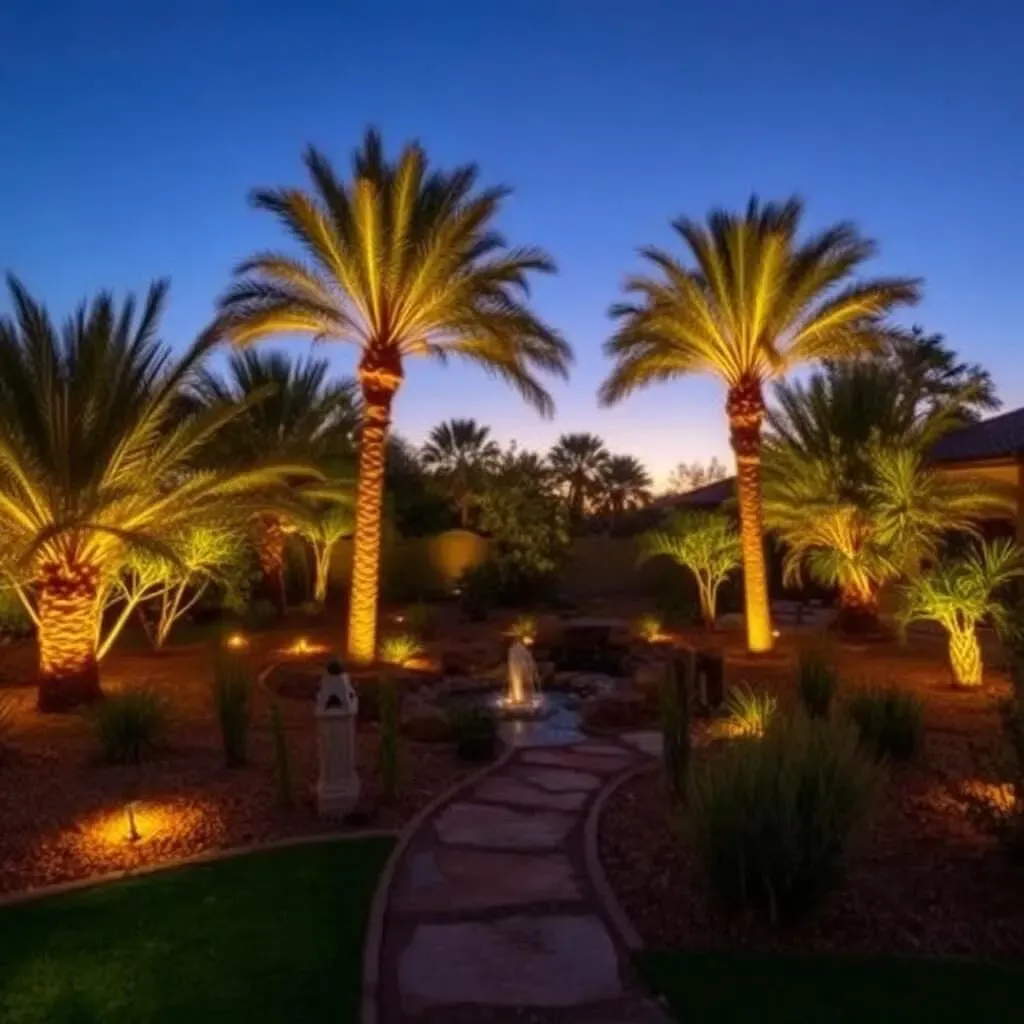
A fixture at ground level aimed up into a tree canopy, palm trunk, saguaro, ironwood, or structural column. Up-lighting is the single most common technique in a desert yard because it converts the most valuable objects (mature trees and cacti) into nighttime focal points.
- Aim from two angles on any specimen tree or palm — one fixture kills the depth.
- For saguaros, aim from three angles at 6–10 ft out; the arms cast their own cross-shadows.
- Use narrow beam (10–24°) for tall palms, medium (36–60°) for canopy trees, wide (60°+) for shrubs.
- Never up-light a wall next to a specimen — the reflected glare kills the tree.
2. Moon-lighting (down-lighting from tree canopies)
A fixture mounted 15–25 ft up in a tree canopy, aimed straight down, casting the actual pattern of the leaves onto the patio or path below. Named because it mimics the effect of a full moon through the branches.
- Requires mature canopy trees (mesquite, palo verde, ironwood, olive, oak) — will not work in a new yard.
- Use warm 2200–2700K, dim beam, wide spread — you want soft dappled shadow, not spotlight.
- Combine with path lighting from the same tree for cohesion.
- Fixtures must be UL-rated for tree mounting with strap or lag; direct-drive screws into the trunk kill the tree over 3–5 years.
3. Path lighting — do it well or don't do it
Low fixtures along walkways, driveways, and steps to light foot traffic. This is the technique most homeowners overdo — a runway of bollards ruins a garden.
- Ideal: down-light from tree canopies or pergolas above the path.
- Acceptable: 12–18" hat-style fixtures every 8–12 ft along the path — never every 4 ft.
- Avoid: bollard fixtures over 24" tall; they turn a garden into an airport taxiway.
- Steps and grade changes must be lit for safety — everything else is aesthetics.
4. Wall washing — soft, even light across a facade
A row of fixtures at a controlled distance from a wall, throwing an even, low-contrast light across it. Use to lift facades, boundary walls (rarely), and outdoor shower or pool walls.
- Fixture distance = 12–18" from a smooth wall for wash; farther for larger wall.
- 3–7 fixtures across a typical Phoenix front elevation. More than that = airport terminal.
- Never wall wash a boundary wall to the property line — it reads institutional.
- 2700K warm. 3000K+ on a stucco wall reads clinical and blue.
5. Grazing — texture on stone, block, and rammed earth
A fixture placed 2–6 inches from a textured wall (natural stone, split-face block, rammed earth, textured stucco), throwing light at a shallow angle across the surface. Every high-and-low detail casts its own shadow.
- The distance from the wall controls the shadow length — start at 4" and adjust.
- Grazing kills flat surfaces. Do not use it on smooth stucco.
- Best applications in Phoenix: dry-stack retaining walls, natural stone veneer, rammed-earth walls, split-face CMU pool walls.
- Use narrow beam (10–24°) — a wide beam turns grazing into wall washing.
6. Silhouette lighting — object dark, wall bright
Place the light behind an object, aimed at a wall or fence behind. The object reads as a dark shape against the lit backdrop. Best for sculptural plants (agave, ocotillo, aloe) and metal art.
- Requires a wall or dense hedge 3–8 ft behind the object.
- Best on plants with strong outline — bad on soft-shape shrubs.
- Use in pairs with up-lighting on nearby features for contrast.
7. Shadowing — object bright, wall shadow
The reverse of silhouette. Place the light in front of the object, aimed slightly up, and the shadow projects onto a wall behind. Great for sculptural plants and ornamental grasses against stucco.
- Fixture distance controls the shadow size — closer = larger, more dramatic.
- Best for plants that already read well in daylight — an ugly plant makes an ugly shadow.
- Combine with grazing on the receiving wall for a layered look.
8. Cross-lighting — depth on the primary feature
Two fixtures on opposite sides of a single feature, at slightly different intensities. The offset intensity creates depth and eliminates the flat cardboard look of single-source lighting.
- The go-to for signature specimen trees — the olive at the front door, the ironwood at the courtyard entry.
- Set one fixture 15–25% brighter than the other — equal is flat.
- Combine with a soft moon-light from above for third-dimension separation.
9. Step and grade-change lighting — safety-first
Recessed low-glare fixtures inside step risers, retaining wall caps, and grade-change edges. Non-negotiable on any run of 3+ steps.
- Trade-line recessed fixtures with anti-glare hoods — big-box step lights are UV brittle in 2–3 Phoenix summers.
- One per riser on outdoor steps; every third cap on retaining walls.
- 2700K warm, low lumen — this is safety wayfinding, not accent lighting.
- Confirm ADA/IBC compliance for commercial installs.
10. Underwater / submerged lighting
Fully submerged fixtures inside pools, water bowls, spillover walls, and water features. In a well-lit yard, the pool is a design element after dark — not a black hole.
- Pool interior — one Pentair Intellibrite or Jandy Nicheless every 8–12 ft, single color-changing channel.
- Water bowls and spillover walls — submersible dot lights inside the bowl, aimed up at the spillover face.
- Baja shelves — one submersible LED per 20 sf of shelf. Skip and the shelf disappears at night.
- Every submerged fixture on its own channel — you never want the pool interior and water feature on one dimmer.
How many techniques should one yard use?
- Small courtyard — up-lighting + moon-lighting + step lighting. Three techniques, done well.
- Typical front elevation — up-lighting + wall washing + path lighting + step lighting.
- Full backyard with pool — up-lighting + moon-lighting + cross-lighting + step + underwater + one signature (silhouette or grazing).
- Anything more usually needs a redesign, not more fixtures.
Frequently asked
- What are the main types of landscape lighting techniques?
- The ten core landscape lighting techniques are up-lighting, moon-lighting (down-lighting from tree canopies), path lighting, wall washing, grazing, silhouette lighting, shadowing, cross-lighting, step and grade-change lighting, and underwater/submerged lighting. Most well-designed Phoenix yards use 5–7 of the ten.
- What is up-lighting in landscape lighting?
- Up-lighting is a ground-level fixture aimed up into a tree canopy, palm trunk, saguaro, or structural column. It's the most-used technique in desert yards because it converts specimen trees and cacti into nighttime focal points. Always use two or three fixtures from different angles for depth — a single up-light kills the object.
- What is moon-lighting in landscape design?
- Moon-lighting is a fixture mounted 15–25 ft up inside a tree canopy, aimed straight down, casting the actual pattern of the leaves onto the patio or path below. Named because it mimics the effect of moonlight through the branches. Requires a mature canopy tree (mesquite, palo verde, ironwood, olive, oak). Use tree-safe UL-rated straps — not screws — for mounting.
- What's the difference between wall washing and grazing?
- Wall washing places a fixture 12–18 inches from a smooth wall to throw even, low-contrast light across the whole surface — flat, gentle, editorial. Grazing places a fixture 2–6 inches from a textured wall (stone, split-face block, rammed earth) at a shallow angle so every high-and-low detail casts its own shadow. Wall washing hides texture; grazing celebrates it. Never graze smooth stucco — it looks like a construction light.
- How do I light a saguaro cactus at night?
- Aim three narrow-beam (10–24°) up-lights at any mature saguaro, positioned 6–10 ft out and evenly around the base. The arms will cast their own cross-shadows onto the ribs. Use 2700K warm and cap the wattage — over-lit saguaros look like museum props. Never wall-wash a saguaro; the flat light kills the ribbing.
- What color temperature is best for desert landscape lighting?
- 2700K warm white is the correct color temperature for desert landscape lighting. 3000K and above reads clinical, blue, and cold against stucco, stone, and desert plants. The one exception is submerged pool lighting on RGBW color-changing fixtures — those get their own channel and their own scene programming.
- How many landscape lighting techniques should I use in one yard?
- Most well-designed Phoenix yards use 5–7 of the ten core techniques. Using all ten usually means the plan is overlit — every yard needs dark space to read a night sky. A courtyard might use three (up-light + moon-light + step). A full backyard with pool typically uses 6–7 (up + moon + cross + step + underwater + one signature grazing or silhouette moment).

David "Dave" Bell
Dave is the owner of AE Outdoor Living in Peoria, Arizona and the current president of the Southwest Hardscape Association — 13 years on the board, 15 years involved. He has designed and built outdoor environments across Greater Phoenix since 2005.