
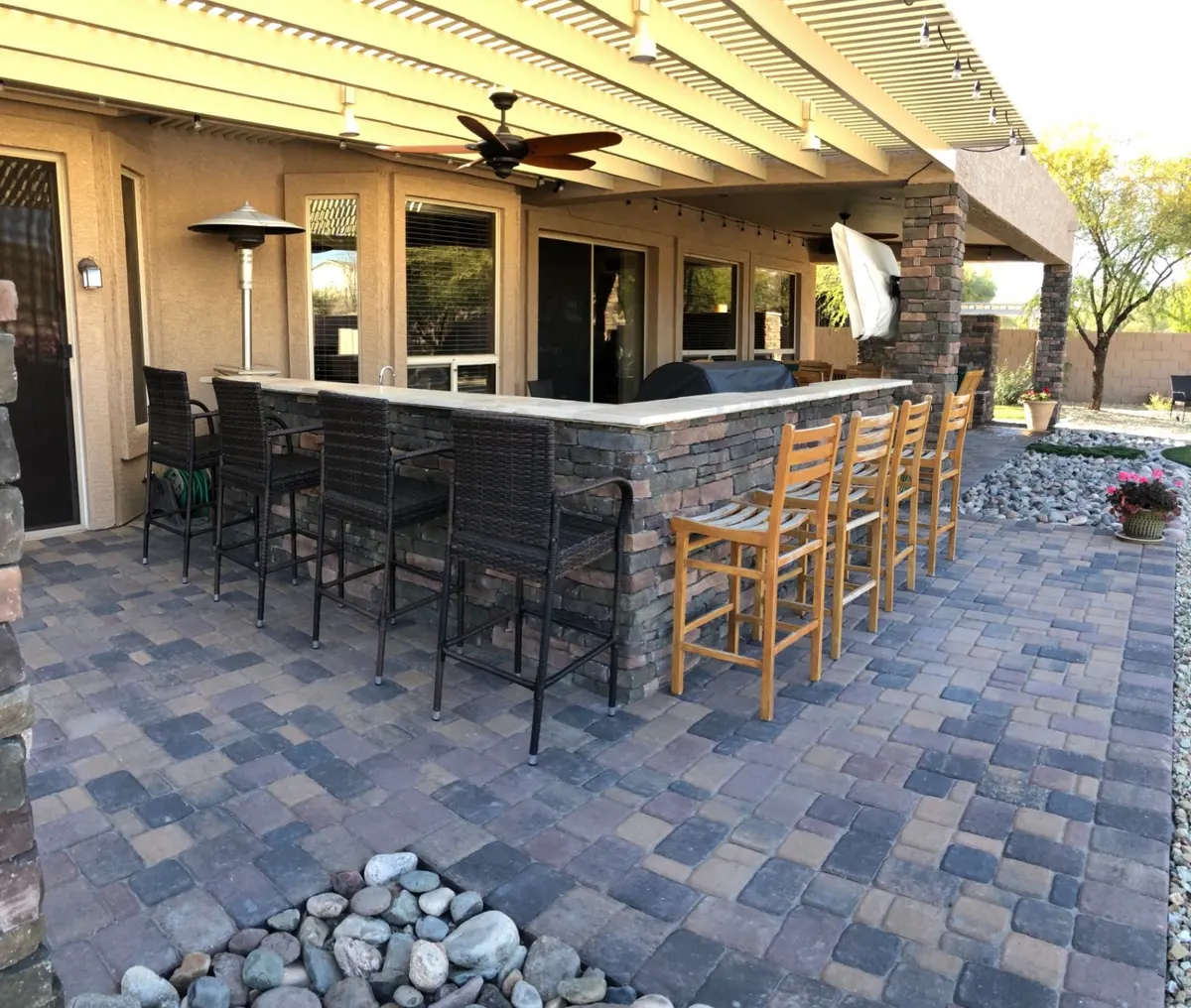
Hardscapes, Pavers & Outdoor Masonry
Patios, pool decking, driveways, walkways, walls, steps, flagstone, travertine, and outdoor masonry.
Quick planning summary
- Best for
- Homeowners who want a deck or patio that still looks right in ten years
- Planning investment
- Pavers are quoted by installed square foot, not material cost.
- Typical timeline
- Most paver installs run one to three weeks of on-site work, depending on square footage, access, and demo.
- Service area
- Phoenix metro — Peoria, Glendale, Surprise, Scottsdale, Cave Creek, Paradise Valley, and surrounding cities.
- AE division
- AE Outdoor Living
Ranges are planning guidance and reviewed periodically. Final figures live in your signed proposal.
See real numbers before you call.
Our pricing guide shows the planning ranges we actually see on Arizona jobs — no "call for pricing," no hidden cost drivers.
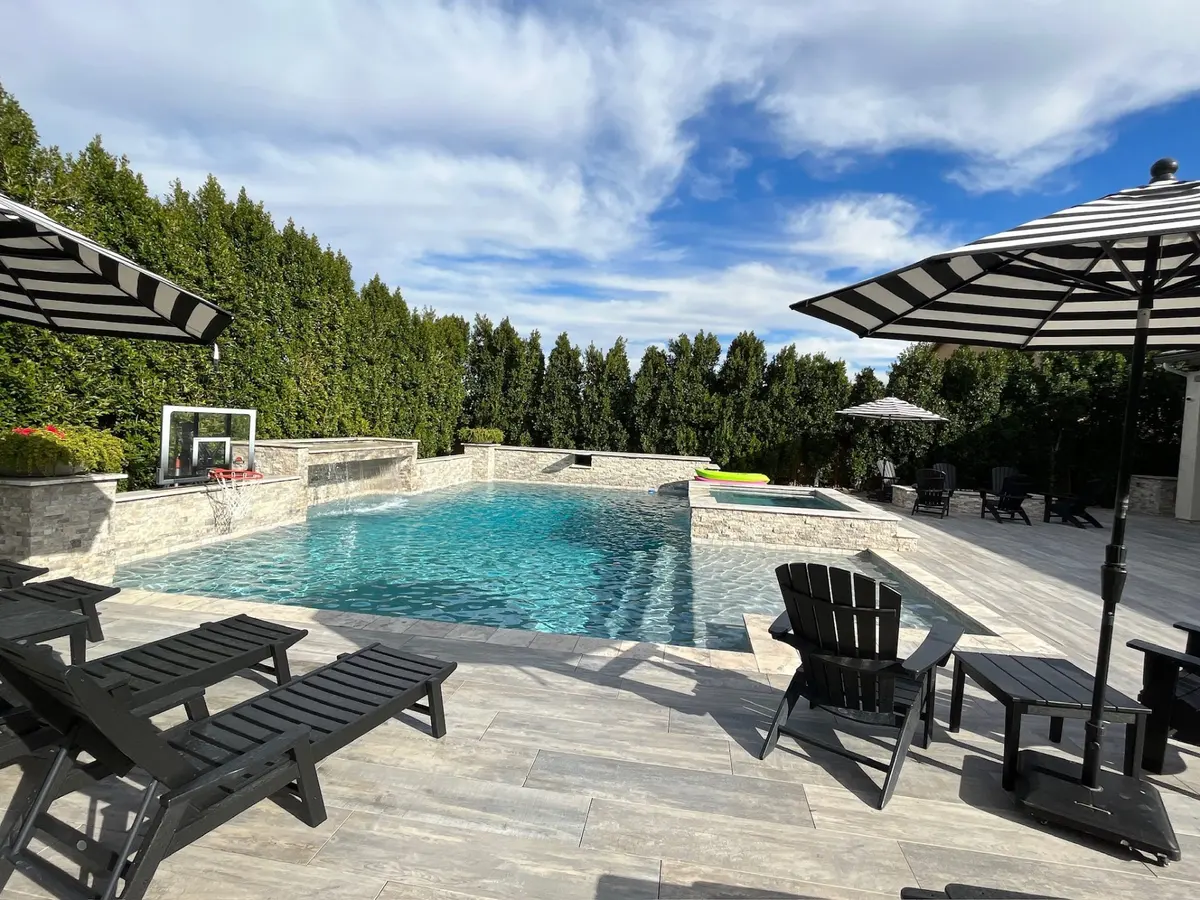
Blackstone at Vistancia Backyard Resort
A complete backyard resort behind a Blackstone golf-course estate — geometric pool, raised spa, full travertine deck, frameless glass, fire bowls, and a layered nighttime lighting plan.
What AE currently offers for this scope
Only options we actively design, source, and build today. Ask in your intake if you don't see what you're picturing.
- Patios, pool decking, driveways & walkways
- Seat walls, retaining walls & raised planters
- Steps & grade transitions
- Flagstone, travertine & porcelain pavers
- Outdoor masonry
- Hardscape demolition & replacement
- Polymeric sand joints, sealed for AZ sun
Where pavers work best
- —Pool decks
- —Patios
- —Driveways
- —Walkways
- —Outdoor kitchen areas
- —Fire pit areas
- —Courtyards
- —Side yards
- —Full backyard remodels
Material options
- —Standard concrete pavers
- —Large-format pavers
- —Travertine
- —Porcelain pavers
- —Natural stone
- —Premium Belgard-style options
Use the right planning tool for this project.
These tools are optional. Explore what is useful, or send us your project details when you are ready.
Southwest Hardscapes Association Authority
Led by David Bell (President of the Southwest Hardscapes Association), our paver installations follow strict base compaction and ICPI standards.
Pavers vs. Concrete & Materials
Unlike poured concrete that cracks in Arizona heat, interlocking pavers flex, allow underground utility repair, and carry 4x the compressive strength.
Paver patios, driveways, and walkways across the Valley
AE installs Belgard, Pavestone, and Acker-Stone pavers on a proper base: 2–3" ABC for patios and walkways, 4–6" ABC for driveways, a 1" sand bed, and polymeric joint sand every time. We never use quarter minus under pavers — that's a turf base, not a hardscape base.
- Phoenix
- Scottsdale
- Paradise Valley
- Arcadia
- Cave Creek
- Carefree
- Fountain Hills
- Peoria
- Glendale
- Surprise
- Goodyear
- Litchfield Park
- Avondale
- Chandler
- Gilbert
- Mesa
ROC-licensed and insured. David Bell, our president, is the current President of the Southwest Hardscapes Association.
The 13 questions AE answers for every hardscapes, pavers & outdoor masonry project
Each link goes to the AE page that answers the question — cost guide, planning tool, warranty scope, real project, or homeowner FAQ. If a question isn't yet linked, it's because we're still finalizing the source page rather than publishing anything we can't stand behind.
- What is it?
Pavers, travertine, and natural stone for patios, walkways, driveways, and pool decks — built on the AE canonical base spec.
See answer - Who is it for?
Owners replacing failing concrete, adding new hardscape, or rebuilding driveways and pool decks.
See answer - Is AE the right fit?See answer
- What are my options?See answer
- What drives the cost?See answer
- What drives the timeline?See answer
- What goes wrong if it's planned poorly?
Settling, joint loss, and edge failure all trace back to base prep — AE's standard spec exists to prevent them.
See answer - How does it hold up in Arizona conditions?
Why AE uses ABC + sand and never quarter-minus under pavers in Arizona conditions.
See answer - What does maintenance look like?See answer
- Permits, HOA, and engineering?See answer
- Warranty and manufacturer docs?See answer
- Show me a real project.See answer
- Is there a planning tool?See answer
The scope items that move the number
Size, selections, access, demolition, utilities, engineering, drainage, permitting, HOA requirements, site conditions, and specialty trades. We surface each one in your written scope instead of teasing a price that omits common cost drivers.
- Square footage
- Material — concrete, travertine, porcelain
- Base prep depth
- Pattern and cuts
- Tear-out of existing slab
- Site access
- Drainage and grading
- Edge restraint and joint sand
- Steps, walls, and transitions
- Permits where required
What this looks like in Arizona heat, soil, and monsoon
Engineered base depth
AE installs 4–6" of compacted ABC on driveways and 2–3" on patios and walkways, with additional depth where build-up or higher-traffic use calls for it. Every install gets a 1" screeded sand bed and polymeric joint sand. Skipping base depth is the #1 reason paver jobs fail in 2–3 years.
Heat-aware materials
Light travertine and porcelain stay barefoot-friendly around pools; standard concrete and dark cobblestone do not. We publish surface-temperature trade-offs honestly.
Polymeric joint sand
AZ heat and monsoon strip cheap joint sand fast. Polymeric sand with proper activation locks joints, blocks weeds, and survives the climate.
Drainage away from house
Pool decks and patios are graded away from the structure with overflow paths planned for monsoon. Pavers don't drain — the base under them does.
How we build it, summarized
- — Written, itemized scope before any work begins; no verbal change orders.
- — Engineering, drainage, and code review documented in the approved design.
- — Manufacturer instructions and current AZ code govern installation methods.
- — Photo documentation captured at each major milestone for the project file.
Final specifications depend on the approved design, site conditions, engineering, applicable code, manufacturer instructions, and signed scope.
See full Construction Standards →Set in your signed proposal
Your signed proposal and agreement control payment milestones, permitting responsibilities, warranty coverage, exclusions, and project scope. Pool and non-pool projects follow different milestone schedules.
What's covered, and by whom
AE workmanship coverage varies by service category — review the category-specific term below that applies to your project. Manufacturer and product warranties are separate, and the signed agreement and project-specific documents control coverage.
- Landscape, hardscape, stone, paversAE workmanship: 2-year workmanship
Website information is for planning purposes. Your signed proposal and agreement control the scope, payment schedule, warranty, and project responsibilities.
Damage caused by severe weather, natural disasters or other outside forces is not covered. See complete warranty terms.
Hardscapes, Pavers & Outdoor Masonry questions, answered
How much do pavers cost per square foot in Arizona?+
General installed paver ranges typically fall between $14–$35 per square foot installed. Final pricing depends on material, pattern, cuts, demolition, access, base preparation, drainage and site conditions. This is preliminary guidance, not a quote.
What causes paver failure?+
Poor base prep causes nearly every failure. We use 4–6 inches of ABC on driveways and 2–3 inches on patios and walkways (more where build-up or higher-traffic use calls for it), compacted in 2–3 inch lifts, topped with a 1-inch screeded sand bed and polymeric joint sand on every install — so the deck stays flat for decades.
Are pavers better than poured concrete?+
Yes — pavers flex with soil movement instead of cracking like a rigid slab. And if one paver does fail, you replace one paver, not the whole deck.
Are travertine pavers hot in summer?+
Travertine stays noticeably cooler than concrete decking — that's why it's the most popular pool-deck material in Arizona.
How often should pavers be sealed?+
Every 3 to 5 years to keep the color vibrant and protect the surface from UV and stains.
What's the typical timeline for a paver installation project?+
Most paver installations, from design to completion, take about 1 to 3 weeks depending on the project's size and complexity. Larger driveways or multiple patio areas will naturally take longer.
How long does a paver driveway take to install vs a paver patio?+
A typical paver patio runs 3–7 working days on site once material is delivered: 1–2 days for demo and excavation, 1 day for ABC base prep and compaction, 1 day for the screeded sand bed and edge restraints, 1–2 days for laying pattern and cuts, then half a day for polymeric joint sand. A paver driveway typically runs 5–10 working days because the base depth is 4–6 inches of ABC (versus 2–3 inches on patios), compacted in lifts, and the laying area is larger. Design, HOA approvals, and permits add 1–3 weeks before the on-site window.
Do I need a permit for paver installation in Arizona?+
Minor paver projects like small patios usually don't require a permit. However, larger installations, especially driveways or extensive remodels, might need one, and we'll help determine that.
Published specifications are typical AE planning or construction baselines. Final specifications depend on site conditions, engineering, manufacturer requirements, applicable code, and the signed scope.
What to clarify before choosing — common planning mistakes to avoid
- Sinking from poor base prep
- Uneven joints
- Poor drainage and standing water
- Edge failure where restraint was skipped
- Wrong base material for the soil
- Bad compaction in lifts
Often built alongside
Project Proof & Transformations
Ready to plan this the right way?
One accountable team — design, written scope, build, and aftercare.