
Synthetic Turf Cleaning & Care Guide
Honest answers on how to clean synthetic turf, control pet odor, keep infill topped up, and power broom — so your turf still looks new in year ten. Built for Arizona heat, monsoon dust, and Valley dog yards.
Get these right and your turf lasts.
Rinse it weekly
A 5-minute hose-down once a week clears dust, pollen, and pet urine before they build up. In monsoon season, rain handles a lot of this for you.
Pets need a system, not luck
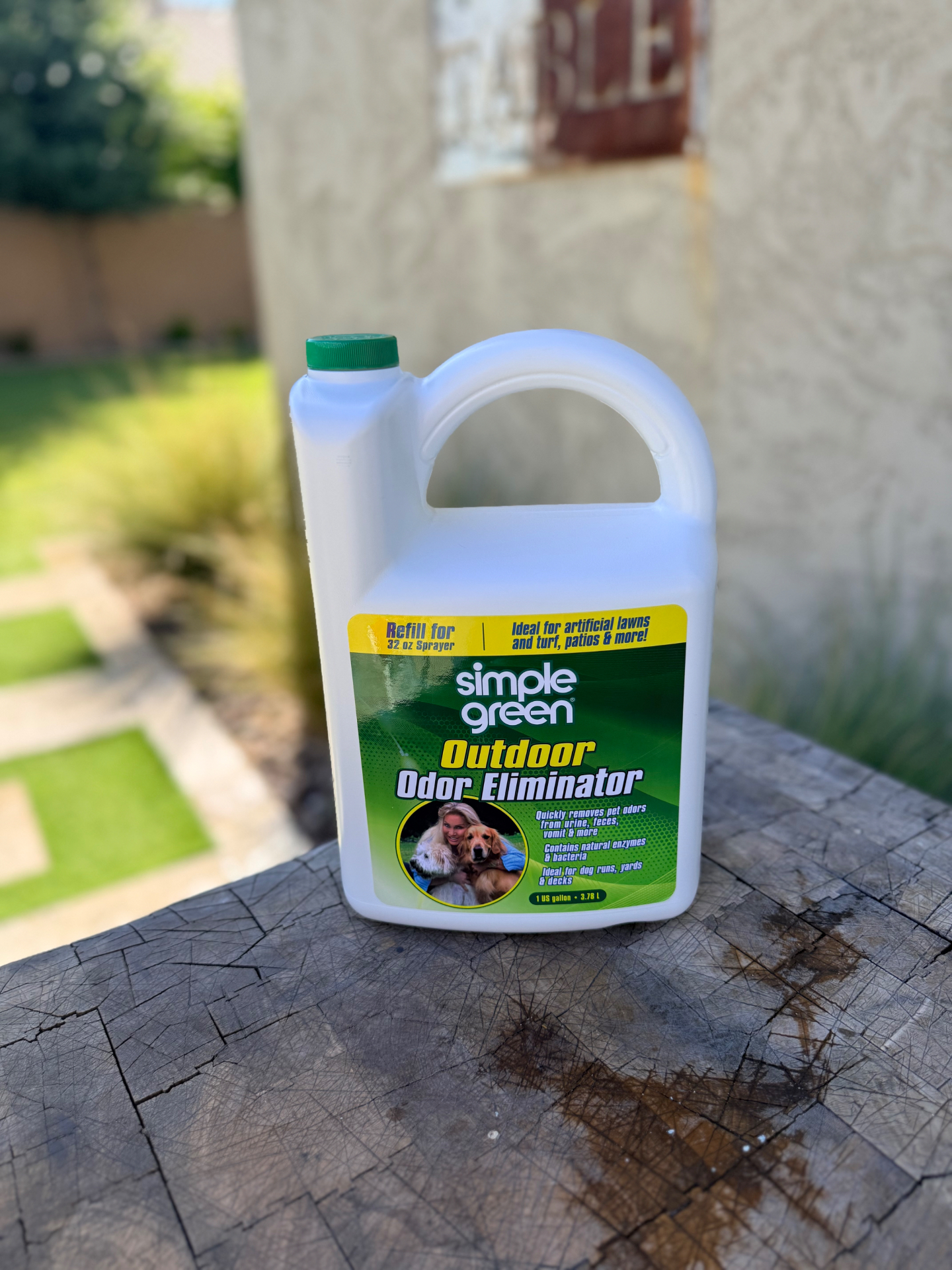
Pick up solids daily. Rinse pee spots within a day. Use an enzymatic turf deodorizer monthly. Done consistently, turf stays odor-free even with multiple dogs.
Power broom 1–2× per year
Brushing stands the fibers back up and redistributes infill. Without it, high-traffic lanes mat down and the turf starts to look tired in 2–3 years instead of 10–15.
Top up infill every 2–3 years
Foot traffic, blowers, and rinsing slowly migrate silica sand out of the turf. Adding a fresh layer keeps the fibers upright, the surface cooler, and the warranty intact.
Routine Cleaning
A simple weekly rhythm that prevents 90% of turf problems:
- Pick up pet solids daily — same as you would with real grass.
- Rinse the entire turf surface once a week with a garden hose on a fan spray for 3–5 minutes. Rinse longer in pet areas.
- Spot-rinse pee areas within 24 hours so urine doesn't soak into the infill.
- Blow off leaves, palm debris, and dust with a leaf blower — do not rake aggressively.
- Cross-brush high-traffic lanes (gates, doorways, dog runs) every few weeks with a stiff push broom to stand the blades up.
- After dust storms or heavy monsoon activity, give the turf a thorough rinse to flush silt out of the infill.
Pet Odor Control
The single most common question we get. Turf doesn't smell — saturated infill does. Here's how to stay ahead of it:
- Rinse pee spots within a day — water is the most important step.
- Apply an enzymatic turf deodorizer monthly (or weekly in heavy-use dog areas). Enzymes break down uric acid; vinegar and bleach do not.
- Spot-treat odors with a 50/50 white vinegar and water rinse, followed by clean water — only as an occasional reset, not a routine.
- If odor persists, the infill itself may be saturated. A deep flush with an enzymatic cleaner, followed by power brooming, usually resolves it.
- Antimicrobial infill (zeolite or coated sand) is worth the upgrade for multi-dog households — we spec it on every pet-focused install.
- Keep the turf well-drained. Ponding water and trapped urine are the actual source of smell, not the turf itself.
Infill Top-Ups & Power Brooming
The two maintenance items most homeowners don't know about — and the reason their turf looks tired in year four:
- Infill is the silica sand (and sometimes coated/antimicrobial sand) that sits between the blades. It weighs the turf down, keeps blades upright, and protects the backing.
- Plan a top-up every 2–3 years for residential lawns, annually for putting greens and high-traffic dog runs.
- Power brooming uses a powered nylon-bristle brush to stand fibers up and redistribute infill evenly. We recommend it once or twice a year.
- Skip metal-bristle brushes and pressure washers — both shred the turf fibers and void most manufacturer warranties.
- AE offers an annual maintenance visit (power broom + infill check + deodorizer application). For most homeowners this is the simplest way to keep turf looking new for 10–15 years.
The real reason we wrote this guide: protecting your warranty.
Every turf manufacturer we install — without exception — voids their warranty if you can't prove the turf was maintained on schedule. Routine care isn't just about looks. It's the paper trail that keeps an 8–15 year warranty enforceable. Without documentation, a claim is a conversation. With it, it's a contract.
Warranties are conditional, not automatic
Every major turf manufacturer (SYNLawn, Shawgrass, Tigerturf, FieldTurf, etc.) ties their 8–15 year warranty to documented homeowner maintenance. No records = no claim. We've seen warranty denials on year-three installs purely because the homeowner couldn't prove they ever rinsed, brushed, or topped up infill.
Documentation is the warranty
When a claim is filed, the manufacturer asks for dates, photos, and product receipts. Saying 'I rinsed it most weeks' isn't enough. A timestamped log of rinses, deodorizer applications, power brooms, and infill top-ups is what keeps the warranty enforceable.
Skip one cycle and the clock resets
Missing a single annual power broom or infill top-up doesn't automatically void coverage — but a pattern of skipped maintenance does. Manufacturers reserve the right to deny claims if the turf failed because the documented care schedule wasn't followed.
Keep receipts for everything you put on the turf
Enzymatic deodorizer bottles, infill bags, replacement seam tape, professional service invoices — save them. If a manufacturer questions whether an off-spec chemical caused the damage, the receipt is your proof.
What to Document (the maintenance log)
This is the minimum log a manufacturer expects to see if you ever file a claim. A spiral notebook in the garage works. A spreadsheet works. A photo album on your phone with dated captions works. What doesn't work is memory.
A turf maintenance log built into your portal.
What to Avoid
These shorten turf life or void manufacturer warranties:
- Metal-bristle brushes or rakes
- Pressure washers above 1,500 PSI or held closer than 12 inches
- Bleach, ammonia, or acid-based cleaners on dog areas (they don't break down uric acid and can damage backing)
- Letting pet solids sit for days
- Mowing, weed-whacking, or edging across the turf
- Hot grills, fire pits, fireworks, or cigarettes directly on the turf — synthetic fibers melt
- Heavy vehicles or sharp furniture legs without protection pads
- Reflected sunlight from low-E windows — this can melt turf and is a glass issue, not a turf defect (deep dive: /guides/artificial-turf-reflection-heat-damage)
Do any of these and the warranty is gone.
Manufacturers are explicit about what kills coverage. None of these are gray areas — if any happen, the warranty is voided and the replacement cost falls back on the homeowner.
- Using bleach, ammonia, solvents, or non-approved cleaners
- Pressure washing above the manufacturer's PSI limit
- Skipping the documented infill top-up schedule (most common denial reason)
- Repairs or modifications by an uncertified installer
- Burns, cuts, or melt damage from grills, fire pits, cigarettes, or fireworks
- Damage from vehicles, equipment, or sharp furniture without protection
- Failure to provide a maintenance log when a claim is filed
Frequently asked turf questions.
Want AE to handle annual turf maintenance?
Power broom, infill top-up, enzymatic deodorizer treatment, and a full turf inspection — one visit a year keeps your install looking new for a decade plus.
Request Turf Maintenance