
Landscape Lighting Design Guide for Phoenix Desert Yards
A great Phoenix landscape lighting plan is editorial — it lights what matters and hides the rest. It survives 115°F summers, monsoon lightning, hard-water sprinkler overspray, and 3 AM javelina traffic. And it looks intentional at night without turning the yard into a used-car lot.
This is the same design framework we use in every AE lighting proposal, condensed into a guide you can use to critique any quote — ours or someone else's.
In this guide+
What to light — and what not to
A Phoenix yard has 5–8 features that matter and 20+ that don't. Design decides which is which:
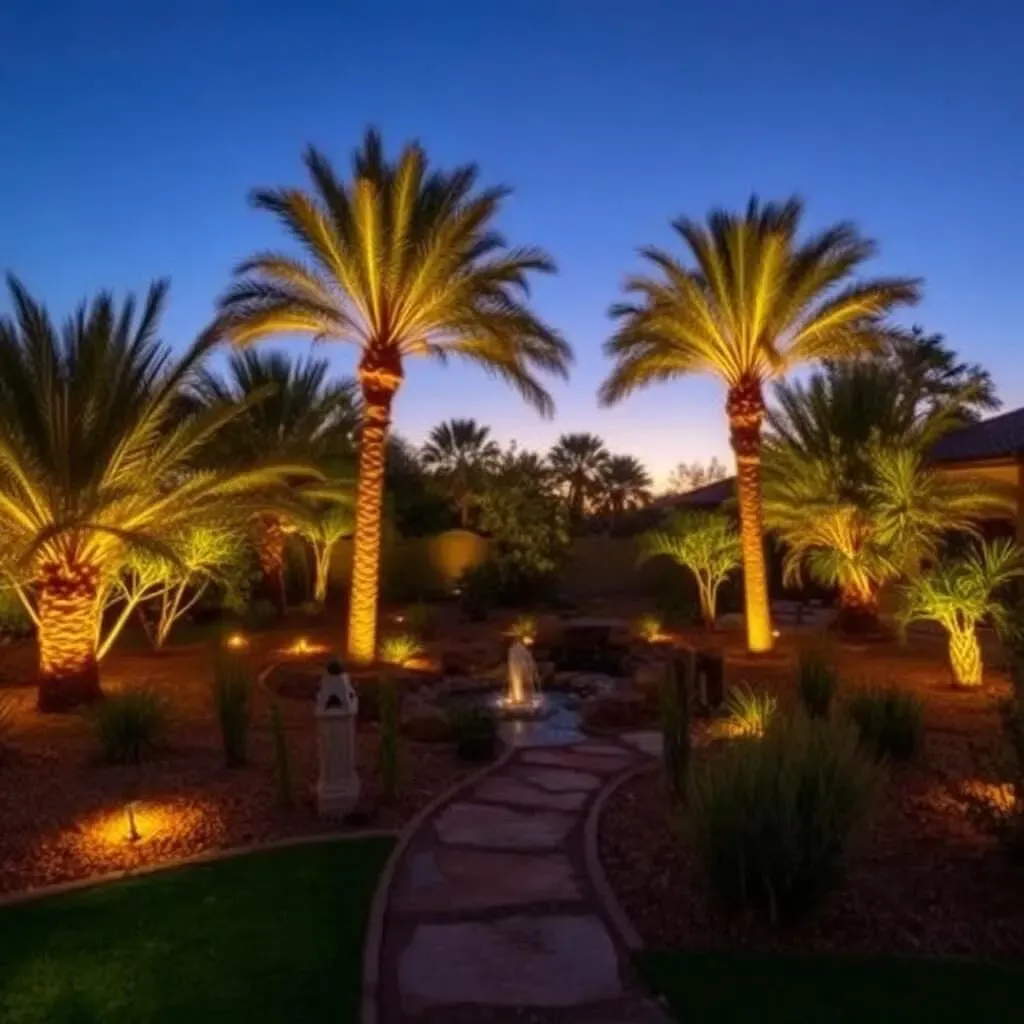
- Every mature palm and saguaro — up-light from two angles, at least 6–10 ft apart, for depth.
- Facades — wash lightly under the eave, 2700K, 3–7 fixtures across a typical front elevation. Texture, not floodlight.
- Paths — down-light from tree canopies or pergolas. Avoid ground-mounted bollards; they turn a garden into an airport taxiway.
- Water — the pool's coping, baja shelf, spillover wall, and any water feature get their own channels.
- Signature plants — one specimen olive, ironwood, or mesquite per view. Not the whole plant palette.
- Never light empty lawn. Empty grass with light on it looks empty.
- Never light a boundary wall to the property line. It reads institutional.
Fixtures that survive Arizona
- Brass or copper only — composite plastic fixtures fail in Phoenix UV within 2–4 years. Cracked lenses, yellow gaskets, water intrusion.
- Trade lines only — FX Luminaire, Vista Pro, Kichler Pro, Volt. Retail-packaged versions of the same brand are the value-engineered SKU.
- 2700K warm white for every landscape fixture. 3000K reads cold. 4000K+ is a parking lot. RGBW belongs on AE LEDs eaves or pool lights, not landscape.
- Beam angle matters — a 25° spot for palm trunks, 60° flood for facade wash. Wrong angle = wrong feel even with a perfect fixture.
- Anti-glare shrouds on every fixture within human eye level. Glare is the single most common install mistake.
Wiring and transformer setup for Arizona weather exposure
- 10 or 12 AWG direct-burial wire — solid copper, not aluminum-clad.
- Continuous runs to fixtures via gel-filled waterproof T-splices. Never Wago-and-tape in a Phoenix bed.
- Commercial-grade multi-tap transformer (12V, 13V, 14V, 15V) sized to total load with 20% headroom. FX, Hadco, or Volt.
- Transformer mounted on a shaded exterior wall with GFCI-protected line-voltage feed. Ventilated enclosure if it's in direct sun.
- Bury wire 6–8 inches minimum along the interior edge of planting beds, away from irrigation trenches.
- Monsoon: every above-grade splice sealed and drip-looped. No standing water at the transformer base.
Scene control — not stand-alone timers
Every fixture on one scene controller — Lutron RA3, FX Luxor, or the AE LEDs app for integrated permanent + landscape. Not a photocell per zone. Not a mechanical timer per channel.
Program at least three scenes: 'Evening' (facade + paths + palms at 60–80%), 'Dinner' (facade at 30%, path at full, water features on), and 'Late Night' (paths only at 20%, everything else dark).
Program a monsoon override — kills water-adjacent zones if the storm-alert integration fires.
Skip individual per-fixture app control unless the client is technical. Scenes are the product.
The five most common Phoenix lighting mistakes
- Plastic fixtures — UV-yellow and brittle in 2–4 years, and every replacement is a re-dig.
- Cold-white 4000K LEDs — turns a warm desert yard into a car dealership.
- Big-box solar path lights — never enough lumens, batteries die in a year, they lean.
- Stand-alone timers per zone — you'll never adjust them, and the yard loses cohesion within a season.
- Lighting the lawn — empty grass with light on it just looks empty at night.
Real Phoenix landscape lighting investment ranges
Frequently asked
- How do you design low voltage landscape lighting for a desert yard?
- Start with the layers, not the fixtures: uplight two or three key architectural features and specimen trees, downlight paths and gathering areas from soffits or 12′+ tree mounts, and add path lights only where feet actually cross. In Phoenix, keep every fixture on 2700K warm white and size transformers to total load + 20% headroom. Skip the row-of-pathlights look — it reads suburban and washes out the architecture.
- How does low voltage landscape lighting work?
- A line-voltage (120V) feed enters a transformer that steps power down to 12–15V. From the transformer, low-voltage cable runs to each fixture in a hub-and-spoke or daisy-chain layout. LED emitters draw 2–15 watts each, so a single 300W transformer can drive 20–30 fixtures. Low voltage is safer to trench near planting beds, easier to expand later, and code-permitted at shallower burial depths than 120V.
- How far can you run low voltage landscape lighting from the transformer?
- As a working rule: 100–150 ft on 12-gauge cable and 150–200 ft on 10-gauge cable before voltage drop pushes fixtures below 10.5V (LEDs dim and color-shift below that). For runs longer than that, use a multi-tap transformer on the 13V/14V/15V taps to compensate, or split the load onto a second transformer closer to the far fixtures.
- What color temperature is best for landscape lighting in Phoenix?
- 2700K warm white for every landscape and architectural fixture. Anything cooler reads industrial or commercial in a desert yard. RGBW color-change belongs on permanent AE LEDs eaves and pool lights — never on brass path or uplights.
- How long do brass low voltage landscape lighting fixtures last in Arizona?
- Brass and copper fixtures last 15–25 years in Phoenix with normal wear (patina develops but is desirable). Plastic composite fixtures fail in 2–4 years — the plastic degrades faster in AZ UV than in almost any other US market. Trade-grade LED emitters last 50,000+ hours and are typically warrantied lifetime by the fixture manufacturer.
- Can low voltage landscape lighting be added to an existing yard?
- Yes, in almost every case. Wire runs along the interior edge of existing beds or under paver joints. Transformers mount on a shaded exterior wall near an existing outlet. Most retrofit installs take 2–4 days and do not require re-trenching planting beds — the exception is when a client wants uplights in the middle of an existing lawn area.
- Should I use solar landscape lights in Phoenix?
- For real facade or feature lighting, no — solar path lights don't produce enough lumens to matter, and the lithium batteries fail in 6–12 months at Phoenix summer roof temps. They're fine as decorative accents in a garden bed you'll re-do in a year, not as the primary lighting layer.

David "Dave" Bell
Dave is the owner of AE Outdoor Living in Peoria, Arizona and the current president of the Southwest Hardscape Association — 13 years on the board, 15 years involved. He has designed and built outdoor environments across Greater Phoenix since 2005.