
How to Light a Phoenix Backyard the Right Way
The yards that look like magazine spreads in daylight and disappear at night are the ones built without a lighting plan. Lighting is the cheapest single upgrade that extends usable hours and triples how often you actually go outside.
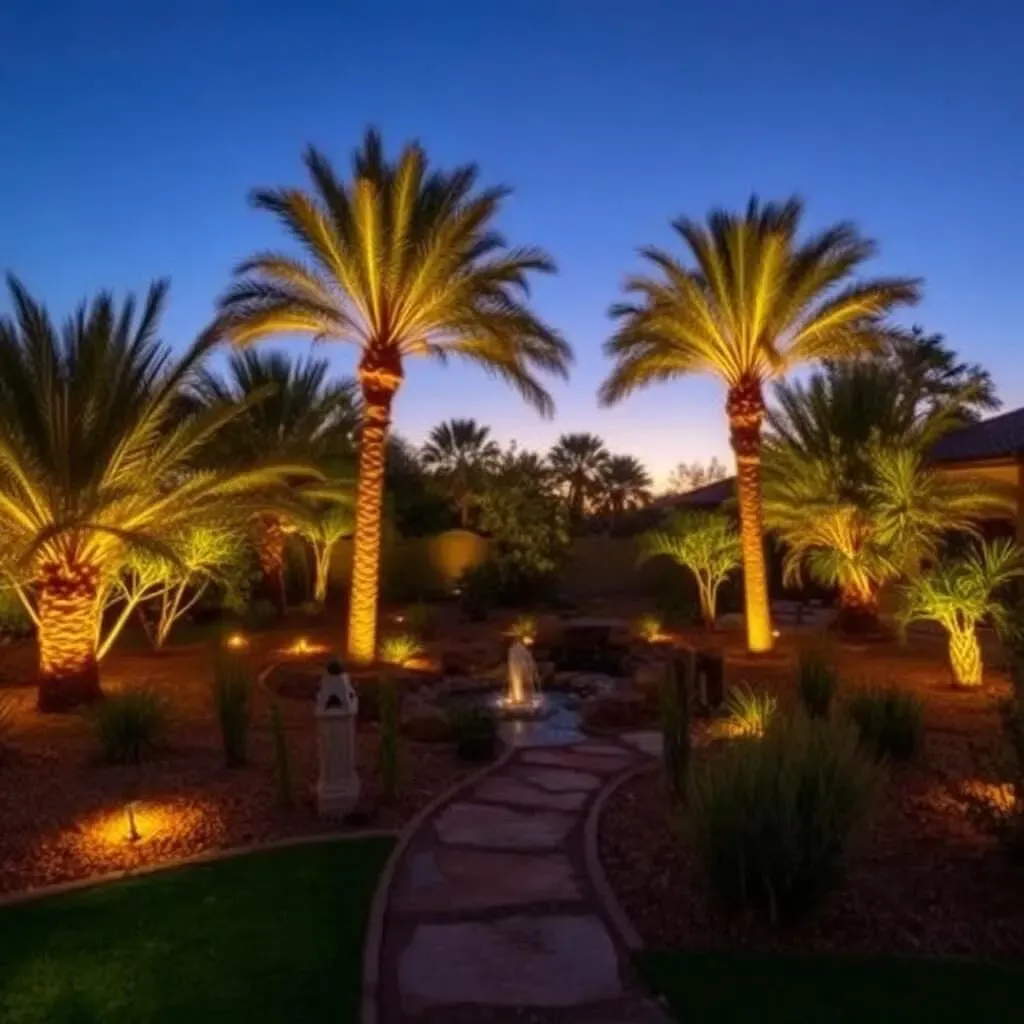
There are two tools that matter in Phoenix: permanent RGBW eave lights (we install our AE LEDs system) for facade, ridge, and feature lighting; and 12V low-voltage landscape lighting for paths, palms, and architecture. Done together, they're transformational.
In this guide+
Two systems, one controller
- AE LEDs (permanent RGBW) — discreet aluminum channel installed under eaves, ridge lines, pergolas, or coping. 16M+ colors, programmable scenes, app and voice control. Replaces the holiday-light hire every December and works year-round.
- Low-voltage landscape lighting — 12V brass and copper fixtures (FX Luminaire, Vista Pro, Kichler Pro) for palm up-lights, path lights, wash lights on facades, and pool deck accents.
- One scene controller — both systems integrate so a single 'Evening' or 'Party' scene controls eaves, palms, paths, and pool lighting together.
Fixtures and transformers that hold up
- Brass or copper fixtures only — composite plastic fixtures fail in Phoenix UV within 2–4 years.
- Color temperature — 2700K (warm white) is the only correct answer for landscape. 3000K reads cold; 4000K+ is industrial.
- Transformer — sized to load with 20% headroom, multi-tap (12V/13V/14V/15V) to compensate for voltage drop on long runs. Hadco, FX, or Volt commercial-grade.
- Wire — 10 or 12 AWG direct burial, run continuous to fixtures via T-splices in waterproof gel-filled connectors. Not Wago-and-tape.
- Smart control — Lutron RA3, FX Luxor, or AE LEDs app-controlled scenes — not stand-alone photocells.
What to light, and what not to
A great Phoenix lighting plan is editorial — light what matters, hide the rest:
- Up-light every mature palm and saguaro from two angles for depth.
- Wash the facade lightly under the eave — texture, not floodlight.
- Down-light paths from trees or pergolas; avoid bollard 'runway' path lights.
- Highlight the pool's coping, baja shelf, and water feature with separate channels.
- Skip lighting the lawn. Empty grass with light on it looks empty.
Real Phoenix lighting investment ranges
Add $1.5k–$3k to integrate AE LEDs, landscape lighting, and pool lighting into a single scene controller.
What ruins Phoenix landscape lighting
- Plastic fixtures — UV-yellow and brittle in 2–4 years.
- Cold-white 4000K LEDs — looks like a parking lot, not a home.
- Big-box solar path lights — they never produce enough lumens, batteries die in a year.
- Stand-alone timers per zone — you'll never adjust them and the system loses cohesion.
- No scene programming — every fixture on or off, no in-between.
Frequently asked
- What is AE LEDs?
- AE LEDs is our permanent RGBW lighting system — discreet aluminum channels installed under eaves, ridges, pergolas, or coping that produce 16M+ colors with programmable scenes via an app. One install replaces seasonal holiday lighting and gives you usable facade lighting year-round.
- How much does landscape lighting cost in Phoenix?
- Plan $3k–$6k for a starter low-voltage landscape lighting plan with brass fixtures, $6k–$12k for a full backyard with palms, paths, deck, and pool accents. AE LEDs permanent installs run $3.5k–$6k for front facade, $6k–$12k for whole-home coverage.
- Are permanent RGBW lights worth it vs hiring out holiday lights every year?
- If you've hired holiday lights for 3+ years, AE LEDs pays back in 2–3 seasons and adds 360 nights of year-round usable lighting beyond the holidays. The ROI math is straightforward.
- What color temperature should outdoor lighting be?
- 2700K warm white for every landscape and architectural fixture. Cooler color temps read industrial or commercial. RGBW systems (AE LEDs, color-change pool lighting) handle holidays and accent moments without committing the whole yard to cold light.
- Can low-voltage lighting be added to an existing yard?
- Yes, in any yard with established trees or hardscape. Wire runs in trenches along bed edges or under pavers. Transformer sits at the side of the house near an outlet. Most installs take 2–4 days.

David "Dave" Bell
Dave is the owner of AE Outdoor Living in Peoria, Arizona and the current president of the Southwest Hardscape Association — 13 years on the board, 15 years involved. He has designed and built outdoor environments across Greater Phoenix since 2005.