
AE LEDs — LED Landscape Lighting That Actually Makes Your Yard Look Like the Brochure
Most landscape lighting looks like a runway or a haunted house. Here's how we design layered LED lighting that makes your yard look architectural at night.
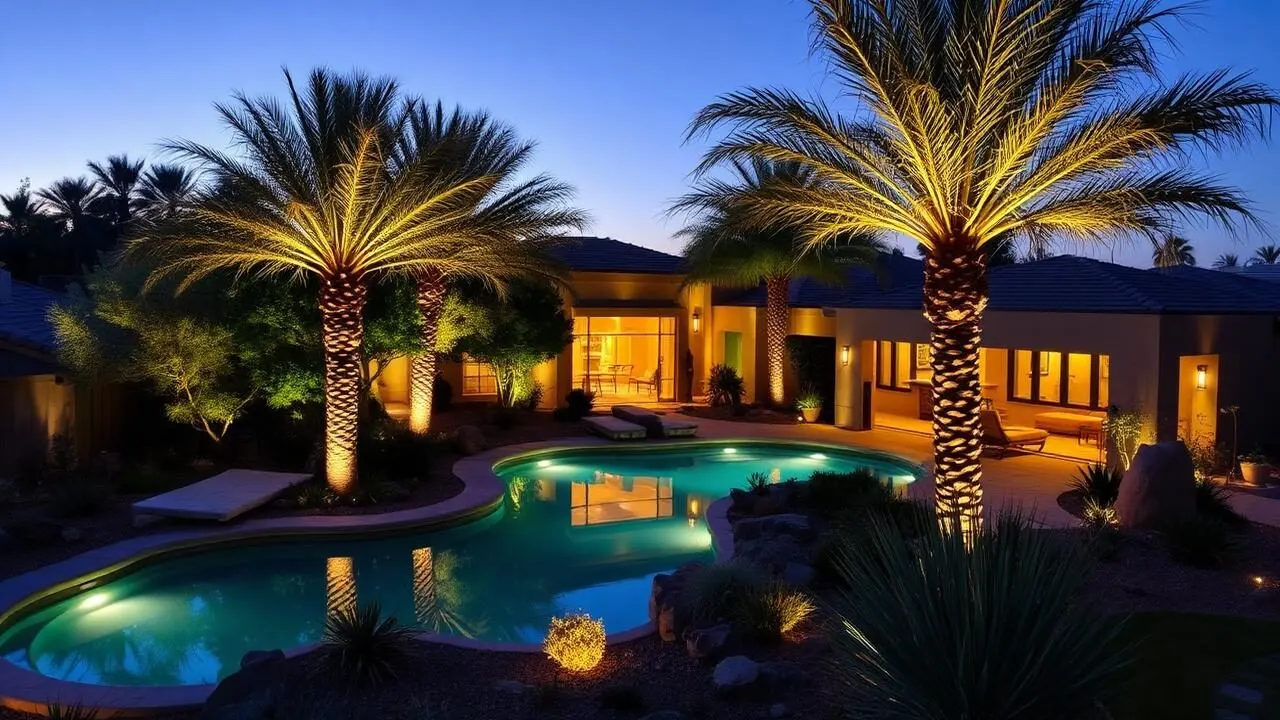
Why most lighting jobs look bad
The mistake is uniform brightness — a row of identical path lights every 6 ft. That reads as 'airport runway' instead of 'high-end yard.' Great lighting is layered: bright accents on the focal points (palm trees, pool, water features), softer ambient on circulation paths, and almost nothing on the boring stuff.
The four layers we always design
- Up-lights on canopy trees (palms, mesquite, ironwood) — the single biggest visual upgrade.
- Wash lights on architectural walls and water features.
- Path lights at switchbacks and steps only — not every 6 ft.
- Pool perimeter glow + bollards near seating — soft, low to ground.
Color temperature matters more than you think
Stick to 2700K (warm white) throughout the yard. Mixed temps (some 3000K, some 4000K, some daylight 'cool white') is the #1 thing that makes a yard look unprofessional. Cool white on palm trees in particular looks alien. 2700K = restaurant patio. 4000K = parking lot.
LED vs halogen — settled
LED won years ago. 90% less energy, 25,000+ hr lifespan vs 2,000 hr halogen, no UV bleach on plants, no melting plastic fixtures. The only reason to install halogen today is replacement bulbs for an existing system you don't want to convert.
Smart control
Astronomical timers (auto-adjust sunrise/sunset by date) are standard now. Add a Lutron Caséta or Halo system and you can hit 'Entertain' from your phone — pool light blue, palm uplights on, fire feature, fountain on, path lights dim. We wire most new builds for it.
Realistic cost
Quality low-voltage LED install: $200–$350 per fixture installed (transformer, wiring, conduit included). A typical backyard takes 18–35 fixtures = $4,500–$11,000. We use FX Luminaire and Volt — both warranty 5+ years on the fixture, lifetime on transformer.

