
How to Choose the Best Outdoor Living Company in Peoria
This is the checklist AE uses when we verify a company before we sub, partner, or refer — written for Peoria homeowners comparing a pool, a complete backyard, or a single trade.
It is contractor-authored and disclosed: AE Outdoor Living publishes it and competes for this work. No company names, no accusations. Ask the questions and let the answers speak.
In this guide+
- 01Who publishes this guide, and how to use it
- 02The Peoria buyer decision framework
- 03Compare by service: what to ask, and where to continue
- 041. ROC license tenure vs. portfolio age
- 052. Insurance — what a certificate does and does not do
- 063. Prior companies, closed entities, and inactive licenses
- 07Peoria due-diligence deep dives
- 084. HOA submittal experience inside your specific community
- 095. Written payment schedule — what Arizona law sets for pool contracts
- 106. Verify the portfolio
- 117. Permits, large projects, and complexity
- 128. Warranty and aftercare — read the contract
- 13The questions Peoria homeowners actually ask
- 14Peoria work you can look at
- 15Building outside Peoria? Start with your city
Who publishes this guide, and how to use it
Peoria homeowners usually shop two to five companies for a pool, a complete backyard, or a single trade like turf, pavers, a patio cover, permanent trim lighting, glass pool fencing, or a built-in BBQ island. The proposals look similar on the cover page. The written scope behind them rarely does.
This page is the checklist we use ourselves when we verify a company before we partner, sub, or refer. It is education, not legal advice, and it is not a compliance guarantee for your specific project. Requirements depend on your scope, your lot, your HOA, and the authority having jurisdiction.
The Peoria buyer decision framework
Ten checks, in the order they usually save the most money. Ask for each item in writing before you sign anything.
- Ask for: An active Arizona ROC license number and the classification that covers your scope
Why it matters — An Arizona license classification defines the scopes an entity may contract to perform. A complete backyard may involve multiple licensed entities or classifications, or properly licensed specialty subcontractors, so verify each legal entity and class with the ROC.
Red flag or omission — A license number that will not verify on the ROC contractor search, an inactive status, or a class that does not match the work being proposed.
- Ask for: The legal entity name on the contract and current insurance certificates sent by the insurer's agent
Why it matters — The entity on the contract is the entity that owes you the warranty. A certificate issued by the insurance producer is evidence of coverage on its issue date; it does not change the policy, and certificate-holder status alone does not create coverage or additional-insured rights.
Red flag or omission — A named insured that does not match the legal entity on the contract, expired effective dates, or no answer about how subcontractors document coverage.
- Ask for: A written list of who performs each trade and who coordinates it
Why it matters — Most complete-backyard projects mix self-performed crews and specialty trade partners. Knowing which is which tells you who shows up when something needs a fix.
Red flag or omission — "We handle everything" with no detail, or a refusal to say which trades are subcontracted.
- Ask for: Written material and build specifications, not just line-item names
Why it matters — Base depth, compaction, sand bed, jointing, glass thickness, hardware type, fixture model, and irrigation components decide how the work performs in Arizona heat and monsoon.
Red flag or omission — A proposal that says "pavers" or "turf" with no spec, thickness, or product named.
- Ask for: Drainage, elevations, and utility locating shown on the plan
Why it matters — Water has to leave the lot. Elevations, slope, and existing utilities can cause costly redesign and change orders when they are discovered after work starts.
Red flag or omission — No slope or drainage note anywhere in the documents, or no plan for locating existing lines before digging.
- Ask for: Who prepares and submits City of Peoria permit documents and HOA design review
Why it matters — Permit and HOA responsibility should be assigned by name, not assumed. Review timelines belong in the schedule.
Red flag or omission — A promise that a permit will not be needed, or a guaranteed approval date before anything has been submitted.
- Ask for: A realistic sequence of work with payment milestones tied to completed phases
Why it matters — For a qualifying owner-occupied residential in-ground pool or spa contract, A.R.S. §32-1158.01 sets maximum payment amounts by construction stage. For other outdoor work, payment triggers should be clear and reasonably tied to completed work.
Red flag or omission — Payment terms you cannot match to a completed stage, or a refusal to state in writing what each payment is for.
- Ask for: The written warranty, what it excludes, and the service path after completion
Why it matters — Identify the legal entity responsible for the workmanship warranty, and distinguish it from manufacturer product warranties. Compare term, exclusions, transferability, claim process, and service expectations. Enforceability and available remedies depend on the contract, the facts, and applicable law.
Red flag or omission — A verbal warranty, an exclusions list you are not allowed to read before signing, or no defined way to request service.
- Ask for: Recent, verifiable local work you can actually look at
Why it matters — Recent nearby projects show current crews, current suppliers, and current quality — not a portfolio from a previous decade or a previous company.
Red flag or omission — No answer about whether the photos are the company's own first-party work, or no privacy-safe context such as neighborhood and month/year.
- Ask for: In-person access to real samples and finished project records
Why it matters — Pavers, turf blades, travertine, glass, cabinetry, and lighting color temperature all read differently in person than on a screen.
Red flag or omission — No way to see physical samples before you approve a finish selection.
Compare by service: what to ask, and where to continue
Each intent below has its own comparison points. These links go to the existing AE page for that scope — no duplicate Peoria landing pages were created for this guide.
- Pool and spa builderShell engineering, steel and gunite spec, equipment brands and models, barrier requirements, milestone draws, and who pulls the permit.Continue
- Complete outdoor living design-buildPrime coordination on one contract versus separate contracts per trade — either way, identify the responsible party and the applicable workmanship or manufacturer warranty for each component.Continue
- Artificial turfBase and drainage detail, infill type, blade height and face weight, pet-area treatment, seams, edge anchoring, and heat behavior in full sun.Continue
- Pavers and hardscapeABC base depth for the use, compaction, the 1-inch sand bed, polymeric joint sand, edge restraint, slope, and how drainage is handled.Continue
- Residential backyard splash padThis is private residential construction — not a City of Peoria public park splash pad. Compare water source and recirculation approach, surface material and slope, drainage, controls, and freeze and maintenance requirements.Continue
- Pergola and ramada builderPost and beam sizing, footing detail, attachment or freestanding design, slat spacing and the shade it actually produces at midday, finish system, and whether a stamped plan is required for the structure.Continue
- Patio cover contractorSolid, lattice, and insulated-panel covers behave differently. Compare the panel or framing system named in the proposal, ledger attachment and flashing, drainage, any electrical, and who prepares the engineering and permit documents — requirements vary by system and site.Continue
- Permanent trim and fascia lightingTrack profile and color, diode quality and spacing, controller and app, mounting method on your fascia, power locations, and the written warranty on both product and installation.Continue
- Glass pool fence and view fenceGlass thickness and tempering mark, mounting method, footing detail where required, hardware material, and the barrier requirement confirmed with your jurisdiction.Continue
- Outdoor kitchen and built-in BBQ islandThis is built-in island and outdoor kitchen construction, not appliance retail. Compare framing material, gas, electrical and water runs, ventilation and clearances, countertop material, door and drawer quality, and appliance specs.Continue
- Landscaping and landscape designIrrigation zoning and controller, drainage, plant sizes at install versus mature size, soil prep, and who maintains the plan after install.Continue
- Landscape lightingFixture material, transformer sizing, wire gauge and burial, beam spread, color temperature consistency, and dark-sky friendly aiming.Continue
1. ROC license tenure vs. portfolio age
Pull the Arizona ROC record on every company you are considering, note the issue date on the current license, and compare it to the portfolio. If the license is newer than the work shown, ask which projects were built under this license, which were built under a prior entity, and who the qualifying party was. Legitimate answers exist — a qualifying party with decades of experience, a rebrand, an ownership change.
2. Insurance — what a certificate does and does not do
Ask for a current certificate issued by the insurance producer and verify that the named insured matches the legal entity on the contract, along with policy types, effective dates, and limits. A certificate is evidence of coverage on its issue date; it does not change the policy. Certificate-holder status by itself does not create coverage or additional-insured rights.
If the contract or your own insurer requires additional-insured status, a waiver of subrogation, or another endorsement, ask the producer to confirm the endorsement itself rather than relying on the certificate.
Common items to review on the certificate:
- Commercial general liability.
- Workers' compensation as required by Arizona law.
- Applicable auto coverage.
Ask how subcontractors document coverage. A "1099" label does not by itself establish classification or insurance status; the Industrial Commission of Arizona publishes guidance on sole proprietor and independent contractor statements. If coverage is missing or disputed, ask an insurance professional or attorney about the specific exposure — this page is education, not insurance or legal advice.
3. Prior companies, closed entities, and inactive licenses
Identify the legal entity responsible for the workmanship warranty and confirm how to submit a claim. Whether a remedy is available depends on the contract, the facts, the entity’s status, and applicable law. Ask whether the owner or qualifying party previously operated under a different company name, and why that entity closed. Legitimate reasons exist — a dissolution, a rebrand, a merger, a move to a new license class — and a prior entity does not by itself establish misconduct.
Search the exact legal entity and license number on the ROC, then search any prior entity or qualifying party separately and verify identity. The absence of a public record does not prove there was no private dispute, and court records are maintained separately, may be incomplete, and require the same identity and context check. Our full entity-history walkthrough is linked in the deep dives below.
Peoria due-diligence deep dives
The summaries above are the short version. Each subject has a full guide — open the one that matches the step you're on.
- How to vet a contractor in PeoriaStep-by-step ROC lookup, license-classification and insurance-document checks, plus current Peoria permit and HOA context.Continue
- How to research an outdoor living companyEntity history, prior and closed companies, qualifying-party changes, and how to verify identity before you draw a conclusion from a public record.Continue
- How to compare outdoor living bids in ArizonaLine-by-line bid comparison: allowances, exclusions, quantities, brands and models, change-order terms, and what a low number is usually leaving out.Continue
4. HOA submittal experience inside your specific community
West Valley communities run their own design review, and requirements and review calendars differ between associations and change over time. Vistancia, Blackstone at Vistancia, PebbleCreek, Estrella, Verrado, Victory at Verrado, and Trilogy at Vistancia each publish their own submittal packet and criteria. Obtain the current guidelines, forms, and review calendar directly from your HOA or its management company.
Instead of asking whether a company works with HOAs, ask what it will do: who prepares the packet, who submits it, who responds to review comments, and by when. Get those roles named in writing.
Ask how recently a company has submitted inside your specific community. Recent same-community experience may help with packet completeness, but it cannot guarantee a review timeline or an approval outcome — the association controls both.
5. Written payment schedule — what Arizona law sets for pool contracts
Get the payment schedule in writing before signing, and ask what each payment is for. For a qualifying owner-occupied residential in-ground swimming pool or spa contract, A.R.S. §32-1158.01 sets maximum amounts that may be required by stage rather than leaving the schedule open.
For outdoor work that is not a pool or spa contract — pavers, turf, shade structures, lighting, landscape, outdoor kitchens — there is no equivalent statutory table. Ask that payment triggers be clear and reasonably tied to work actually completed, and that each trigger be described in the contract.
Stage maximums the statute describes for a qualifying owner-occupied residential in-ground pool or spa contract:
- Not more than 15% of the contract price at contract execution.
- Not more than 25% after excavation.
- Not more than 25% after steel, plumbing, and pneumatically applied concrete are installed, or after installation of a prefabricated pool or spa.
- Not more than 25% after decking is installed.
- The remaining original contract sums before the interior finish is applied, plus amounts for approved written change orders.
- Where the purchaser requires a payment and performance bond, the statute permits a different agreed schedule.
6. Verify the portfolio
Ask for privacy-safe evidence on any project in the portfolio — homeowners are entitled to their privacy, so do not ask a company to hand over names or addresses:
- Whether the photos are the company's own first-party work.
- The neighborhood and the month and year the work was completed.
- The recorded scope of what that company actually performed.
- A public permit record where one was required and is available.
A reverse-image search can help identify stock or manufacturer imagery, but it does not confirm who built a project — verify the context with the company either way.
Any homeowner call or site visit should happen only with that homeowner's prior permission, arranged by the company. The absence of an exact address is not a red flag; it is normal privacy practice.
7. Permits, large projects, and complexity
- Have they pulled municipal permits in your city — Peoria, Goodyear, Surprise, Buckeye, Litchfield Park, Avondale — in the last 12 months? Permits are public record; ask for permit numbers.
- Have they completed projects at the scale you're building? A $180k pool with structural retaining walls, a full outdoor kitchen, and integrated lighting is a different job than a $60k plaster remodel.
- Who is the actual project manager on your job? What else are they running the same week?
- How is the design engineered? Ask whether a stamped structural plan is included for a ramada or patio cover, who prepares it, and whether the jurisdiction requires one.
8. Warranty and aftercare — read the contract
Read the warranty section. What's covered, what's excluded, and for how long. Separate the contractor's workmanship warranty from the manufacturer warranties on equipment, turf, glass, fixtures, and finishes — they are different documents with different claim paths.
Then compare the service path alongside the warranty language. Ask: if I call you 18 months from now with a pump that is cycling wrong, or a paver that has shifted, who takes the call, what is the response process, and is it in writing? Response times depend on the company's staffing and scheduling, so ask for the commitment rather than assuming one.
The questions Peoria homeowners actually ask
Short, direct answers. Every one of these is grouped so you are not reading the same paragraph twice.
- Step 1How do I compare pool builders in Peoria, and what belongs in a complete-backyard proposal?
Compare the written scope, not the cover price. A complete proposal names the shell size and engineering, steel and gunite specification, equipment brands and models, barrier approach, deck material and square footage, electrical and gas runs, landscape and irrigation restore, cleanup and haul-off, permit responsibility, HOA submittal responsibility, the milestone payment schedule, and the written warranty. When two proposals differ substantially in price, compare those lines first — scope, specification, and inclusions usually explain more of the gap than the pool shell does.
- Step 2Which contractor license or class should cover the work?
It depends on the scope. Arizona license classifications define the scopes an entity may contract to perform, and a complete backyard may involve multiple licensed entities or classifications, or properly licensed specialty subcontractors. Ask which classification covers each part of your project and which legal entity holds it, then search that exact entity and license on the Arizona Registrar of Contractors and review status, classification, and issue and expiration dates before you sign. Licensing and insurance are separate checks. Confirm current rules with the ROC — this is education, not legal advice.
- Step 3Who handles City of Peoria permits and HOA submissions?
Assign it in writing. Many companies prepare and submit permit documents and HOA design packages on the homeowner's behalf; some leave one or both to the homeowner. Whichever it is, the contract should say so by name, and the schedule should include a realistic review window. Nobody can promise a specific permit requirement, review time, or HOA approval in advance — the City of Peoria and your HOA control that.
- Step 4Is it better to design the pool, spa, patio, kitchen, lighting, and landscape together?
Designing them together lets the conduit, gas, water, drainage, and elevations get resolved once, which can reduce rework and change orders later. Sleeves under a deck are inexpensive during construction and expensive after it. You do not have to build it all at once — but the plan should show what is coming so the infrastructure is stubbed for it. If separate companies handle separate phases, ask each one who owns the drainage and who owns the sleeving.
- Step 5What turf specifications matter for pets, drainage, heat, and heavy use?
Ask for the product name, face weight, pile height, backing and perforation, infill type and rate, base material and compacted depth, seam method, and edge anchoring. Pet areas need drainage and an infill chosen for odor management. Artificial turf can become very hot in direct Arizona sun, so plan shade for the areas people stand in. Base material and compacted depth depend on the system, soil, load, and drainage design, so ask for the specification in writing either way. Where AE's documented starting standard is referenced, treat it as AE's standard for its own installations rather than a universal rule.
- Step 6What paver base, compaction, edge restraint, slope, and drainage details belong in writing?
Base material and depth depend on the system, soil, load, and drainage design, so ask any company to publish its own numbers. As AE's documented starting standard — not a universal rule — AE specifies 2–3 inches of ABC base for patios and walkways, 4–6 inches for driveways, additional base where build-up or heavier traffic requires it, a 1-inch bedding sand layer, and polymeric joint sand. Compaction should be called out in lifts, edge restraint should be named, and the plan should show slope away from the structure with a stated drainage path. Whatever company you choose, ask them to publish their numbers the same way.
- Step 7Pergola versus solid patio cover or ramada: what actually changes?
An open pergola filters light and does not stop rain. A solid cover provides more shade and weather protection than an open pergola, and it can support fans, heaters, and lighting more readily — but flashing, drainage, wind and structural design, footing detail, electrical, and permit requirements depend on the system and the site. Ask which one the drawing shows, what the footing and flashing details are, whether the jurisdiction requires a stamped plan, and who submits it.
- Step 8What should I compare in a residential splash-pad system?
Residential splash pads are private construction and are not the same as a City of Peoria public park splash pad. Compare the water approach (drain-to-waste versus recirculating), the surface material, slope and drainage, nozzle count and spray heights, controls and activation, freeze and shutdown procedure, and the ongoing maintenance the homeowner has to perform. Ask what maintenance the system needs monthly and who performs it.
- Step 9How do permanent trim-lighting systems differ?
Compare the track profile and how visible it is in daylight, the diode type, spacing, and color rendering, the controller and app and whether it needs an account or subscription, the mounting method on your specific fascia or masonry, where power is added, and the written warranty on the product and on the installation separately. To see a system at night, ask for a showroom demonstration, a documented comparable installation, or a visit arranged only with that homeowner's prior permission.
- Step 10What should be verified before ordering a glass pool barrier?
Confirm the required barrier height and any project-specific requirements with your municipality or the authority having jurisdiction, and with your HOA and insurer where relevant, before anything is fabricated. Arizona A.R.S. §36-1681(B)(1) states at least five feet for barriers within that statute's scope, but local ordinances, project classification, existing conditions, and approved documents control the final requirement. Then verify the written scope names glass thickness and type, the safety-glazing designation, the tempering identification mark that appears on every tempered panel, the mounting method and hardware material, and the footing detail where one is required. Panels are field-measured and fabricated to size — tempered glass cannot be cut or drilled after tempering. No fence, gate, or barrier replaces active adult supervision: designate an undistracted adult Water Watcher whenever children are in or near water.
- Step 11What utility, ventilation, clearance, cabinet, countertop, and appliance details matter in an outdoor kitchen or BBQ island?
Ask where gas, electrical, and water are coming from and who runs them, what the appliance manufacturer requires for clearance to combustibles and for ventilation of enclosed spaces including any gas-appliance venting, what the island framing and exterior finish are, what the countertop material is and how it behaves in sun, and the model numbers of every appliance. Manufacturer installation instructions and the authority having jurisdiction control the final detail, so those requirements belong in the written scope, not in conversation.
- Step 12What should a Peoria landscape plan say about irrigation, drainage, plant maturity, lighting, and maintenance?
It should show irrigation zones by plant type with the controller and emitter sizes named, a drainage path for monsoon flow, plant sizes at install alongside expected mature size and spread so the plan does not look overgrown in three years, lighting locations with fixture type and transformer sizing, and the maintenance the plan needs by season. Ask who performs maintenance after install and what the first-year plant replacement terms are, in writing.
Peoria work you can look at
First-party AE project records from Peoria and Vistancia. Each card shows the recorded location and the exact recorded scope, and links to the full project record. We publish only what is documented — no budgets, timelines, or details we cannot support.
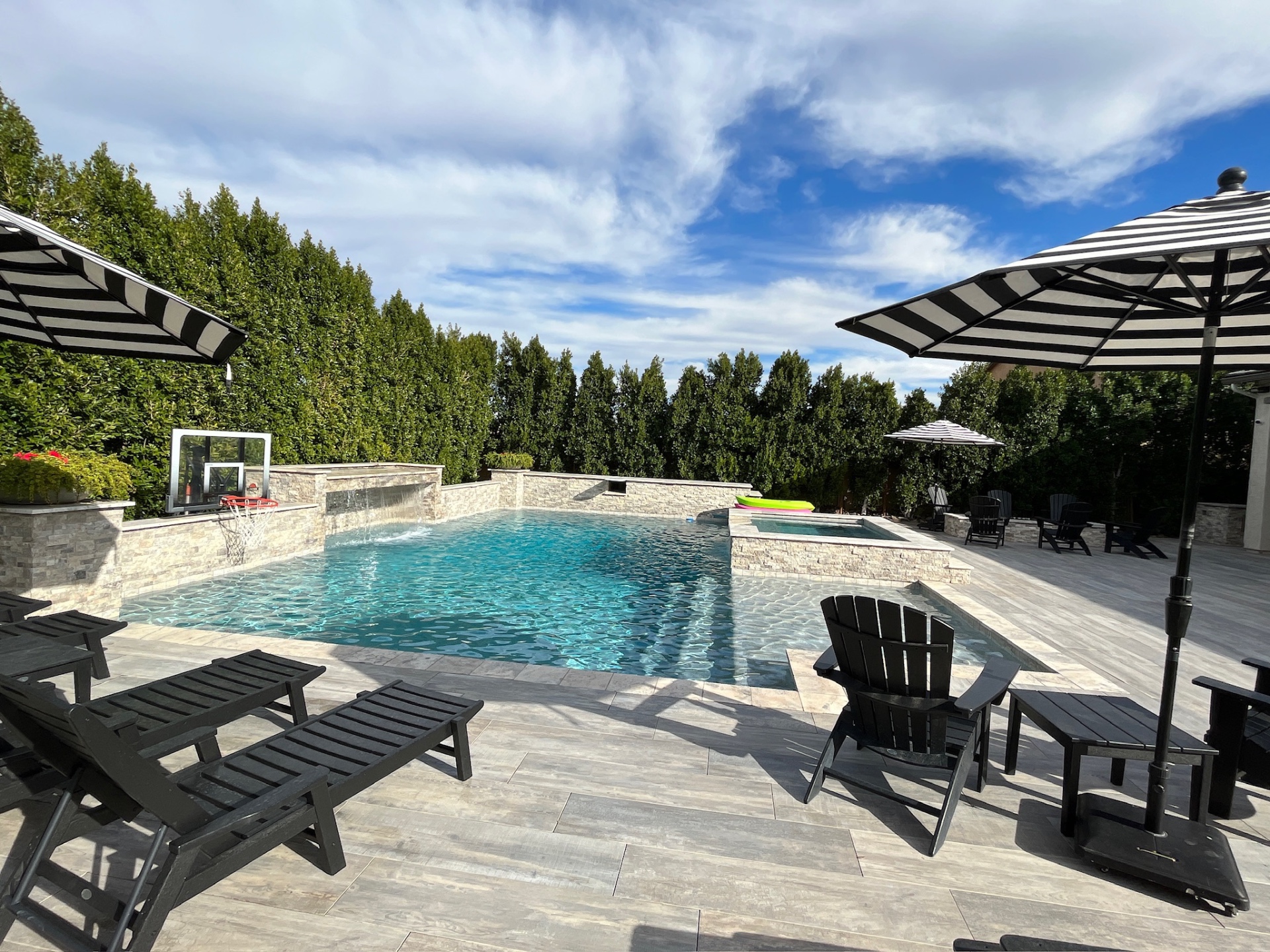 Blackstone at Vistancia · Peoria, AZ
Blackstone at Vistancia Backyard Resort
Recorded scope: Custom Pool, Raised Spa, Travertine Pavers, Artificial Turf, Fire Features, Landscape Lighting, Glass Fencing.
See the full project record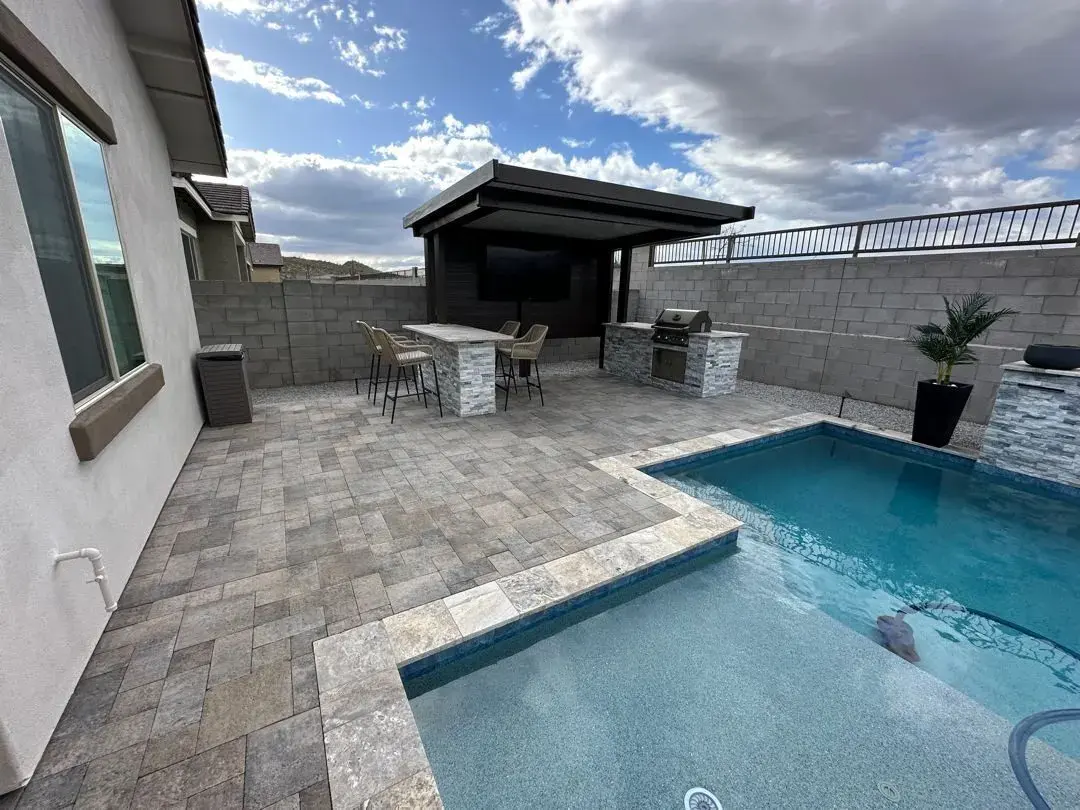 Trilogy at Vistancia · Peoria, AZ
Trilogy at Vistancia Outdoor Living Upgrade
Recorded scope: Outdoor Kitchen, BBQ Island, Paver Patio, Shade Pergola, Landscape Lighting.
See the full project record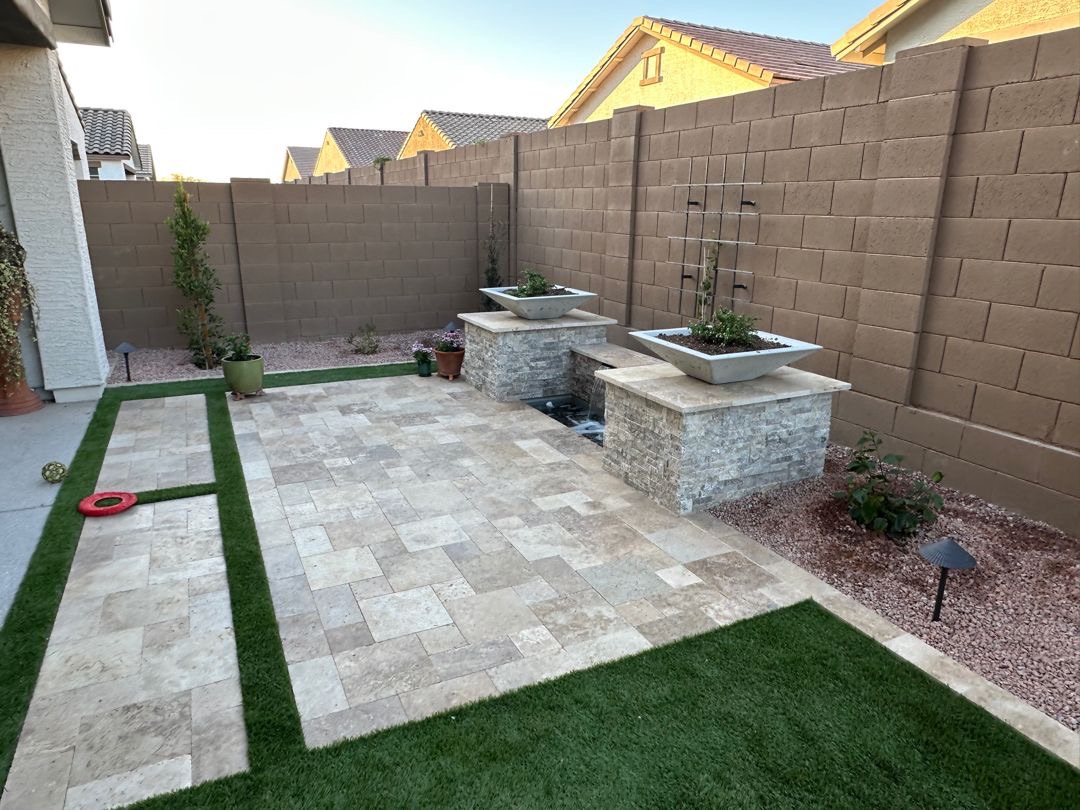 Peoria · Peoria, AZ
Hayes Residence — Peoria Side-Yard Courtyard
Recorded scope: French-Pattern Travertine Paver Patio, Stacked-Stone Spillway Water Feature, Twin Planter Columns with Travertine Caps, Artificial Turf Runway with Paver Borders, Covered Patio with Flake-Coat Concrete Finish, Decomposed Granite Beds & Desert Planting, Steel Wall Trellises, Low-Voltage Path Lighting.
See the full project record
Building outside Peoria? Start with your city
This checklist works anywhere in the West Valley, but permitting, HOA submittal, and site conditions are set locally. If your project is in one of these cities, the city hub is the right next step — it collects the services, local considerations, and recorded work for that area.
- Outdoor living in SurpriseSurprise services, local build considerations, and the city's permitting and HOA path.Continue
- Outdoor living in GoodyearGoodyear services and what changes on Estrella-area and newer-community lots.Continue
- Outdoor living in BuckeyeBuckeye services, including Verrado-area design review and lot conditions.Continue
Frequently asked
- How do I choose the best outdoor living company in Peoria?
- Verify five things in writing before you sign: an active Arizona ROC license whose classification covers your scope, a current certificate issued by the insurance producer whose named insured matches the legal entity on the contract, a written statement of who performs and who coordinates each trade, a written material and build specification that includes drainage and elevations, and a payment schedule tied to completed work — for a qualifying owner-occupied residential in-ground pool or spa contract, within the stage maximums in A.R.S. §32-1158.01. Then confirm recent verifiable Peoria-area work, the written warranty and service path, and in-person access to real samples. Apply the same checklist to every company, including AE. AE publishes this guide and competes for this work; we do not rank or grade other companies.
- Do I need a permit for a pool, patio cover, or outdoor kitchen in Peoria?
- It depends on the scope, and the City of Peoria decides. Structures, electrical, gas, and pool work commonly involve plan review, and your HOA may have a separate design review. Confirm requirements through the City of Peoria's plan review and permits page and get permit and HOA responsibility assigned by name in your contract. No contractor can guarantee a permit outcome, a review time, or an HOA approval in advance.
- How tall does a glass pool fence need to be in Peoria?
- Confirm the required height with your municipality or the authority having jurisdiction, and with your HOA and insurer where relevant, before anything is fabricated. Arizona A.R.S. §36-1681(B)(1) states at least five feet for barriers within that statute's scope, and AE's baseline recommendation for a pool barrier is a five-foot system — but local ordinances, project classification, existing conditions, and the approved documents control the final requirement. No barrier is childproof or a substitute for supervision: designate an undistracted adult Water Watcher whenever children are in or near water.
- How do I check a contractor's ROC license in Arizona?
- Search the ROC's public contractor search for the exact legal entity or license number on your contract, then review status, classification, issue and expiration dates, and the other information the ROC actually publishes. Search any prior entity or qualifying party separately and verify you have the right identity before drawing a conclusion. The absence of a public record does not prove there was no private dispute, and court records are maintained separately, may be incomplete, and need the same identity and context check.
- What insurance should a West Valley pool or landscape contractor carry?
- Ask for a current certificate issued by the insurance producer and verify that the named insured matches the legal entity on the contract, along with policy types, effective dates, and limits. A certificate is evidence of coverage on its issue date; it does not change the policy, and certificate-holder status alone does not create coverage or additional-insured rights. If the contract or your insurer requires additional-insured status, a waiver of subrogation, or another endorsement, ask the producer to confirm the endorsement itself. Common items to review include commercial general liability, workers' compensation as required by Arizona law, and applicable auto coverage. A "1099" label does not by itself establish classification or insurance status, so ask how subcontractors document coverage. If coverage is missing or disputed, ask an insurance professional or attorney about the specific exposure.
- How long does HOA review take in Vistancia, PebbleCreek, Estrella, or Verrado?
- Requirements and review calendars differ between associations and change over time, so ask your HOA or its management company for the current guidelines, forms, review calendar, and its own estimate of the timeline — and treat that estimate as a scheduling assumption, not a commitment. Get it stated in writing who prepares the packet, who submits it, and who responds to review comments. Recent same-community experience may help packet completeness, but no contractor can guarantee a review time or an approval outcome.
- How should payments be structured on an Arizona pool contract?
- For a qualifying owner-occupied residential in-ground swimming pool or spa contract, A.R.S. §32-1158.01 sets maximum amounts by stage: not more than 15% at contract execution; not more than 25% after excavation; not more than 25% after steel, plumbing, and pneumatically applied concrete are installed, or after installation of a prefabricated pool or spa; not more than 25% after decking; and the remaining original contract sums before the interior finish is applied, plus approved written change orders. Where the purchaser requires a payment and performance bond, the statute permits a different agreed schedule. Read the statute, and remember your signed contract and current law control. For work that is not a pool or spa contract, payment triggers should be clear and reasonably tied to completed work.
- What are my options if a contractor damages my property in Arizona?
- Available remedies depend on your contract, the facts, the nature of the damage, any notice or deadline requirements, and the dispute-resolution terms you agreed to. Review the Arizona Registrar of Contractors complaint process for licensed work, and consult Arizona construction counsel about your specific dispute. This page is education, not legal advice.
- Where can I find complaints against Arizona contractors?
- The Arizona ROC publishes information about licensed contractors, including the complaint information the agency makes public. Court records are maintained separately, may be incomplete, and require you to verify identity and context before drawing a conclusion. The absence of a public record does not prove there was no private dispute.

David "Dave" Bell
Dave is the owner of AE Outdoor Living in Peoria, Arizona and the current president of the Southwest Hardscape Association — 13 years on the board, 15 years involved. He has designed and built outdoor environments across Greater Phoenix since 2005.