AE Outdoor Living
Arizona licensed, bonded & insuredServing Arizona homeowners since 2005Peoria design showroomWritten, itemized project scopesProject-specific payment & warranty terms
DIY Learning Center

Build it yourself. The right way. Real specs from the crew that does it for a living.

Step-by-step guides for the outdoor projects most homeowners can pull off in a weekend or two — written by AE Outdoor Living, taught the same way we teach our own crew. Every guide lists the real tools, the real materials, the real Arizona-specific spec, and the part people skip that always comes back to haunt them.

The honest version: Most contractors won't publish this. They're afraid you'll cancel the quote. We're not. If you have the time and the curiosity, build it yourself — we'd rather you do it right than do it wrong. If it gets bigger than a weekend, hand it to us. Either way, you'll know what 'right' looks like.
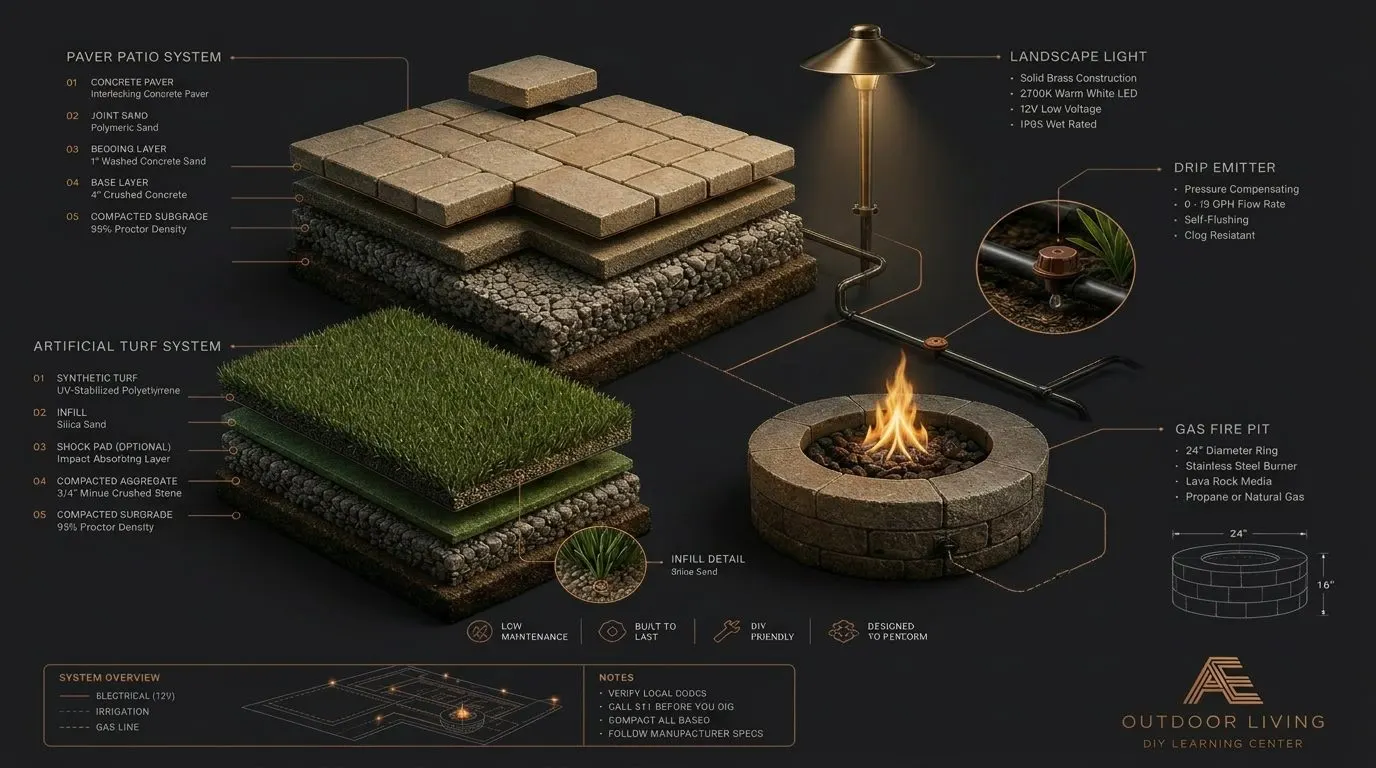
AE Outdoor Living DIY Learning Center — branded exploded diagram showing paver patio, artificial turf, brass landscape light, drip emitter, and gas fire pit components
AE Outdoor Living DIY Learning Center — every guide is built off the same engineering specs we use on installed jobs.
01

What's actually in the DIY Learning Center

Every guide here is the same spec we'd use on a real install — written so you can build it yourself. No watered-down 'consumer version,' no skipped steps to avoid scaring you off. The investment numbers are what materials and tool rentals actually cost in Phoenix this season. The tips and the 'common mistakes' lists come straight from the rescue jobs we've taken over from other people's weekend projects.

02

How to use these guides

  • Read the full guide before you buy anything. The tool list at checkout is cheaper than the tool list at hour three of the project.
  • Check the difficulty rating honestly. 'Intermediate' means you've done at least one similar project — not that you've watched videos.
  • Buy the right material the first time. The most expensive part of every DIY rescue we do is tearing out the wrong base, wrong sand, wrong wire gauge, wrong turf seam tape.
  • If a section of the guide says 'this is the part people skip' — that's the part that fails. Don't skip it.
  • When in doubt, photograph and call. A 5-minute phone consult has saved homeowners thousands of dollars in our DMs every month.
03

What we'd never recommend you DIY

  • Pools and spas — engineering, permits, $80k+ on the line.
  • Structural retaining walls over 3 feet — engineered design + permits required in most Arizona jurisdictions.
  • Glass pool fences — life-safety barrier; see our core-mount vs bolt-down comparison for why even pro installs fail.
  • Paver driveways — 4–6" ABC + compaction + edge restraint at vehicle loads is not a weekend project.
  • Permanent holiday lights on a 2-story roof — fall risk is real; let us hang them on the AE LEDs track and you keep them year-round.
  • Anything tied into a main gas line — gas pit stub-outs from an existing accessible line are fine; new main runs need a licensed plumber.
  • Electrical above 12V landscape lighting — line-voltage outdoor lighting, sub-panels, EV chargers need an electrician.
04

Why we built this

Our founder David Bell has been doing outdoor work in Arizona for 15 years (currently President of the Southwest Hardscapes Association). The single biggest thing he learned: homeowners don't usually want the lowest-priced bid — they want to understand what they're paying for. The Learning Center is the part where you understand. Some readers DIY. Some hand it to us. Some DIY the patio and hire us for the pool. All of that is fine. We didn't build a company that gives back. We built a company on giving back — and free education is part of that.

All DIY guides

DIY Paver Patio

Small backyard patio (under 200 sq ft) — base prep, sand bed, pattern layout, polymeric joints. The whole real spec, not the YouTube shortcut.

Intermediate · Weekend × 2$8–$14 / sq ft DIY

DIY Artificial Turf

Small dog run or play area (under 300 sq ft). Base depth, drainage, seaming, infill, nail-down — and where the cheap turf videos go wrong.

Intermediate · 2–3 days$6–$11 / sq ft DIY

DIY Low-Voltage Landscape Lighting

Plan a 12V path & accent lighting layout, size the transformer, run wire correctly, and avoid voltage-drop dim-out at the far end.

Beginner-friendly · 1 weekend$500–$2,500 kit

DIY Drip Irrigation

Build a real drip zone off your existing hose bib or valve — emitters, GPH math, pressure regulation, and how to keep it from clogging in caliche soil.

Beginner · 1 day$120–$400 per zone

DIY Paver Fire Pit

Build a 36–48" gas or wood fire pit with retaining-wall block — footing, gas stub-out, lava rock, and the safety distances HOAs actually check.

Intermediate · 1–2 days$350–$1,800 in materials

DIY Paver Walkway

The easiest paver project to start with — a 3-4 ft wide walkway from drive to gate or porch to patio. Same spec as a patio, smaller footprint, faster win.

Beginner · 1 weekend$6–$12 / sq ft DIY

DIY Retaining Wall (under 3 ft)

Build a code-compliant retaining wall up to 30" tall — leveling pad, interlocking block, drainage gravel, perforated drain pipe. The hard stop at 3 feet, explained.

Intermediate · 1–2 days$22–$45 / linear ft DIY
FAQ

Common questions.

Because the alternative is letting homeowners learn from a 4-minute TikTok that skips the base prep and ends with a sinking patio. Our position is simple: if you have the time and you want to learn the craft, we'd rather you do it right than do it wrong. And if it gets bigger than a weekend, we're a phone call away. Education first, sales second — that's the brand.

Yes. Every spec is calibrated for our climate, our soils (caliche, expansive clay), our codes, and our HOA realities. ABC depths, sand types, turf cool-fill, lighting wire gauges, drip emitter ratings, fire-pit setbacks — all written for Phoenix metro, not a generic national audience.

No. We point you at the real product names and where to get them (Home Depot, Ewing, SiteOne, Ferguson, AZSod, Phoenix Bond). No affiliate links, no padded supply markup. The price ranges in each guide are real shelf prices in our market.

Send us photos of where you are. We do 'rescue takeovers' regularly — usually a paver patio that bowed on a bad base, a turf install with no drainage, or a lighting run with voltage drop. We'll quote the takeover honestly: sometimes finishing your work, sometimes redoing the part that's wrong.

Yes. Pools, structural retaining walls over 3 feet, glass pool fences (life-safety barrier), permanent holiday lighting on a 2-story roof, anything tying into a main gas line, and paver driveways. Each of those has a real failure cost — drowning, collapse, fire, electrocution, or a $20k rebuild — that's not worth the savings. We say so on every relevant page.

Done right, yes — a clean paver patio and lit, drip-irrigated landscaping read as 'maintained' to appraisers and buyers. Done wrong (settling pavers, dead turf seams, exposed wire), they read as deferred maintenance and discount the home. The DIY savings disappear if a buyer's inspector flags the work.

Short version: paver patios and walkways at grade almost never need a city permit in Phoenix, Scottsdale, Mesa, Chandler, Gilbert, Tempe, Peoria, or Surprise — but most HOAs require an architectural review form with a site plan and material spec before you break ground. Retaining walls 30 inches and taller (measured from the bottom of the footing to the top of the wall) DO require a permit and usually engineered drawings in every Valley jurisdiction we work in. Fire pits don't need a city permit, but you must verify setbacks: typically 10 ft from any structure, 10 ft from a property line, and 25 ft from a pool equipment pad with gas. Gas stub-outs tied to a new main line require a licensed plumber and a gas permit — no exceptions. When in doubt, call your city's building department before you dig; the call is free and the re-do is not.

October through April is the sweet spot for everything outdoor in the Valley. Polymeric joint sand activates correctly between 32°F and 90°F — install pavers in July and the polymer sets before you've finished sweeping. Artificial turf is the same: the backing can hit 160°F+ on a summer install and your seams won't bond cleanly. Low-voltage lighting and drip irrigation are technically year-round, but you don't want to be trenching in caliche at 112°F. If you have to install in summer, work the first 3 hours after sunrise, hydrate hard, and skip polymeric sand days where the surface temp will exceed 90°F before you can soak it in.

Buy: rubber mallet ($18), 4-ft level ($35), screed boards (free — scrap 2x4), tape measure, contractor wheelbarrow, masonry chisel and 3-lb hammer, knee pads (your future self will thank you), and a $40 angle grinder with a diamond blade for paver and block cuts. Rent: plate compactor ($55–$75/day at Home Depot — non-negotiable for paver and turf base), wet saw if you're doing a lot of curve cuts ($65/day), trenching shovel or mini-trencher for lighting and drip ($85/day). Skip: paver splitter rentals (the angle grinder does the same work for less), gas tampers (overkill for residential), and 'paver edging kits' from big-box (use spiked steel edge restraint from Ewing or SiteOne, half the price and twice the hold).

Almost never on the insurance side — homeowner's policies in Arizona don't care who installed your patio, turf, or lighting, as long as the work is to code. The exceptions: structural retaining walls over 3 ft (a wall failure that damages a neighbor's property can become a liability claim, and insurers can deny it if the wall wasn't permitted), and gas fire pit lines tied to your main without a permit (a leak fire is the fastest way to get a claim denied). Home warranties (the separate service plans like AHS or Choice) typically won't cover DIY work at all — anything they categorize as 'owner-installed' is excluded from the start, so don't expect a warranty to pick up a settling patio. If you're planning to sell within 2 years, photograph every layer as you build it (base, sand, polymeric, drainage gravel, drain pipe, wire runs) — that documentation has saved multiple homeowners we know from inspection re-negotiations.

Started a project and want a pro takeover?

Send photos of where you are — we'll quote it honestly. Sometimes that's finishing your work, sometimes that's redoing the part that's wrong. No judgment, no pressure.

Get an Honest Quote
Your home investment — protected

Why this is an investment, not a cost.

An AE backyard is engineered to add daily livability and long-term home value. We publish honest ranges and build to code with a licensed and bonded Arizona crew. AE provides project-specific workmanship and manufacturer-warranty information in the signed agreement. Website summaries are for planning only.

  • Licensed, bonded & insured in Arizona. ROC 340966 (R-62) · ROC 341002 (R-3) · ROC 347738 (KA-5) · ROC 211530 (CR-21). Most Arizona contracting work valued at $1,000 or more — or requiring a permit — must be performed by a properly licensed contractor, subject to statutory exemptions. Verify the legal entity, license status, and classification with the Arizona Registrar of Contractors.
  • Real ranges, itemized scope. You see materials, finishes, equipment models, and a line-item budget before you sign — not a one-line "pool — $90,000."
Related guides

Keep learning before you build.