Install artificial turf the right way — project-specific base, seams, and infill.
A small DIY turf area — dog run, side yard, kids' play zone under 300 sq ft — is a real weekend project. Bigger than that, you're racing the Arizona sun and the seam adhesive's open time. This guide covers the general approach we take on installs: base sized for the site, the right adhesive, the right infill, in the right order.
- AZ ROC 211530 · 347738 · 341002 · 340966
- Arizona-built since 2005
- President, Southwest Hardscapes Association
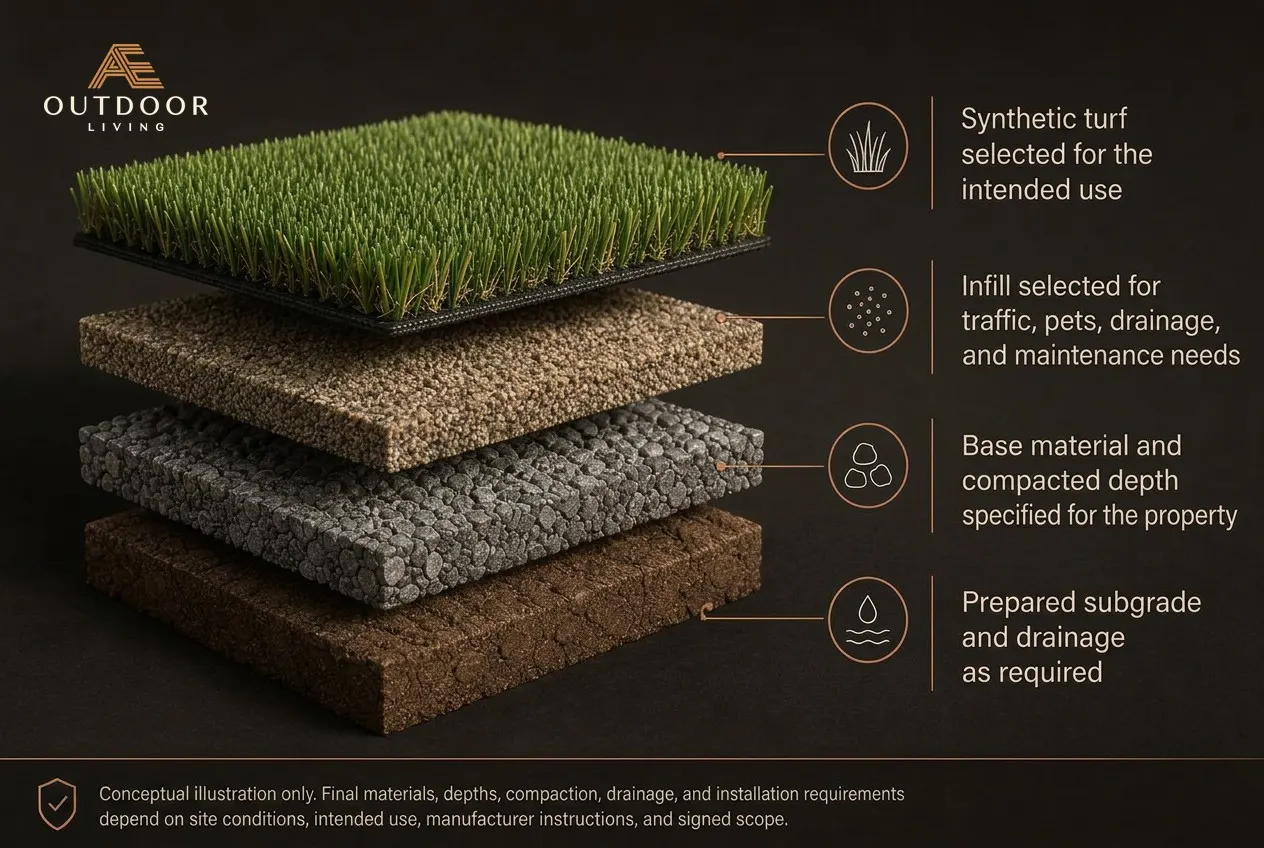
The base is a major driver of the outcome
Artificial turf is a finished surface stretched over a base — like pavers, like tile, like carpet. Quarter-minus (decomposed granite) is one common turf base material, but the correct base material, depth, compaction target, grading, and drainage strategy depend on the site's soil, intended use, drainage requirements, manufacturer instructions, and applicable local standards. Woven weed barrier is placed between subgrade and base.
What separates a clean install from a rough one
Three things: seam discipline, infill discipline, and edge nailing. Seams done with proper urethane adhesive and a reinforced tape strip stay tight and become far less visible than seams glued with the wrong product. Infill installed in multiple passes with a power-broom between them stands blades up; installed in one heavy dump, it can mat the pile down. A perimeter nailed at close centers stays tight; nailed too sparsely, corners can curl up.
When you should hand this one to us
- Install over 600 sq ft — the rental costs and labor curve start losing to a pro quote.
- Pet-specific zones over 200 sq ft — drainage and odor control benefit from the AE Pet Turf Infiltration System.
- Putting greens — different turf, different infill ratios, different fringe work. Specialty install.
- Steep slopes, multi-level transitions, or integration with existing landscape lighting / irrigation that needs to be re-routed.
- Tiered backyards or anywhere a retaining wall needs to be built before the turf goes down.
Tools you'll need
- Plate compactorRentableSame as for pavers — 3,000 lb force class minimum.$70/day rental
- Sod cutter (if removing grass)RentableSlices existing turf for easy roll-up.$80/day rental
- Power broomRentableStands turf blades up after install and works infill into the pile. Don't skip this — it's the difference between a matted look and a real lawn look.$75/day rental · $300 buy
- Carpet kicker / turf stretcherRentablePulls turf tight before nailing edges.$25/day rental
- Razor knife + extra hook bladesCut from the BACK of the turf, between rows of stitching.$35
- 5" galvanized landscape nails (6" for sandy soil)Every 4-6" around the perimeter, 12-18" through the field.$25/box of 50
- Rubber malletDriving nails without splitting the backing.$15
- Drop spreaderEven infill distribution.$60
- Garden rake + flat shovel + wheelbarrowBase spreading.$120 total
Rentable items are available at most Home Depot / Sunbelt locations by the day.
Materials
- Base material (e.g. quarter-minus / decomposed granite)Quarter-minus is one common turf base material. Final base material, depth, compaction target, and grading depend on the property's soil, intended use, drainage requirements, manufacturer instructions, and applicable local standards.$30–$45 per ton delivered
- Turf (face weight and pile selected for the use)Product selection depends on intended use, traffic, pets, sun exposure, and manufacturer options. Pet-conscious lines typically use flow-through backing.$3.50–$6.50 per sq ft
- Seam tape + seam adhesive5–6" wide reinforced seam fabric + turf-specific urethane adhesive per manufacturer instructions.$0.50 per linear ft seam
- Infill — silica sand, ZeoFill, or manufacturer-recommended blendInfill weight per square foot depends on the selected turf and use. Sand is the common baseline; zeolite blends are one option for pet zones.$0.50–$1.10 per sq ft installed
- Weed barrier (woven, NOT spun)Between subgrade and base.$50 for 4×100 ft roll
- Bender board or metal edge (optional)Hard line between turf and adjacent landscape — cleaner finish than 'tucked' edges.$8 per 8 ft
Planning example: 300 square feet at the typical $11–$18 installed range equals approximately $3,300–$5,400 before separately quoted demolition, specialty drainage, pet-system upgrades, putting-green work, or unusual site conditions. A DIY install typically saves on labor but shifts equipment rental, sourcing, and warranty risk to you.
Mark the area. Call Arizona 811. If you have an existing irrigation zone in the install area, cap the heads now or you'll be cutting valves into your new turf later.
Sod cutter takes existing grass off in strips (rent the gas-powered one — the manual is a punishment). For dirt or existing granite, skim to make room for the new base at the depth you're planning for the site.
Drainage matters more than people think — turf is a barrier surface, water has nowhere to go but the lowest point. Slope away from the house per your drainage plan. Standing water under turf can grow mildew and hold odor.
Woven fabric, edge-to-edge, lap seams 6". Pin every 3 ft.
Spread the selected base material in even lifts, water-mist lightly, and compact each lift in two perpendicular passes. Final depth, compaction target, and grading should follow soil conditions, drainage requirements, and manufacturer instructions. Final grade should mirror your slope exactly — turf doesn't smooth out a wavy base, it telegraphs every bump.
Unroll all panels in their final orientation (grain direction must be consistent — pile always 'leans' one way; if you flip a panel, the color will look different). Let panels sit in the sun 2-4 hours to relax wrinkles before cutting or seaming.
Trim edges from the BACK of the turf with a sharp hook blade, cutting between rows of stitching so you don't leave bald lines. For seams: butt the two cut edges within 1/16" (no overlap, no gap), lay seam tape underneath shiny-side down, apply S-shaped beads of adhesive, press the turf into the adhesive, and weight the seam for 30 minutes.
Carpet kicker to pull each panel tight. 5" galvanized landscape nails every 4-6" around the perimeter, driven flush (not into) the backing.
Through the body of the turf, every 12-18" in a diamond pattern. Drive nails into the V between blades so they disappear.
Run the power broom first to stand blades up. Drop-spread infill in multiple passes per the turf manufacturer's spec, brooming between each pass to drive infill down to the backing. Final infill depth: blades stand up but tips of infill aren't visible. Over-infilling looks 'frosted.'
One last power-broom pass. Rinse with a hose to settle infill and clean any cut debris. Done.
Pro tips from our crew
- Always run turf grain in the same direction. The blades are directional — flip one panel and you've created a visible 'seam line' that no amount of brushing fixes.
- Seam adhesive sets fast in Arizona heat. Work in short sections and don't lay more adhesive than you can press into within a few minutes.
- Use two passes of infill, not one. The first pass settles to the backing; the second pass stands the blades. One heavy dump can leave a matted or frosted look.
- Pet-conscious turf has perforated backing — don't tape over the perforations on seams, they're your drainage path.
- For high-shade or low-drainage spots, consider a layer of pea gravel under the base for extra water capacity.
- Artificial turf can become dangerously hot in direct Arizona sunlight. Surface temperature varies with product, color, infill, shade, airflow, and weather. Always test the surface before allowing children or pets onto it.
Common DIY mistakes we get called to fix
- Under-thickness or under-compacted base. Turf sits on a graded, compacted base for a reason — a base that isn't sized and compacted for the site can settle and telegraph unevenness over time.
- Using the wrong base material for the application. Base material selection depends on drainage, intended use, and manufacturer instructions; a material that works for one application is not automatically correct for another.
- No slope. Water pools, mildew grows, odor follows.
- Skipping the power broom and the infill pass. Without infill standing the blades up, turf can read matted from day one.
- Seaming with regular contact cement or 'all-purpose' adhesive. Turf-specific seam adhesive (moisture-cure urethane) is what manufacturers spec for AZ heat.
- Mixing turf rolls from different production batches without checking. Dye lots vary — always order all your turf from one batch and confirm it on the invoice.
- Nailing into the blades. Nails go in the V between rows so the green hides them.
- Dark or 'designer' colors in high-sun areas without shade, rinsing, or cooling-focused infill. Dark surfaces can get very hot in direct Arizona sun; plan for use and test before pets or children walk on them.
More DIY & related services
If your turf install starts feeling like more than a weekend, that's normal.
Most homeowners who start one of these projects finish it. Some realize halfway in that the prep, the equipment rental, or the physical scale isn't worth their Saturday. No judgment — we built our business on doing it right the first time. If you'd rather hand it off (or you've started and want a clean takeover), send a few photos and we'll quote it honestly.
Common questions.
Need a pet-friendly zone, putting green, or bigger install?
Larger turf installs and pet-specific drainage systems are where pro install really pays off. Send dimensions and a few photos — we'll quote it honestly and explain the AE Pet Turf Infiltration System if it applies.
Get a Turf QuoteWhy this is an investment, not a cost.
An AE backyard is engineered to add daily livability and long-term home value. We publish honest ranges and build to code with a licensed and bonded Arizona crew. AE provides project-specific workmanship and manufacturer-warranty information in the signed agreement. Website summaries are for planning only.
- Licensed, bonded & insured in Arizona. ROC 340966 (R-62) · ROC 341002 (R-3) · ROC 347738 (KA-5) · ROC 211530 (CR-21). Most Arizona contracting work valued at $1,000 or more — or requiring a permit — must be performed by a properly licensed contractor, subject to statutory exemptions. Verify the legal entity, license status, and classification with the Arizona Registrar of Contractors.
- Real ranges, itemized scope. You see materials, finishes, equipment models, and a line-item budget before you sign — not a one-line "pool — $90,000."
Plan your investment with a designer.
Five minutes, a real range, and no sales pressure. Or vet any Arizona contractor (us included) before you spend a dollar.