
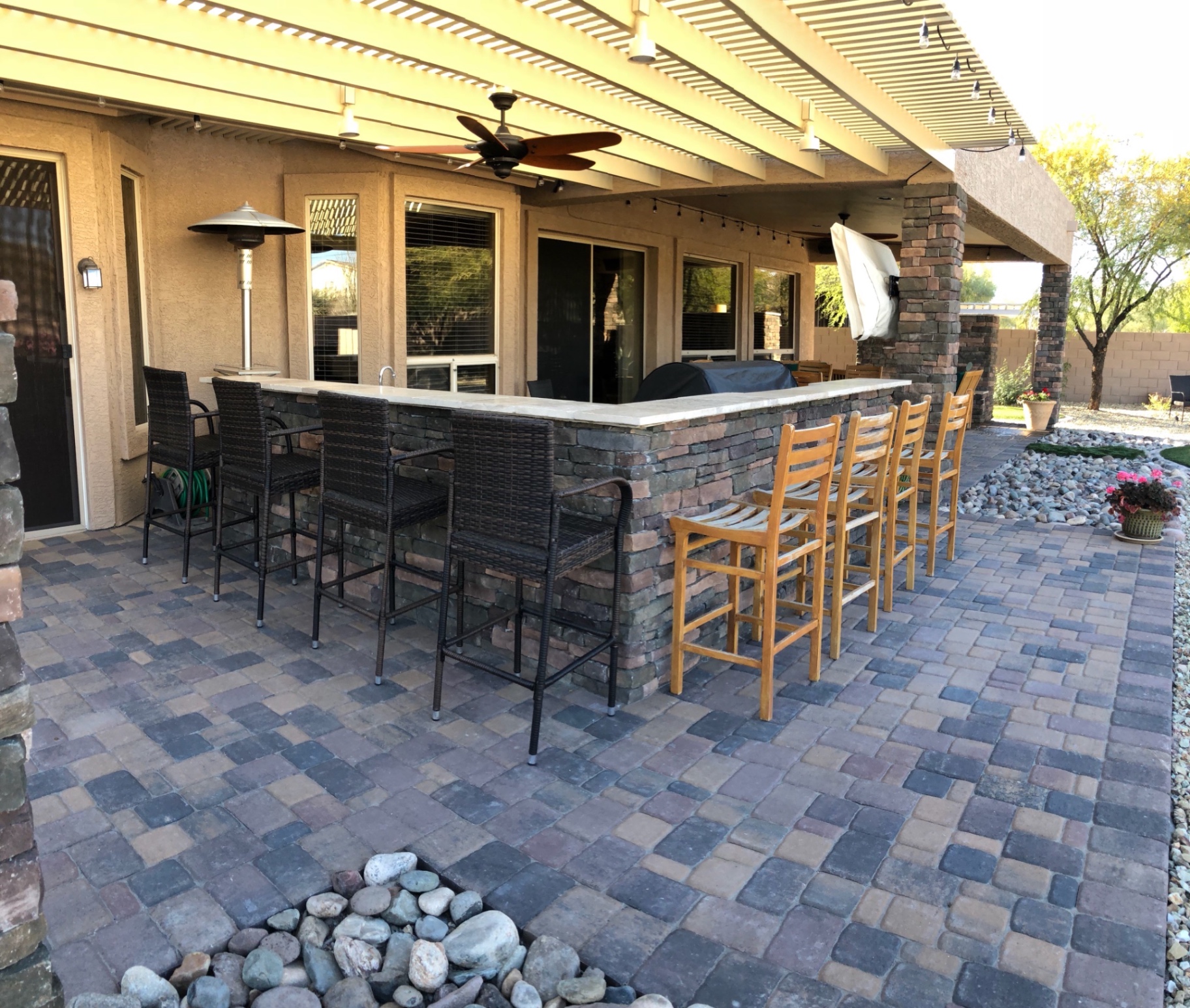
What Homeowners See Is Only the Top Layer
A homeowner normally chooses pavers by looking at color, texture, size, pattern, and price. Those choices matter, but they are not what determines whether a driveway stays flat or whether a patio starts developing low spots.
Most of the long-term performance comes from the part of the project that gets buried.
A conventional interlocking paver system includes prepared soil, a structural aggregate base, a separate bedding layer, edge restraint, the pavers themselves, and properly installed jointing material. Each layer has a different job.
When one material is expected to do every job, the installation may look finished on day one but lack the structure we want underneath it.
At AE Outdoor Living, we would rather explain the hidden cost upfront than save money by burying a shortcut.
What Is 1/4-Inch Minus?
The word “minus” is important. It means the material includes everything smaller than the stated screen size.
With 1/4-inch minus, the largest particles are approximately 1/4 inch, but the blend also contains much smaller particles and fine material. Depending on the source, the exact gradation can vary.
Quarter-minus is easy to spread, easy to shape, and capable of producing a tight, smooth-looking surface. That is part of why it is tempting to use.
But a surface that looks smooth and feels hard is not automatically the same thing as a properly built structural base.
The structural base beneath pavers needs to distribute loads, remain stable under repeated use, and support the bedding layer without relying on the pavers to hide imperfections. AE specifies an aggregate base with a broader, controlled gradation and larger angular particles for that role.
Why Do Some Installers Put Quarter-Minus Under Pavers?
Quarter-minus can be attractive to an installer because it spreads quickly and is easy to fine-grade. It may also reduce excavation, material volume, trucking, and labor compared with a deeper structural-base installation.
Those are real production advantages for the installer. They are not proof that the material is the right structural base for the project.
Homeowners rarely see the base once the job is complete. Two proposals can therefore appear to include the same pavers while covering completely different preparation underneath them.
That is why the lowest square-foot price does not always represent the same installation.
“You are not only buying the paver. You are buying everything the contractor is willing to bury underneath it.”
Why AE Does Not Use 1/4-Inch Minus as the Structural Base
1. It Is Not the Structural Gradation We Specify
AE uses a properly specified aggregate base course for the structural layer. A broader range of angular aggregate creates the load-supporting structure we want beneath the bedding material and pavers.
Quarter-minus is dominated by smaller particles. We do not treat it as an interchangeable substitute for the structural aggregate base called for in our conventional installations.
2. “It Compacts Hard” Is Not Enough
Quarter-minus can feel extremely hard after it has been placed and compacted. That observation by itself does not establish that the layer has the correct gradation, depth, density, moisture condition, or load-carrying behavior for the application.
The base must be evaluated as part of the entire pavement system—not by whether a boot heel leaves a mark on installation day.
3. Fine-Rich Material Can Be More Sensitive to Moisture
Materials containing a high percentage of fine particles have small pore spaces and can hold moisture differently than a properly specified base assembly.
Moisture beneath pavers is not controlled by one material alone. Surface slope, drainage planning, soil conditions, irrigation, compaction, edge details, and the complete pavement design all matter.
AE plans the grade and base as a system instead of assuming one thin, tightly graded layer will solve every condition.
4. An Arizona Paver Manufacturer Specifically Warns Against It
Phoenix Paver’s Arizona installation guidance tells installers to specify ABC material for the base and warns that 1/4-inch minus may slump over time and contribute to surface problems associated with efflorescence.
Efflorescence is the white or chalky deposit that can appear when moisture carries dissolved salts to the surface. Quarter-minus is not the only possible source of efflorescence, but moisture movement and material selection are both reasons to build the underlying system correctly.
5. The Shortcut Can Stay Hidden Until After the Final Payment
The frustrating part of a poor base is that it can be invisible at first. The pavers may initially look straight, clean, and level.
Movement tends to reveal itself later through rocking pavers, wheel-path settlement, low spots, joint-sand loss, uneven borders, or water collecting where it should not.
Repairing those symptoms often requires lifting the pavers and correcting the buried work. That is why AE focuses on the base before the decorative surface goes down.
1/4-Inch Minus, ABC Base, and Bedding Sand Are Not the Same Thing
- Primary role
- Fine grading or other material-specific applications — not AE's structural paver base
- Characteristics
- Particles approximately 1/4 inch and smaller, including fines; easy to spread and shape
- AE's use
- Not used as the structural base beneath a conventional paver installation
- Primary role
- Structural base course
- Characteristics
- Broader controlled gradation with larger angular aggregate and fines designed to compact as a stable base
- AE's use
- Installed at the project-specific depth, moisture-conditioned as needed, graded, and compacted in controlled lifts
- Primary role
- Thin setting and bedding layer immediately below the pavers
- Characteristics
- Consistent material selected for the paver system; not intended to replace the structural base
- AE's use
- Screeded as a separate layer over the completed structural base
Material names and gradations can vary by supplier and region. The approved project specification, manufacturer guidance, expected load, and actual site conditions should control the final assembly.
What a Proper Conventional Paver System Looks Like
What AE Outdoor Living Installs Instead
There is no single base depth or construction detail that is correct for every Arizona yard. A pedestrian patio, pool deck, walkway, and vehicle driveway should not automatically receive identical preparation.
AE evaluates the application and builds the system around the expected use and actual site conditions.
- 1
Evaluate the Existing Site
We look at the existing soil, elevations, access, drainage direction, irrigation, adjoining concrete, pool structures, gates, walls, and the loads the finished surface will carry.
- 2
Excavate for the Complete Assembly
Excavation must account for the prepared soil, compacted structural base, bedding layer, paver thickness, and final elevation. Simply scraping enough soil away to hide the paver is not a complete base plan.
- 3
Prepare the Subgrade
Loose or unsuitable areas are addressed before the base goes in. Separation fabric, stabilization, or additional excavation may be appropriate in certain conditions, but those measures should be selected for the site rather than installed as a meaningless one-size-fits-all add-on.
- 4
Place the Structural Aggregate Base in Controlled Lifts
The structural base is placed in manageable layers instead of dumping the entire depth at once. Each lift can then be graded, moisture-conditioned when necessary, and compacted before the next lift is added.
- 5
Establish the Finished Grade and Drainage
The base controls the final plane of the pavers. We establish the slope before the decorative surface is installed so water is directed away from structures and does not collect in preventable low areas.
- 6
Install a Separate Bedding Layer
The bedding layer provides the final setting bed for the pavers. It is kept consistent and is not expected to correct a poorly graded structural base.
- 7
Install the Pavers, Edge Restraint, and Jointing Material
The pavers are laid in the approved pattern, cut cleanly at boundaries, restrained at exposed edges, compacted as appropriate for the product, and completed with the specified jointing material.
How Deep Should the Base Under Pavers Be?
There is no honest universal answer.
The required depth depends on factors including:
- Patio, walkway, pool deck, courtyard, or driveway use
- Pedestrian versus vehicle loading
- Soil strength and consistency
- Existing fill or disturbed soil
- Drainage conditions
- Paver type and manufacturer requirements
- Large vehicles, trailers, RVs, or concentrated loads
- Project-specific engineering or municipal requirements
Driveways and other vehicle areas generally require more structural support than a lightly used pedestrian patio.
AE determines the assembly after evaluating the project. We do not advertise one base depth as the answer for every yard.
The correct question is not only, “How many inches are included?” It is, “What material is being compacted, in how many lifts, over what soil, and for what load?”
Does Every Paver Installation Over Quarter-Minus Fail?
No material fails on a timer.
An installation may appear stable for a long period depending on the soil, load, moisture exposure, material source, depth, compaction, edge restraint, and how the area is used.
AE's standard is not based on whether a shortcut might survive under favorable conditions. Our standard is based on whether we believe the complete assembly is appropriate, defensible, and something we are prepared to stand behind.
That is why we do not use 1/4-inch minus as the structural base in our conventional paver installations.
Should You Tear Out Existing Pavers Just Because Quarter-Minus Was Used?
Not automatically.
Do not tear apart a functioning surface solely because someone identifies the material underneath it as quarter-minus.
Instead, look at actual performance. Warning signs can include:
- Pavers that rock when stepped on
- Visible wheel-path settlement
- Low areas that collect water
- Borders moving outward
- Repeated joint-sand loss
- Uneven transitions at concrete or coping
- Pavers sinking near downspouts or irrigation leaks
- Recurring surface deposits or staining that need diagnosis
If the surface is performing well, monitor it and correct drainage or irrigation problems before they become larger issues.
If there is active movement, the correct repair may require lifting the affected pavers, identifying the cause, rebuilding the base, and resetting the surface. The repair should address the cause rather than only adding more joint sand on top.
Questions to Ask Before Hiring a Paver Contractor
- 1.What exact material will be used for the structural base?
- 2.Is the base material listed by name in the written proposal?
- 3.What will the compacted base depth be for this specific application?
- 4.Will the base be installed and compacted in multiple lifts?
- 5.How will the existing soil and soft areas be evaluated?
- 6.What material will be used for the separate bedding layer?
- 7.How will the finished slope and drainage be established?
- 8.What type of edge restraint will be used?
- 9.What jointing material is included?
- 10.Are vehicle areas being prepared differently from pedestrian areas?
- 11.What manufacturer installation requirements apply to the selected paver?
- 12.What workmanship warranty covers settlement or movement?
- 13.If geotextile or stabilization is included, what site condition is it addressing?
- 14.Who is responsible for repairing irrigation, drainage, or utility conflicts discovered during excavation?
A professional contractor should be able to answer these questions clearly. “That is how we always do it” is not a specification.