
Pool and Outdoor Living Company in Surprise, Arizona
Surprise lots are bigger and newer than the metro average — which means more design opportunity and more surface area to get right. We deliver complete backyards in Marley Park, Sun City Grand, Asante, and the surrounding master-plans.
Surprise — newer construction, larger lots, and outdoor living engineered for the West Valley sun.
What Surprise actually requires
West Valley sun exposure is the most intense in the metro. Material choice matters — we specify pavers and turf that don't read hot, and engineer shade structures that actually shade.
Private HOA/CC&R and ARC requirements — including any age-restricted community standards — vary by property and current governing documents. The owner confirms them directly with the association; city review does not replace private approval. AE assists only where that work is currently offered, accepted and explicitly assigned in the signed scope, and no approval or timing is guaranteed.
City of Surprise Community Development handles municipal permitting, and pool-barrier requirements fall within the scope of ARS §36-1681 plus whatever the city has adopted. AE performs only the work currently offered, accepted and explicitly assigned in the signed scope; the customer confirms the current requirements for the property with the authority having jurisdiction and any HOA/ARC or insurer, and no permit, inspection, HOA, or code acceptance is guaranteed.
Outdoor living scopes delivered in Surprise
The full outdoor living scope, tuned for Surprise lots
Most Surprise projects combine several scopes under one AE crew. Start with a custom pool build wrapped in pavers and travertine hardscape (see why we don't use quarter minus under pavers for the base spec we hold to), add an outdoor kitchen or pergola, finish with desert-smart landscape, artificial turf, landscape lighting, and misting systems for shoulder-season use. Investment ranges live in the pricing guide, and the projects library shows finished work across the Valley — including neighborhoods around Surprise. Before you sign with anyone, run the Surprise contractor vetting checklist.
Plain disclosure: AE Outdoor Living publishes this guide, serves Surprise, and competes for this work. We are not a neutral directory and we do not independently rank Surprise companies. What follows is the verification process we ask homeowners to run on every bid in their stack — including ours. Check us the same way you check everyone else.
How to choose a pool or outdoor living company in Surprise
There is no ranking that settles this. There is a document check. Nine things separate a company that can actually deliver a Surprise project from one that can only sell it — and every one of them is verifiable before you sign.
- 1.The exact ROC entity and classification
Look up the legal entity on the ROC's contractor search — not the brand on the truck, not a DBA on a yard sign. Record the license number, status, issue date, qualifying party, and the classifications held. A classification that covers one trade does not authorize another, and a Surprise whole-yard project routinely crosses pool, hardscape, landscape, structural, and electrical scopes. If one entity does not hold every classification the work needs, ask which licensed entity performs each part.
- 2.Producer-issued insurance evidence
Ask the insurance producer or carrier to send a current general liability certificate and evidence of workers' compensation appropriate to the scope, issued in the same legal entity name that holds the license. A certificate is evidence of coverage at a moment in time; it does not amend the policy, and being listed as certificate holder does not make you an additional insured.
- 3.A written scope with real specifications
Quantities, materials by manufacturer and model, base and bedding depths, equipment by model number, finish selections, electrical and gas provisions, and what is explicitly excluded. If a line reads 'pavers' with a square-foot number and no base spec, you cannot compare it to a bid that publishes one.
- 4.Drainage, elevations, and utilities on paper
Where water goes during a monsoon cell, what the finished elevations are at the house, at thresholds, and at the property line, and where existing utilities, sleeves, and irrigation run. A Surprise lot that drains toward the slab after a new deck is poured is a scope failure, not a weather event.
- 5.Who handles City review, and who handles the HOA
City review and HOA/ARC review are separate processes. Your contract states who prepares, submits, and responds to each. The City and the association control their own outcomes and timing, and neither approval nor a review window is guaranteed.
- 6.Payment milestones you can see
For a licensed contractor's qualifying owner-occupied residential in-ground pool or spa contract, A.R.S. §32-1158.01 limits the payment due on contract execution to 15 percent and ties later payments to the stages listed in the statute, requires written change orders, and provides a bond exception. Your signed contract and current law control.
- 7.A written contract, not a proposal summary
A.R.S. §32-1158 addresses written contract requirements for residential work. Read the actual document. A quote emailed as a PDF with a signature line is not the same thing as a contract with scope, schedule terms, change-order process, and warranty language in it.
- 8.The warranty entity, term, exclusions, and claim path
Identify the legal entity responsible for the workmanship warranty, the term and what starts it, the exclusions, what voids it, how to submit a claim in writing, and what is manufacturer coverage rather than workmanship coverage. Whether a remedy is available depends on the contract, the facts, the entity's status, and applicable law.
- 9.Work you can actually verify
Ask which projects this licensed entity built and in what year, and ask for recent references you may contact with the homeowner's prior permission. You do not need a stranger's address or a drive-by to verify a company — a neighborhood, a month and year, the recorded scope, and a public permit record where one exists will do it.
Every Surprise outdoor living intent, and the one page that owns it
This hub covers choosing a multi-trade outdoor living company in Surprise. It deliberately does not compete with our own service pages. Whatever you are actually shopping for, the page below is the one to read — and each row names what that intent is not, because half of the mismatched calls we take are a searcher who landed one category off.
- Custom pool or pool-and-spa builderPool builder in SurpriseNot pool cleaning, weekly service, or equipment-only replacement.
- Complete backyard, whole-yard design-buildComplete backyard transformationsNot a single-trade install — this is the one-contract, multi-scope path.
- Artificial turf installerArtificial turf installationNot a turf supplier or roll-goods retailer. A supplier sells material; an installer is responsible for base, drainage, seams, infill, and edge detail.
- Pavers, driveways, and hardscapePavers in SurpriseNot stamped or poured concrete, and not a sealing-only service.
- Residential backyard splash padResidential splash padsNot a public park or municipal aquatic splash pad. Public and semi-public facilities fall under different rules than a private residential feature.
- Pergola or ramadaPergolas and ramadas in SurpriseNot a solid-roof patio cover. A louvered or open-top structure and a solid cover are different products with different review paths.
- Solid patio coverPatio coversNot a pergola, shade sail, or retractable awning.
- Permanent trim lightingAE LEDs permanent trim lightingNot landscape lighting. Permanent trim lighting is a fixed architectural track on the roofline and fascia; landscape lighting is a low-voltage ground-plane system.
- Landscape lightingLandscape lighting in SurpriseNot permanent holiday trim lighting, and not a seasonal hang-and-remove service.
- Glass pool fence or glass barrierSonoran GlassNot mesh removable fencing or wrought iron. Glass is a material choice; the governing barrier requirement comes from the City and your approved documents.
- Outdoor kitchen or built-in BBQ islandOutdoor kitchens in SurpriseNot appliance retail and not a restaurant. This is site-built cabinetry with gas, electrical, and sometimes water and drain.
- Landscape design-buildLandscape design and installationNot lawn maintenance, mow-and-blow, or weekly yard service. Design-build means plan, grade, irrigation, and installation.
Compare Surprise proposals line by line
Put two or three Surprise bids side by side and the price difference usually resolves into a scope difference. For each trade: what to compare, what to demand in writing, and the gap we see most often in bids homeowners bring us.
- What to compare
- Shell engineering and structural detail, excavation and over-dig assumptions, equipment by model, plumbing line sizing, barrier provision, and startup responsibilities.
- Demand in writing
- Equipment model numbers, interior finish product, waterline tile, deck interface, barrier scope, and the statutory payment stages. Plus the discharge plan for startup and future backwash.
- Common scope gap
- Barrier responsibility left undefined, and rock or caliche excavation priced as an allowance rather than a stated condition.
- What to compare
- Whether one contract covers every trade, who holds each classification, and how the schedule sequences trades that block one another.
- Demand in writing
- A trade-by-trade scope list, the sequence, what is excluded, and which party carries the warranty for each portion.
- Common scope gap
- Sleeves and conduit omitted, so a later phase requires cutting finished deck or turf.
- What to compare
- Base material and compacted depth, drainage approach, seam layout, infill type and rate, edge restraint, and product warranty versus workmanship warranty.
- Demand in writing
- Turf product and face weight, base depth, infill product and pounds per square foot, seam locations, and nailer or edge detail.
- Common scope gap
- Infill rate unstated, and drainage assumed to work because the pad is permeable.
- What to compare
- Base material and compacted depth for the actual use, bedding layer, joint sand type, edge restraint, and how existing subgrade will be handled.
- Demand in writing
- Paver product, pattern, base depth by area, bedding depth, joint sand type, and the drainage and elevation plan at the house.
- Common scope gap
- Base depth generic across patio and driveway, with no statement about what happens if unsuitable subgrade is found.
- What to compare
- Whether the feature recirculates or drains, the surface material, the deck drainage, and the electrical and plumbing provisions.
- Demand in writing
- Feature list, water handling method, surface product, drain routing, and the electrical scope. Plus who confirms classification with the City.
- Common scope gap
- Water disposal and classification treated as an afterthought, discovered during review.
- What to compare
- Structural attachment or freestanding footing detail, engineered drawings where required, finish system, and integrated electrical.
- Demand in writing
- Structure dimensions, product and finish, footing or attachment detail, engineering responsibility, and every fan, light, heater, and circuit.
- Common scope gap
- Engineering and footing detail excluded, then added as a change order after review.
- What to compare
- Attached versus detached, square footage against the City's handout threshold, roof structure, and drainage tie-in.
- Demand in writing
- Cover dimensions and square footage, attachment detail, drainage, and who submits for review.
- Common scope gap
- Square footage and permit responsibility left vague in the proposal.
- What to compare
- Track product and mounting method, channel color against the fascia, controller and app, and how product terms differ from installation terms.
- Demand in writing
- Product line, linear footage, mounting detail, controller model, and the product and workmanship terms separately.
- Common scope gap
- Linear footage estimated from a photo rather than a measured elevation.
- What to compare
- Glass thickness and type, mounting method, footing or substrate detail, hardware, and who confirms the governing barrier requirement.
- Demand in writing
- Glass thickness and safety-glazing designation, hardware, mounting and footing detail, panel schedule, and gate hardware.
- Common scope gap
- Substrate and footing conditions assumed, and the governing barrier requirement never confirmed with the City in writing.
- What to compare
- Cabinet construction, countertop material for outdoor exposure, appliance list by model, gas line sizing for total burner load, and ventilation approach.
- Demand in writing
- Appliance models and cutouts, cabinet framing material, counter product, gas and electrical provisions, and the ventilation detail.
- Common scope gap
- Gas sizing and ventilation left to 'per code' with no stated design, so the trade decides on site.
- What to compare
- Whether a real plan exists, plant sizes and quantities, soil prep, irrigation zoning and controller, grading and drainage, and establishment responsibility.
- Demand in writing
- Plant schedule with sizes, irrigation zone map and emitter counts, grading plan, and who waters during establishment.
- Common scope gap
- Irrigation shown as a lump sum with no zone count, and grading treated as included without a plan.
- What to compare
- Fixture material and finish, transformer sizing and location, wire gauge and run lengths, control method, and fixture product warranty.
- Demand in writing
- Fixture schedule by type and location, transformer size, wire gauge, and the control system.
- Common scope gap
- Transformer capacity undersized for the fixture count once the plan grows during design.
The order a Surprise whole-yard project has to run in
Surprise lots skew newer and larger, which means more surface area, longer utility runs, and more chances to bury something you will want later. Sequence is the single largest driver of whether a phased plan stays affordable. This is the order we work in and why each step has to precede the next.
- 1. Drainage and finished elevations
Everything downstream inherits these numbers. Set where water leaves the yard, what the finish height is at the slab, thresholds, gates, and the property line, and where the low points land — before anyone prices a surface.
- 2. Sleeves and conduit
Empty sleeves under future decks, drives, and turf cost very little now and are the difference between a future phase being an add-on and being a demolition. Sleeve every crossing you can imagine wanting: low-voltage, irrigation, gas, data, pool remote.
- 3. Gas, electrical, and water rough-in
Kitchen gas, fire-feature gas, pool equipment power, subpanel capacity, hose bibs, and the landscape-lighting home run all get placed while the ground is open and the trades are already mobilized.
- 4. Pool and spa shell
The heaviest equipment and the deepest excavation go first. Running a pool crew across a finished deck is how finished work gets damaged.
- 5. Shade structures
Footings and posts land before the surface they sit in. Coring a finished paver field for a pergola post is avoidable rework.
- 6. Outdoor kitchen structure
Masonry and framing follow the utility rough-in and precede the surrounding surface, so the deck can be cut around a real footprint instead of a guess.
- 7. Deck, pavers, and hardscape surfaces
Surfaces go in once every penetration, footing, and sleeve is placed and verified. This is the point of no easy return.
- 8. Glass barrier or fencing
Mounting follows the finished surface and the approved detail, because the substrate and the finished elevation determine the mounting method.
- 9. Lighting
Permanent trim lighting on the architecture and low-voltage landscape lighting on the ground plane both land after structures exist and before planting fills in the sightlines.
- 10. Irrigation and landscape
Planting goes last so nothing gets driven over, and so irrigation is zoned around the finished layout rather than a plan that shifted during construction.
You do not have to build all of it at once. You do have to plan all of it at once. A full plan with drainage, elevations, sleeves, and utility stubs set in phase one lets you add a kitchen, a shade structure, or a lighting system years later without rebuilding finished work. Phasing without a plan is what turns a later phase into a demolition line item.
Nearby Waddell project — not a City of Surprise case study
These photos are AE work in Waddell, which is near Surprise but is not the City of Surprise. Our public project registry has not yet tagged a City of Surprise case study, and we will not relabel Waddell work as a Surprise project for search. What these images document is base and installation method on a large West Valley lot — nothing about dates, budgets, homeowners, or permits is implied beyond the recorded photo captions.
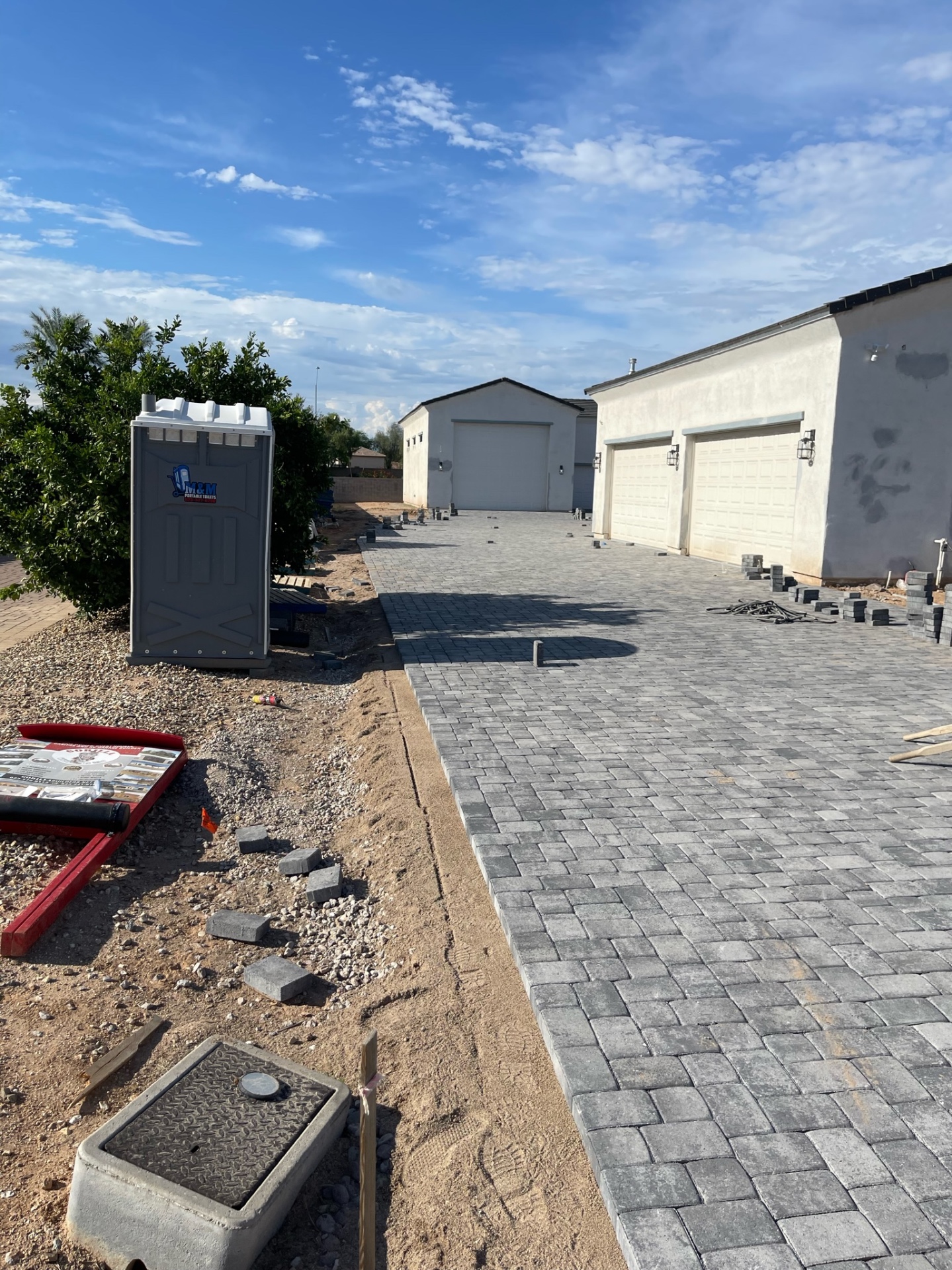
Waddell (Surprise-area) three-car-garage driveway paved with charcoal-blend tumbled pavers laid in a runner-course field with soldier-course border by AE Outdoor Living
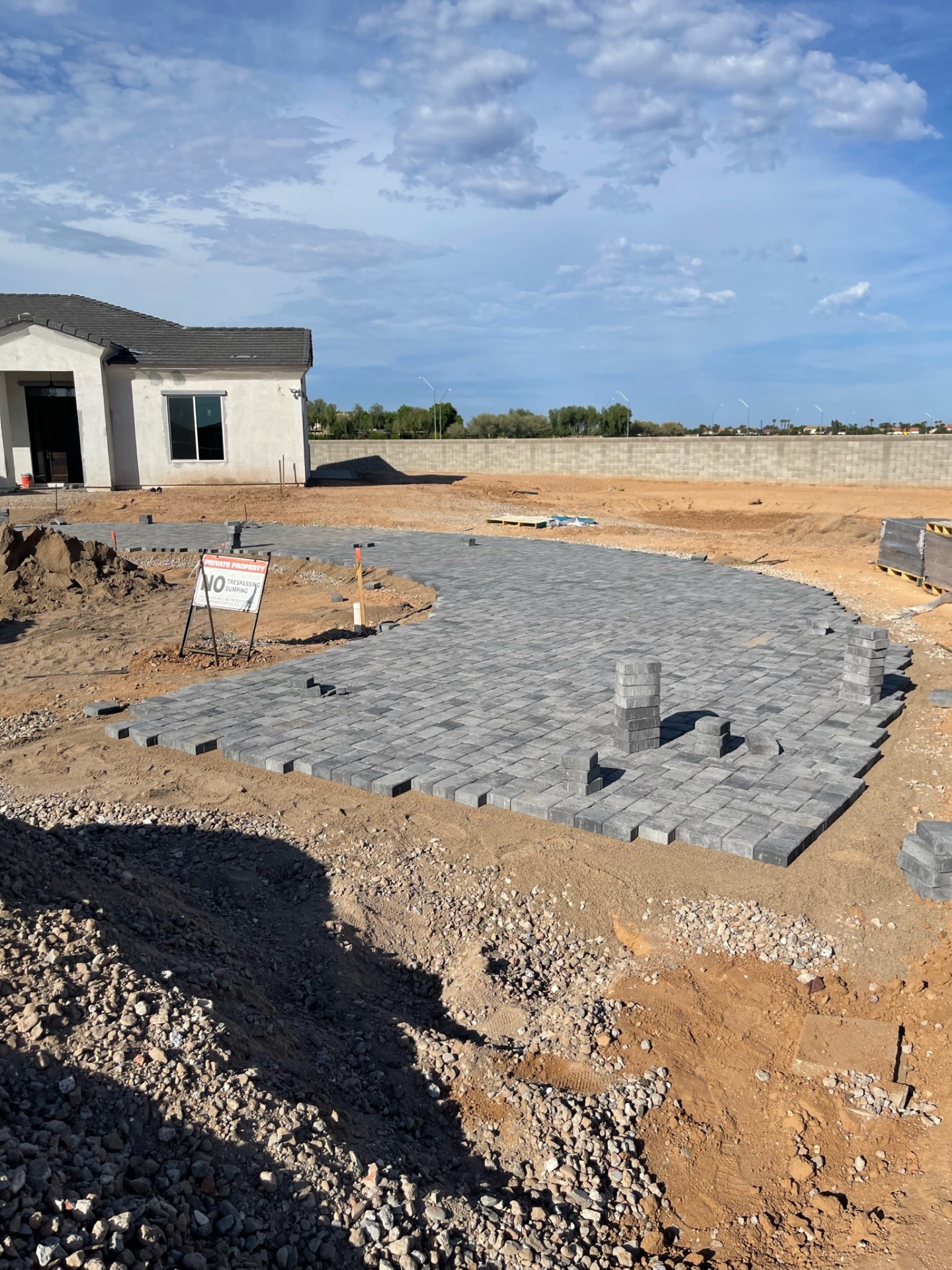
Waddell (Surprise-area) 12,000 sq ft charcoal paver backyard patio in progress with soldier-course border defining a curved edge against Sonoran-desert lot by AE Outdoor Living
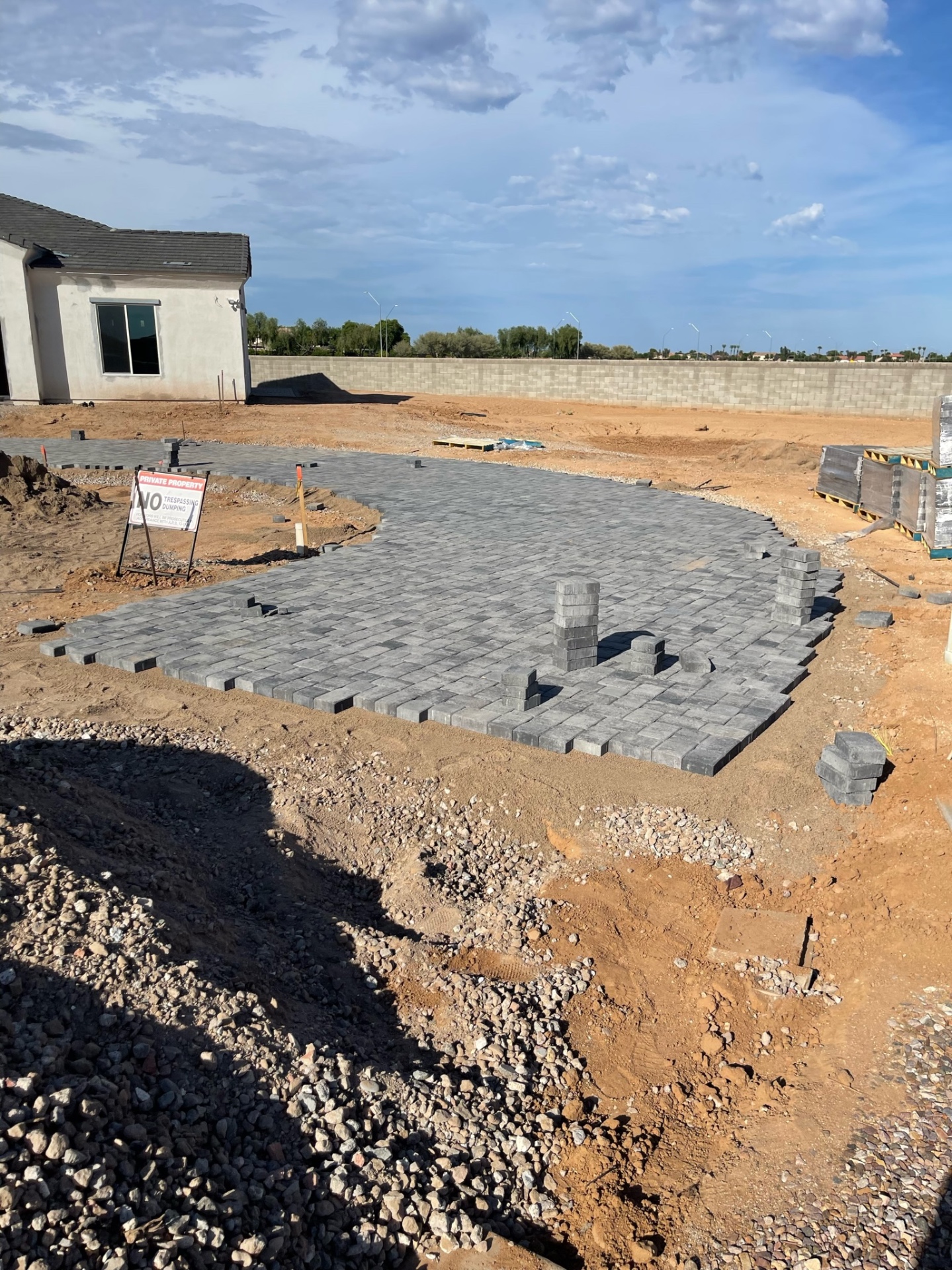
Waddell (Surprise-area) rear paver patio field laid on compacted sand base with soldier-course perimeter and painted CMU boundary wall by AE Outdoor Living
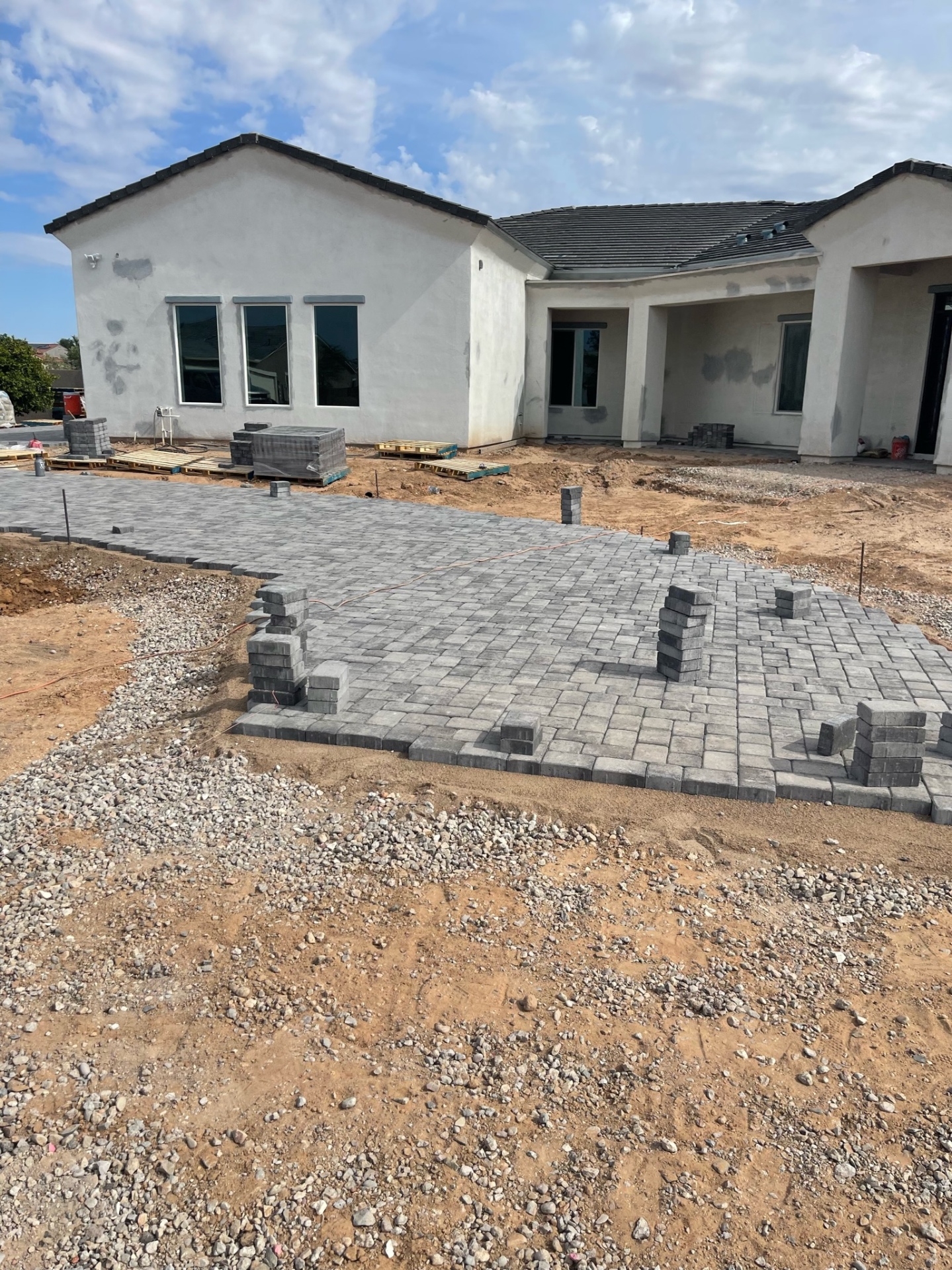
Waddell (Surprise-area) charcoal paver rear patio spanning the full back of a single-story stucco home with covered ramada opening by AE Outdoor Living
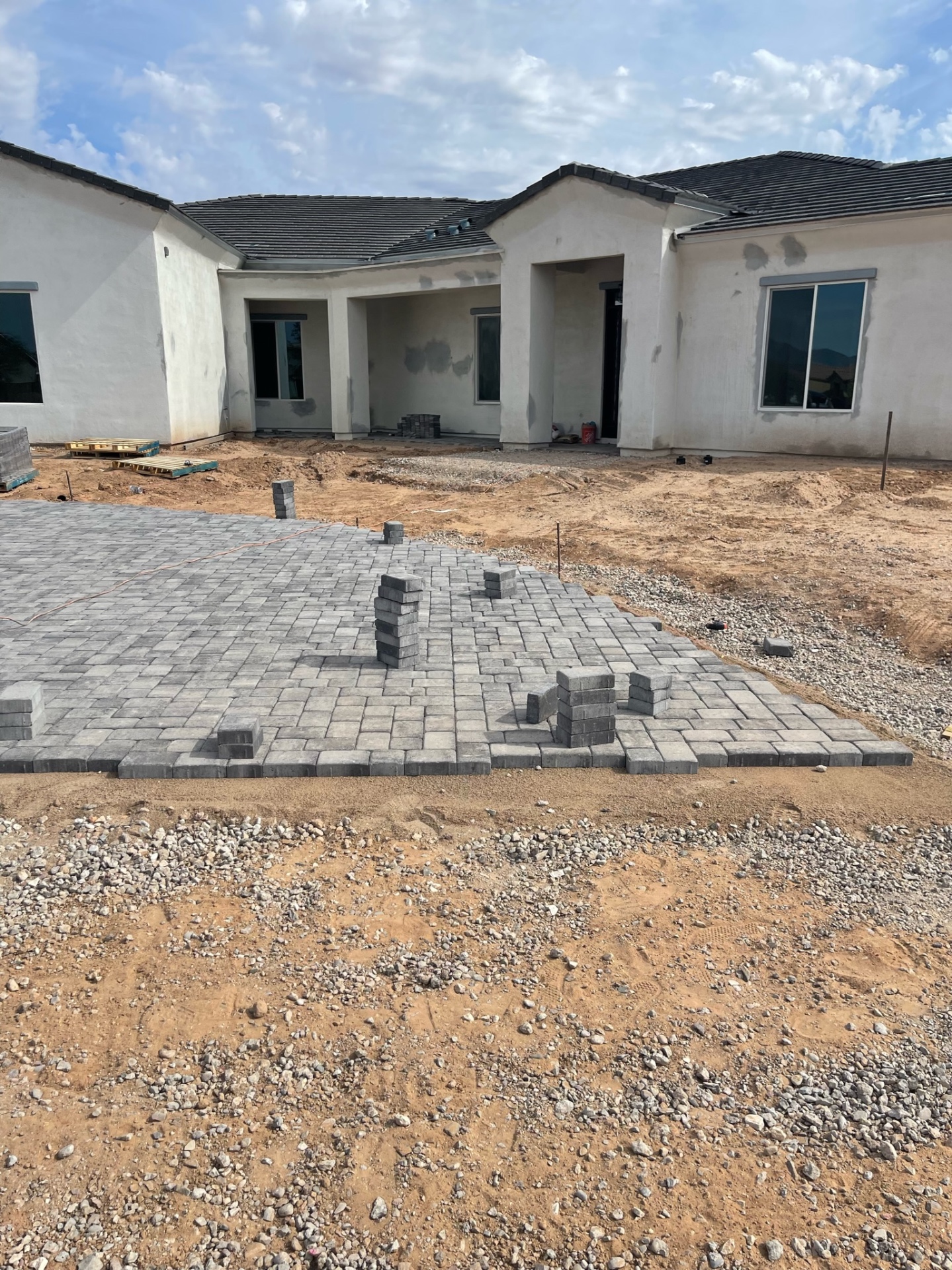
Waddell (Surprise-area) large paver patio at rear of tile-roof stucco home with soldier-course edging and stacked bundles for continued install by AE Outdoor Living
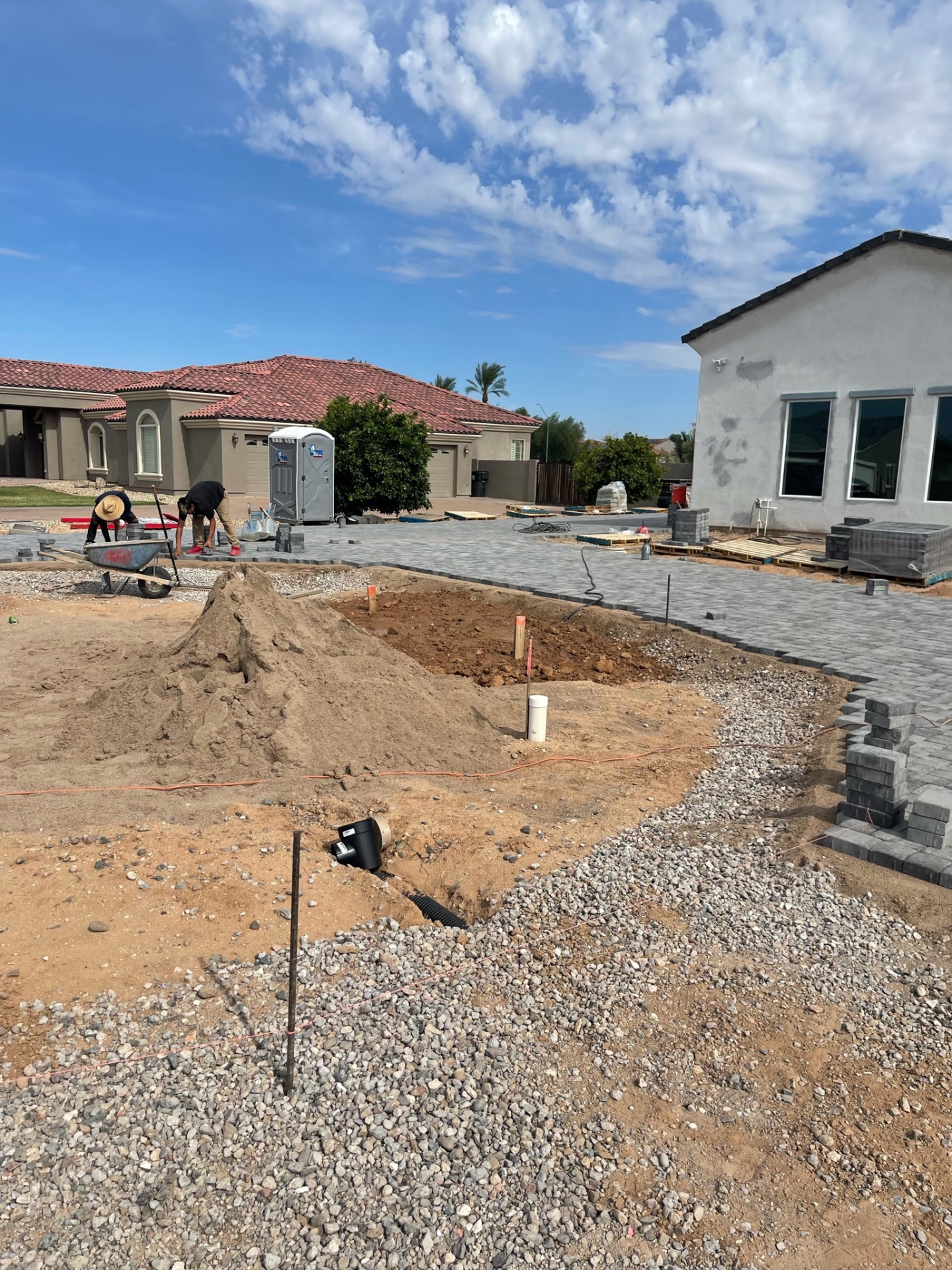
Waddell (Surprise-area) paver install in progress with sand base staged for pool shell area, compacted ABC and edge-course pavers curving around future pool by AE Outdoor Living
Surprise buyer questions, answered
Direct answers to what Surprise homeowners actually ask us. Where the answer depends on your property, the answer says so and names who decides.
How do I verify a Surprise outdoor living company is licensed for my scope?
Arizona licenses contractors at the state level, so the ROC record is the same whether the job is in Surprise or anywhere else. Search the legal entity on the ROC contractor search and record the license number, status, issue date, qualifying party, and classifications. Then map the classifications against your actual scope. A whole-yard Surprise project can cross pool, hardscape, landscape, structural, and electrical work, and one license does not automatically cover all of it. If it does not, ask in writing which licensed entity performs each portion.
What building codes does Surprise use right now?
As of January 1, 2026, Surprise uses the 2024 International Codes and 2023 NEC with local amendments. Requirements depend on exact scope/site and current City review; HOA is separate. Read the City's adopted-codes page and the 2026 local amendments document before you assume a detail from a statewide article applies to your lot.
What is the pool barrier requirement in Surprise?
Surprise's current local ordinance specifies a 48-inch minimum for covered residential barriers. Arizona's general statute contains a five-foot rule and exemptions, including provisions concerning local ordinances. Confirm the governing requirement with Surprise Building Safety; do not design from a statewide summary alone. Glass is a material choice, not a compliance guarantee. No fence, gate, or barrier replaces active adult supervision — designate an undistracted adult Water Watcher whenever children are in or near water.
Do I need a permit for a patio cover in Surprise?
The City's patio-cover handout says attached covers over 200 square feet require a permit, and detached covers may require engineered design. Do not read that as a rule that every smaller cover is permit-free — confirm your specific cover with Surprise Building Safety. Attachment method, structure type, and site conditions all change the answer, and the review outcome belongs to the City rather than to your contractor.
Does a pergola or ramada follow the same rules as a patio cover?
They are different products and they can be reviewed differently. An open-top or louvered structure, an attached solid cover, and a freestanding detached structure each raise different questions about attachment, footing, engineered design, and any integrated electrical. Confirm your specific structure with Surprise Building Safety, and have the proposal state who prepares and submits the package.
How much can a Surprise pool builder ask for up front?
For a licensed contractor's qualifying owner-occupied residential in-ground pool or spa contract, A.R.S. §32-1158.01 limits the payment due on contract execution to 15 percent and ties later payments to the stages listed in the statute, requires written change orders, and provides a bond exception. Your signed contract and current law control.
Do I need a permit for pavers, turf, or landscape work in Surprise?
Some surface and irrigation work may be exempt from a building permit, but grading, drainage, easement, right-of-way, zoning, utility, and HOA requirements can still apply. Confirm your specific scope before assuming an exemption. Driveway aprons, right-of-way work, retaining elements, and anything that changes drainage across a property line deserve a specific answer from the City rather than an assumption from the bid.
How is a backyard splash pad handled in Surprise?
How a private residential splash pad is classified depends on depth, whether water is recirculated or sent to drain, and the plumbing and electrical involved. Public and semi-public aquatic rules are different, and a residential feature should not be planned from public-facility guidance. Have the proposal state the water-handling method and who confirms the classification with the City before fabrication or excavation starts.
Where does pool backwash and drainage go?
Pool backwash and drainage should follow current City of Surprise guidance and should not be routed to the street, an alley, or the public right-of-way. The City publishes pool maintenance and discharge guidance, along with water-conservation and landscape-watering guidance that is worth reading while you are still choosing plant palette and irrigation zoning.
Will my HOA approve this, and how long does review take?
City review and HOA/ARC review are separate processes. Your contract states who prepares, submits, and responds to each. The City and the association control their own outcomes and timing, and neither approval nor a review window is guaranteed. We will not publish a review window as a promise. Ask your association for its current submittal requirements and meeting calendar in writing, and ask your contractor to state in the contract what they prepare and what you submit.
Is glass fencing a code-compliant pool barrier?
Glass is a material choice, not a compliance determination. Whether a specific system satisfies the governing barrier requirement depends on the City's current local ordinance, the statute's applicability, your project classification, existing conditions, and the approved documents. Glass is a material choice, not a compliance guarantee. No fence, gate, or barrier replaces active adult supervision — designate an undistracted adult Water Watcher whenever children are in or near water.
What do I need to know about outdoor kitchen ventilation and clearances?
Ventilation, clearances to combustibles, and gas sizing follow the appliance manufacturer's installation instructions, the approved design, a qualified trade, and the authority having jurisdiction. Different appliances specify different clearances and different ventilation, so a universal rule about hoods or materials is not a safe basis for a decision. Ask the proposal to name the appliance models and state the ventilation detail rather than deferring the design to the field.
How should permanent trim lighting be quoted versus landscape lighting?
They are separate systems with separate scopes. Permanent trim lighting involves product and installation decisions that may have different warranty terms — ask for the product and workmanship terms in writing. Landscape lighting should be quoted with a fixture schedule, transformer sizing, and wire gauge, because those three determine whether the system still works when you add fixtures later.
What does a Surprise project cost?
Any number published before a site visit is a planning range, not a quote. Investment depends on scope, materials, access, existing conditions, drainage work, utility runs, and current material pricing. Our service pages publish planning ranges with their variables stated, and the signed proposal is the only number that controls. If a company gives you a firm price for a whole-yard project without walking the lot, that is a finding, not a convenience.
Should I hire one company for everything or separate trades?
Either can work. One contract concentrates coordination, sequencing, and warranty responsibility with one entity, which matters most on projects where trades block one another. Separate trades can be right when scopes are genuinely independent and you are willing to own the sequencing and the seams between them. The wrong version of either is the one where nobody owns drainage, elevations, and sleeves.
Does AE have completed City of Surprise projects in the public gallery?
Not yet. Our public project registry has not tagged a City of Surprise case study, and we are not going to relabel nearby work to fill that gap. We serve Surprise and we can discuss relevant work directly, but the gallery on this site will say where a project actually was.
Official Surprise and Arizona sources
These are the primary sources behind the statements on this page. Requirements change, and the authority having jurisdiction controls the answer for your property. Read the source, not a summary.
Sources last verified 2026-08-21.
- City of Surprise — permits and applications
- City of Surprise — currently adopted building codes
- City of Surprise — 2026 local code amendments (PDF)
- City of Surprise — permits and inspections
- City of Surprise — swimming pool barrier information
- City of Surprise — Ordinance 2025-14 / current local pool-barrier language (PDF)
- City of Surprise — patio cover handout (PDF)
- City of Surprise — pool maintenance and discharge
- City of Surprise — water conservation
- City of Surprise — landscape watering guidelines
- Arizona pool barrier statute — A.R.S. §36-1681
- Arizona pool/spa payment law — A.R.S. §32-1158.01
- Arizona written-contract law — A.R.S. §32-1158
- Arizona ROC — before you hire
- Arizona ROC — license classifications
- Arizona ROC — contractor search
Common Surprise questions
- Does AE Outdoor Living serve Surprise, AZ?
- Yes. AE Outdoor Living is an Arizona ROC-licensed outdoor-living design-build company delivering complete backyard transformations, custom pools & spas, pavers & hardscapes, artificial turf across Surprise, including ZIP codes 85374, 85378, 85379, 85387, 85388. Warranty entity, term, and exclusions are stated in the signed agreement for your project.
- What outdoor-living services are most common in Surprise?
- The services highlighted for Surprise on this site are complete backyard transformations, custom pools & spas, pavers & hardscapes, artificial turf. West Valley sun exposure is the most intense in the metro. Material choice matters — we specify pavers and turf that don't read hot, and engineer shade structures that actually shade.
- Do Surprise HOAs require design review for backyard projects?
- Private HOA/CC&R and ARC requirements — including any age-restricted community standards — vary by property and current governing documents. The owner confirms them directly with the association; city review does not replace private approval. AE assists only where that work is currently offered, accepted and explicitly assigned in the signed scope, and no approval or timing is guaranteed. Requirements and review calendars are set by each association, so confirm your community's current submittal package and meeting schedule directly with the HOA or ARC.
- Are permits required for outdoor-living work in Surprise?
- City of Surprise Community Development handles municipal permitting, and pool-barrier requirements fall within the scope of ARS §36-1681 plus whatever the city has adopted. AE performs only the work currently offered, accepted and explicitly assigned in the signed scope; the customer confirms the current requirements for the property with the authority having jurisdiction and any HOA/ARC or insurer, and no permit, inspection, HOA, or code acceptance is guaranteed. Whether a specific scope needs a permit depends on the exact work, the site, and current City requirements. Confirm with the Surprise building department, and note that City review and HOA review are separate processes.
- What's the typical timeline for a Surprise outdoor-living project?
- Timeline depends on scope, site conditions, material availability, City review, HOA review, and utility coordination — none of which a contractor controls end to end. A single-trade surface project and a multi-trade whole-yard build are very different schedules. Rather than publish a universal duration, we put a written schedule and the assumptions behind it in the proposal, and we tell you which milestones depend on third-party review.
- Does AE Outdoor Living publish investment ranges for Surprise projects?
- Where we publish a planning range, we state the variables behind it. A planning range is not a quote: actual investment depends on scope, materials, access, existing conditions, and current pricing, all confirmed in a Project Fit Review before a proposal is issued. The Budget Builder at /budget-builder gives Surprise homeowners a ballpark before booking, and the signed agreement for your project controls the final numbers.
Community work is foundational, not an add-on
We didn't build a company that gives back. We built a company on giving back. Across the Valley — including Surprise — that shows up in Shop With a Cop, our Day of Giving, backpack drives, donated backyards, and the Purposeful Giving Alliance.
See how AE gives back across ArizonaReady to plan your Surprise project?
Tell us your address, scope, and goals. We'll confirm availability for your location and recommend the right next step.