
Pool and Outdoor Living Design-Build in Glendale, Arizona
Glendale spans the master-planned Arrowhead Ranch communities through historic downtown's mature-canopy ranch homes. We adjust material palette and scope to fit each — newer subdivisions get cleaner desert-modern lines, established neighborhoods get work that respects existing trees and architecture.
Glendale outdoor living — Arrowhead Ranch through historic downtown Glendale.
What Glendale actually requires
Arrowhead-area communities can carry private design review under their own governing documents. Older Glendale has flood-irrigation lots that demand engineered drainage and saturation-rated assemblies.
Private HOA/CC&R and ARC requirements vary by property and current governing documents, and private review is separate from municipal permitting. The owner confirms them directly with the association. AE assists only where that work is currently offered, accepted and explicitly assigned in the signed scope, and no approval or timing is guaranteed.
City of Glendale Building Safety issues building permits under the codes the city has adopted, and pool-barrier requirements fall within the scope of ARS §36-1681 plus whatever the city has adopted. Flood-irrigation district engagement is confirmed on affected lots before base prep. AE performs only the work currently offered, accepted and explicitly assigned in the signed scope; the customer confirms the current requirements for the property with the authority having jurisdiction and any HOA/ARC or insurer, and no permit, inspection, HOA, or code acceptance is guaranteed.
Outdoor living scopes delivered in Glendale
The full outdoor living scope, tuned for Glendale lots
Most Glendale projects combine several scopes under one AE crew. Start with a custom pool build wrapped in pavers and travertine hardscape (see why we don't use quarter minus under pavers for the base spec we hold to), add an outdoor kitchen or pergola, finish with desert-smart landscape, artificial turf, landscape lighting, and misting systems for shoulder-season use. Investment ranges live in the pricing guide, and the projects library shows finished work across the Valley — including neighborhoods around Glendale. Before you sign with anyone, run the Glendale contractor vetting checklist.
This page is about Glendale, Arizona — the West Valley city in Maricopa County, not Glendale, California. It is published by AE Outdoor Living, a company offering outdoor living design-build services to Glendale homeowners, so treat it as a useful commercial page rather than neutral consumer research. Apply every check below to AE exactly as you would to any other bidder, and confirm requirements with the authority having jurisdiction and your association before you sign anything.
How to choose an outdoor living company in Glendale, AZ
Glendale properties vary in lot conditions, existing improvements, utilities, zoning, and private-review requirements. Use the same nine checks on every proposal so differences are easier to compare.
- 1.Confirm which jurisdiction actually reviews your address
A Glendale mailing address does not by itself prove City of Glendale jurisdiction. Parcels with Glendale mail can sit in unincorporated Maricopa County, where the County permit center reviews the work instead. Confirm the reviewing authority for the actual parcel before anyone prices permit-relevant scope, because the submittal path, fees, and inspection process differ.
- 2.Treat City review and HOA/CC&R approval as two separate gates
Municipal review and private community review are different reviewers with different standards and different timing. Passing one does not satisfy the other, and City codes do not override more restrictive private CC&Rs. If the property is governed by an HOA, confirm its architectural-review process and obtain every approval required by the association and reviewing authority before ordering materials.
- 3.Put permit and inspection responsibility in writing
Ask each bidder, in writing, who prepares the submittal, who pays fees, who schedules inspections, and who is responsible for corrections. 'We handle permits' is not a scope line. Whatever is assigned should appear in the signed contract, and the authority still controls requirements, review, approval, and timing.
- 4.Get drainage, elevations, and utilities on the plan
Ask for finished elevations, slope direction, the planned drainage path, and how existing utilities and irrigation are handled. Confirm site-specific grading and drainage before finished surfaces are installed.
- 5.Read the written scope and material specifications
Compare the specification, not the total: base material and compacted depth, bedding, joint treatment, edge restraint, panel or paver product, appliance make and model, fixture counts, and equipment brand and model. Ask each company to write down what is excluded, not only what is included.
- 6.Verify the entity, ROC license, and insurance yourself
Get the exact legal entity name that will appear on the contract, then look it up on the Arizona ROC contractor search for number, classification, qualifying party, and current status. Request current certificates of general liability and workers' compensation from the insurer or agent. Verify the contractor's Arizona ROC license, classification, and current status. For work inside City limits, also confirm the City business license Glendale requires; do not confuse that business license with the state contractor license.
- 7.Read the payment milestones before the price
Arizona statute sets payment and change-order rules for qualifying owner-occupied residential in-ground pool and spa contracts. Those rules are specific to that contract type and do not automatically extend to landscape, hardscape, or general outdoor-living work, so read the milestone schedule and change-order process in each contract you receive.
- 8.Compare warranties and the service path, not the adjective
Ask what the written workmanship warranty covers, what it excludes, how manufacturer warranties on equipment and materials are registered, and exactly how a service call is opened after the final walk. Compare the written terms side by side; verbal reassurance is not a warranty.
- 9.Ask for realistic scheduling without a guarantee
A credible schedule names the sequence, the dependencies, and the parts nobody controls — review cycles, inspection availability, association review, utility coordination, weather, and material lead times. Be skeptical of any firm completion date offered before jurisdiction, scope, and approvals are settled.
One page per Glendale question
This hub covers general Glendale outdoor living planning. When your question is narrower, these are the pages that own it.
- Pool and spa design and constructionPool builder in GlendalePool-specific planning and construction detail, not general yard design.
- Paver patios, pool decks, and drivewaysPavers in GlendaleHardscape surfaces and base spec — not turf and not structures.
- Artificial turf and low-water lawn conversionArtificial turf in GlendaleTurf base and infill are a different spec from paver base.
- Pergolas and patio coversPergolas and shade in GlendaleShade structures and their footing, span, and attachment detail.
- Outdoor kitchens and built-in BBQ islandsOutdoor kitchens in GlendaleAppliances, utilities, and counters — not the patio surface underneath.
- Landscape and architectural lightingLandscape lighting in GlendaleLow-voltage landscape lighting, not permanent trim lighting.
- Fire pits and fire featuresFire pit installation in GlendaleFire scope and its gas or electrical rough-in.
- Grade changes and retaining wallsRetaining walls in GlendaleStructural grade retention, which is reviewed differently from flatwork.
- Glass pool barriersGlass pool fencingThe complete barrier system, designed to the requirement confirmed for the property.
- Residential splash padsSplash padsResidential splash-pad scope; the reviewing authority determines any pool, barrier, plumbing, electrical, drainage, or sanitation classification.
- Vetting any Glendale contractorHow to vet a contractor in GlendaleLicense, insurance, and contract verification steps — apply them to AE too.
- Whole-yard coordinationComplete outdoor transformationsMulti-trade sequencing on one schedule, not a single-trade scope.
What to compare, scope by scope, on a Glendale bid
When two Glendale proposals look alike, the difference is almost always sitting in a row nobody asked about.
- What to compare
- Shell engineering, excavation assumptions, equipment list by brand and model, decking scope, barrier system, and where equipment sits relative to the house and neighbors.
- Demand in writing
- Payment milestones, change-order process, engineering responsibility, who submits plans electronically, who schedules each inspection stage, and what happens if soil or excavation conditions differ from the assumption.
- Common scope gap
- Barrier, gates, hardware, and bonding treated as an add-on instead of part of the designed system.
- What to compare
- Glass thickness and type, safety-glazing designation, mounting method, spigot or hardware material, gate hardware, and panel layout against the confirmed requirement.
- Demand in writing
- Who confirms the required height and barrier configuration with the AHJ and, where relevant, the HOA and insurer before fabrication.
- Common scope gap
- A quoted price per foot with no confirmed height, no footing or core-mount detail, and no gate scope.
- What to compare
- Span, post count and placement, footing detail, attachment condition at the house, materials, and whether electrical is included.
- Demand in writing
- Structural design responsibility, permit-relevant scope, setback and lot-coverage assumptions, and any HOA design submittal.
- Common scope gap
- Fans, heaters, lighting, and the circuits to run them excluded from the structure price.
- What to compare
- Compacted base depth for the actual use, bedding course, joint sand, edge restraint, and how the new field meets existing slabs, coping, and door thresholds.
- Demand in writing
- Finished elevations, slope direction, drainage handling, and cut and soldier-course detail at borders.
- Common scope gap
- Patio base depth quoted for a driveway, or grade transitions left off the plan entirely.
- What to compare
- Base material and compaction, infill type, drainage below the panel, seam layout, edge attachment, plant sizes at maturity, and irrigation zoning by water need.
- Demand in writing
- Whether existing irrigation or flood-irrigation infrastructure is modified, capped, or preserved, and who is responsible for that coordination.
- Common scope gap
- Full-sun and pet areas specified with the same infill as a shaded lawn, or a controller left on the old planting's schedule.
- What to compare
- Appliance make and model, counter material, framing method, ventilation clearances, and utility rough-ins.
- Demand in writing
- Gas line sizing and routing, electrical circuits, and the permit-relevant portion of the utility work.
- Common scope gap
- A gas BBQ or fire feature priced with no gas run, no plan review, and no clearance check for the specified appliances.
- What to compare
- Fixture count and type, transformer sizing, wire gauge and runs, control method, and how fixtures are aimed and shielded.
- Demand in writing
- Circuit locations, sleeving under future hardscape and turf, and warranty terms on fixtures versus labor.
- Common scope gap
- A fixture count with no transformer capacity, no sleeving, and no plan for future additions.
- What to compare
- Water supply and sanitation approach, drainage destination, surfacing, control equipment, and electrical.
- Demand in writing
- Who confirms plumbing, electrical, drainage, and structural classification with the reviewing authority before anything is fabricated.
- Common scope gap
- An assumption that a residential splash pad is automatically exempt from review.
- What to compare
- Trade sequence, single point of responsibility, site protection, access plan, and how each trade's warranty is documented.
- Demand in writing
- Which portions are self-performed, which are subcontracted, and how change orders are priced mid-project.
- Common scope gap
- Underground work — drainage, conduit, sleeves, gas — left to a later phase that then requires demolition.
A Glendale yard sequence to confirm for the approved scope
Sequence is what keeps a finished surface from being cut open six months later. This is the order we plan in, whether the whole yard is built now or in phases.
- Confirm jurisdiction and the private review path
Establish whether the City of Glendale or unincorporated Maricopa County reviews the parcel, and identify the HOA or CC&R review that applies. Both answers change the submittal path and the realistic schedule.
- Survey grades, drainage, and existing utilities
Finished elevations, slope direction, and the discharge point drive everything above them. Existing irrigation, gas, electrical, and any flood-irrigation infrastructure gets located before layout, not during excavation.
- Lock the design and material specifications
Appliance models, fixture counts, glass configuration, structure spans, and paver products set the utility, structural, and base requirements. Specifications first, pricing second.
- Submit for review and secure the approvals that apply
Electronic plan submission and completeness review come before construction on permit-relevant scope, and association review runs on its own separate track and timing.
- Excavate, run underground, and build the pool shell
Excavation, plumbing, gas, conduit, sleeves, and any shell work happen while the yard is open. Adding capacity you may want later costs far less now than after the surfaces are set.
- Set structures and footings
Pergolas, ramadas, kitchens, seat walls, and retaining elements need footings placed before surfaces are set around them.
- Install hardscape surfaces and decking
Base, bedding, and the surface field go in once elevations and everything below them are final and inspected where required.
- Install turf, planting, and irrigation
Soft scope follows hard scope so grading and compaction equipment never crosses a finished lawn.
- Trim out lighting, equipment, barriers, and finishes
Fixtures, controls, glass panels, and final water-feature commissioning close the project. Required pool barriers and gates are not a generic closeout item: they must be installed and approved at the stage the reviewing authority requires, which may be before plaster or before the pool is filled.
Phasing works when phase one carries the underground work. Grading, drainage, conduit, sleeving under future decking and turf, and equipment access have to be designed for the finished yard even if only part of it is built now. Each phase is still its own signed scope with its own requirement confirmation.
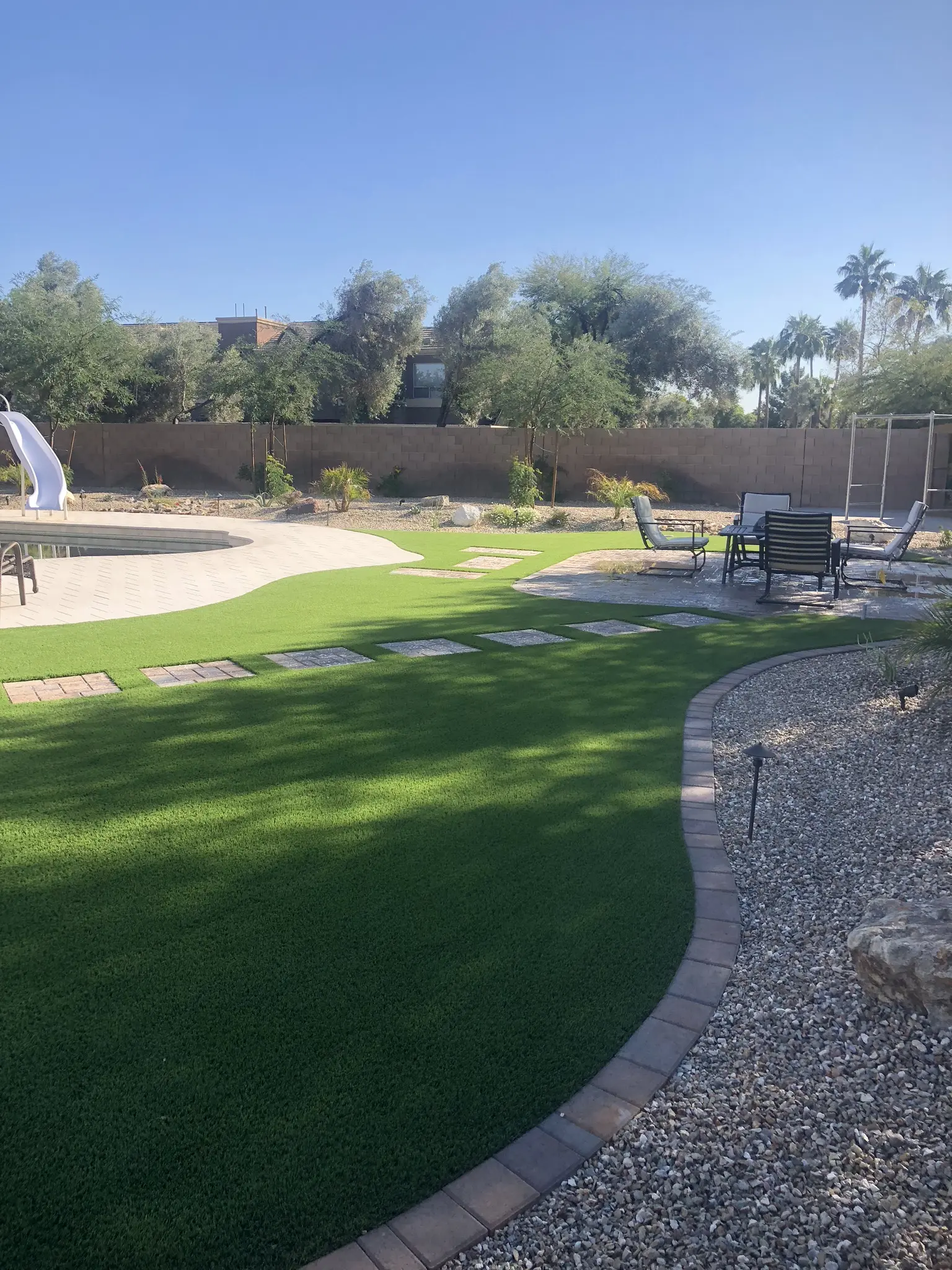
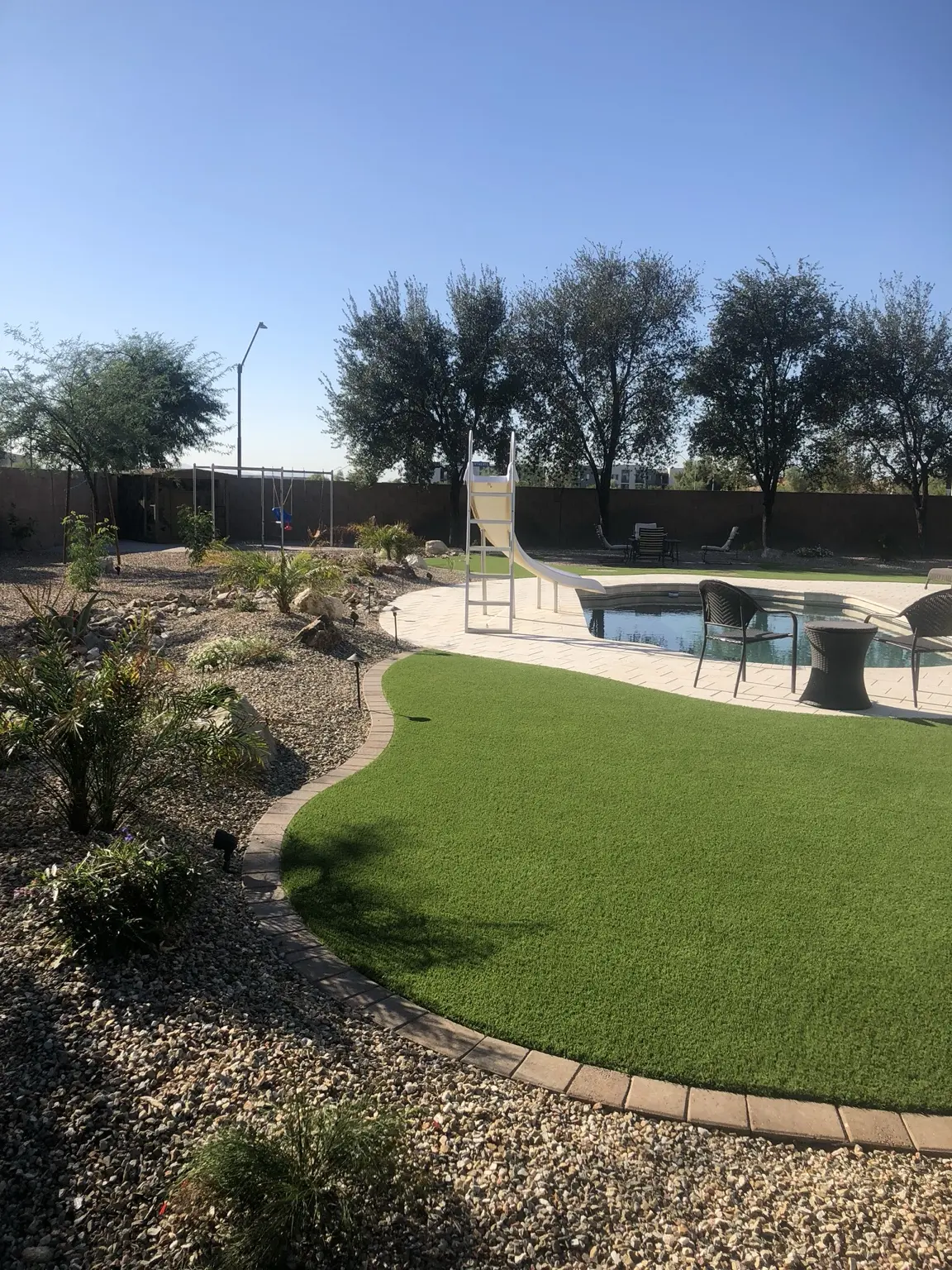
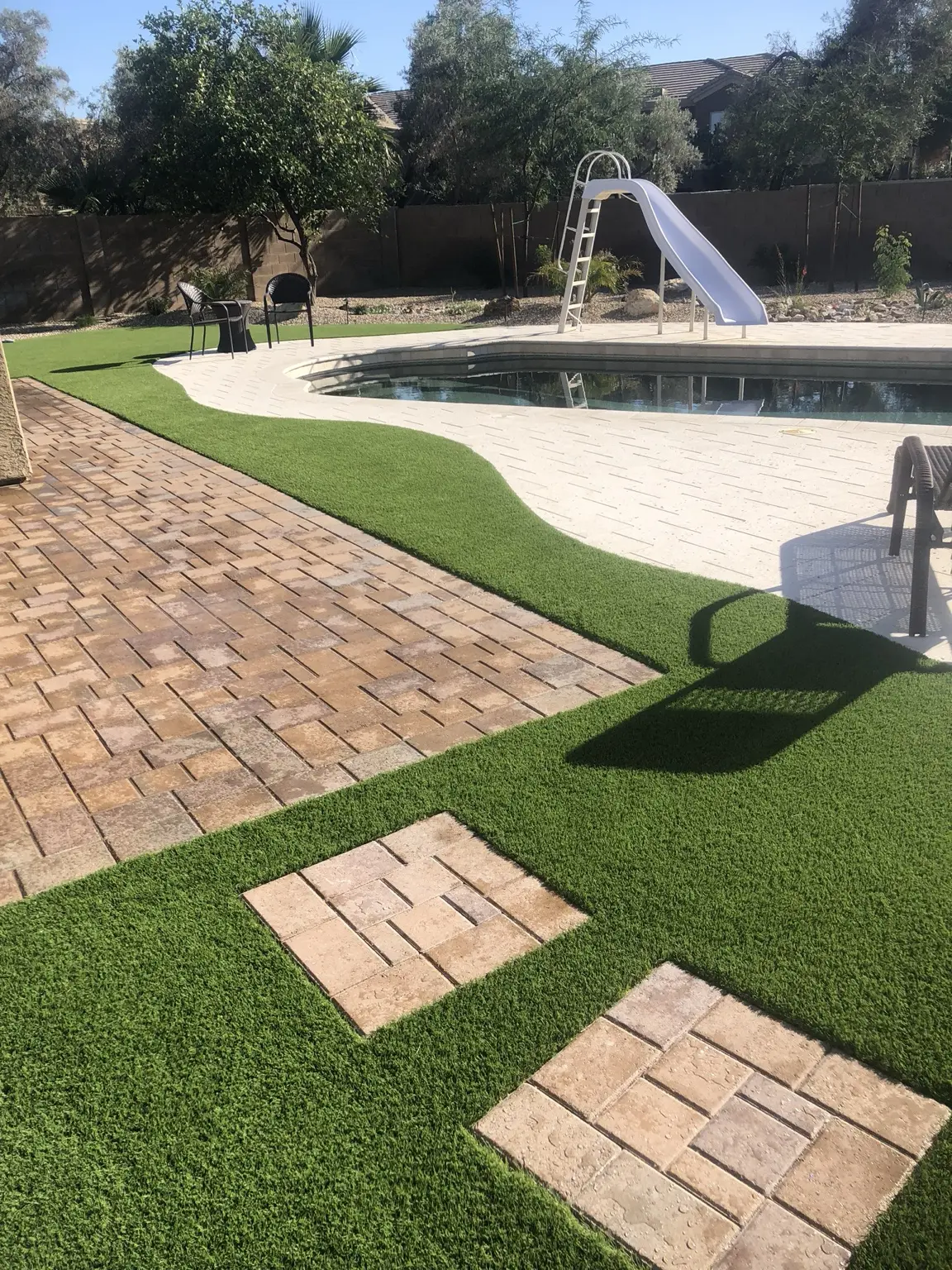
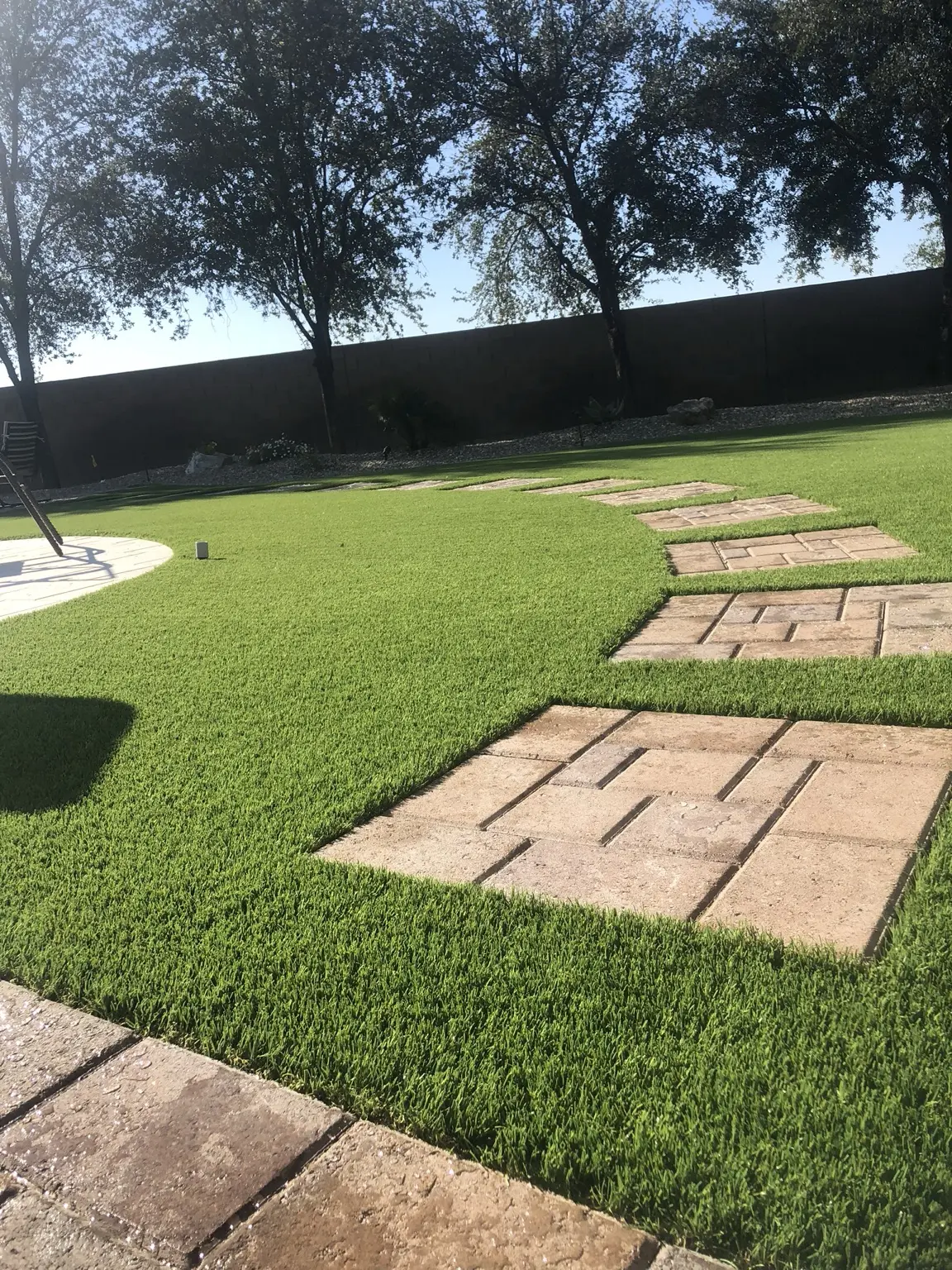
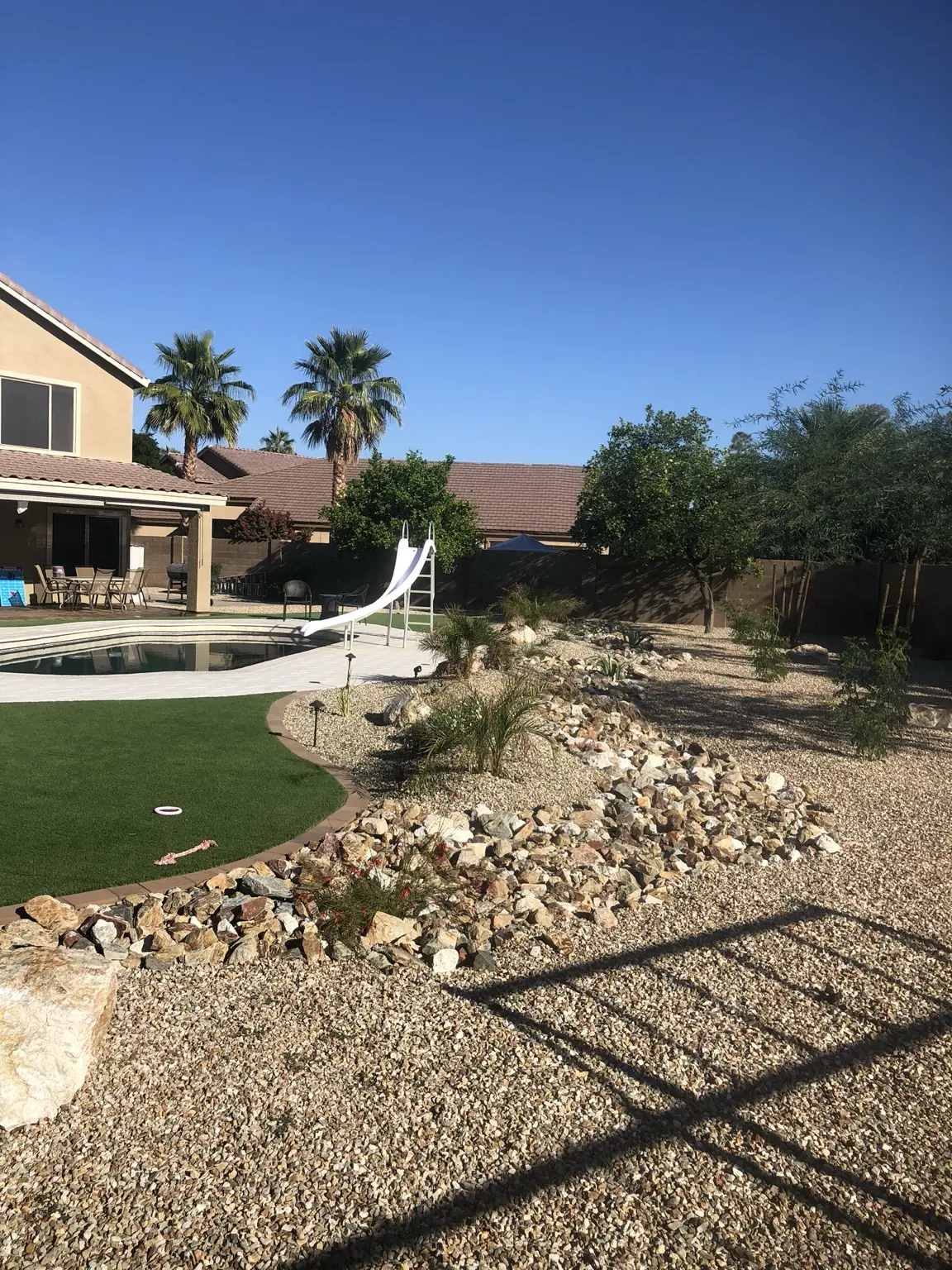
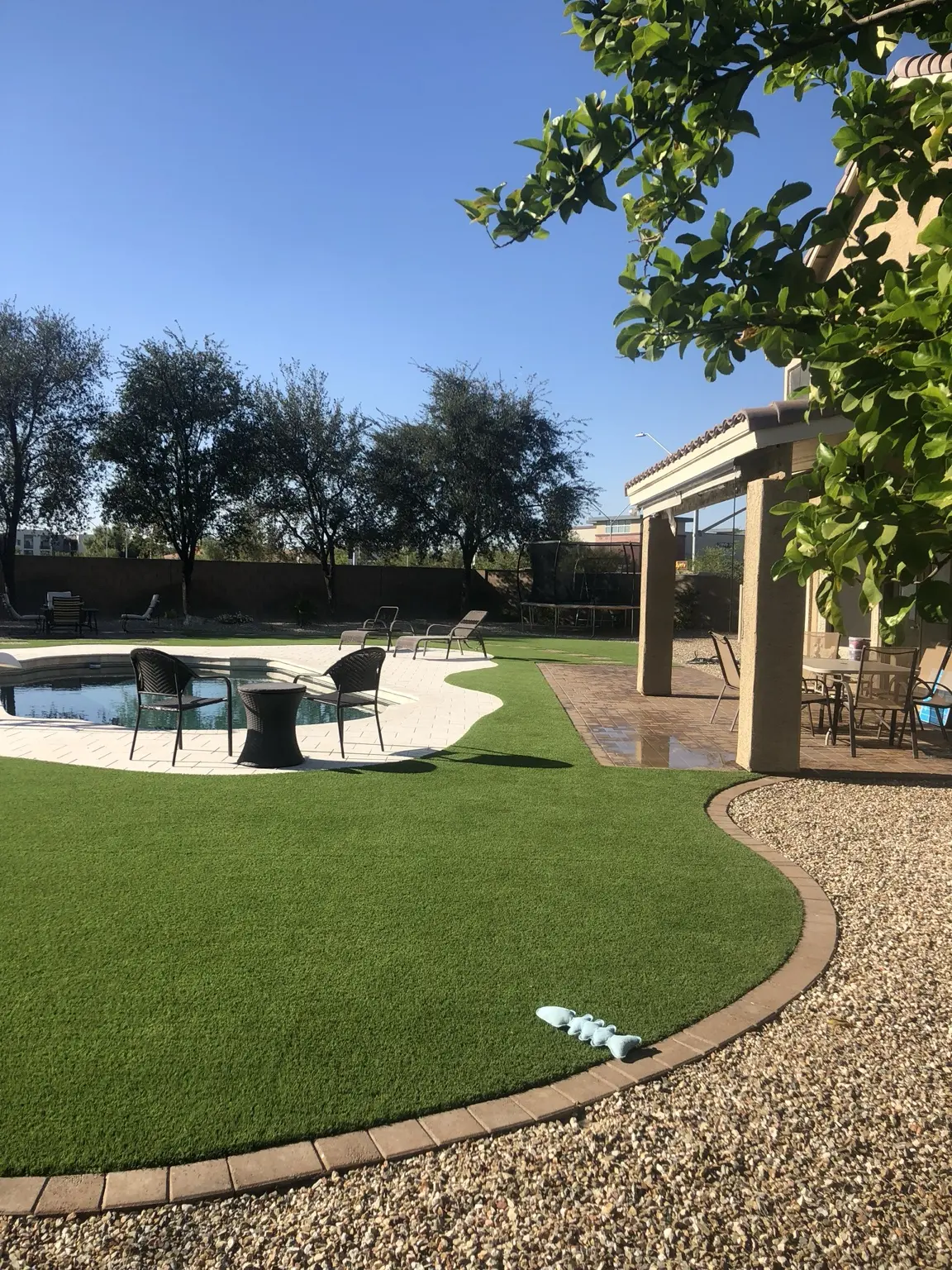
Documented Glendale project: turf, pavers, landscaping and lighting
This is the Glendale project we have on file. It establishes documented AE artificial turf, paver hardscape, desert landscaping and low-voltage lighting work in Glendale. It does not establish an AE pool build or pool remodel — the pool, pool deck, slide, house and patio cover are shown only as site context in this evidence record.
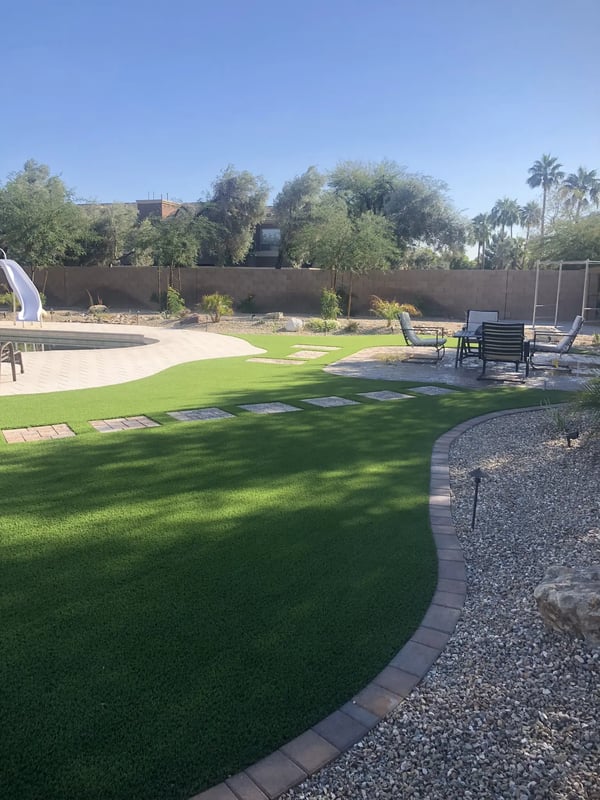
- Recorded scope: artificial turf, paver stepping pads, walkway, borders and patio transitions, desert rock landscaping, and low-voltage landscape lighting. Recorded project types: full backyard transformation, pavers, turf, lighting.
- Recorded location: Glendale. We do not publish a budget, timeline, completion date, permit history, review outcome, or homeowner statement for this project.
- Eight original photos come from AE project records, owner-verified by David Bell on August 21, 2026.
- The pool, pool deck, slide, house and patio cover are shown only as site context in this evidence record. This project record does not claim AE designed, built, remodeled, resurfaced, repaired, or permitted it.
Outdoor living services available to Glendale homeowners
Availability and scope, stated plainly. Our stored Glendale project record covers turf, paver hardscape, desert landscaping and low-voltage lighting only, so no other scope below is presented as a completed Glendale case study — these are the pages that explain each scope and the standards we build to.
- Pools and spas
Design, engineering coordination, construction, and equipment selection, with barrier and decking scope planned as part of the same system.
- Pavers and hardscape
Patios, pool decks, driveways, and walkways with project-specific base, edge restraint, jointing, drainage, and traffic assumptions documented in the written scope.
- Artificial turf and landscape
Turf, desert planting, irrigation zoning, and low-water conversion designed for the lot rather than templated.
- Shade structures and outdoor kitchens
Pergolas, ramadas, patio covers, and built-in kitchens, with structural detail and utility rough-ins confirmed as project-specific scope.
- Glass pool fencing
Custom-fabricated, project-specific glass barrier systems designed to the requirement confirmed for the property.
- Residential splash pads
Water, sanitation, drainage, surfacing, and electrical classified with the reviewing authority before fabrication.
Jurisdiction, review, and water notes for Glendale, AZ properties
- Glendale, Arizona is a West Valley city in Maricopa County. A Glendale mailing address does not by itself establish City of Glendale jurisdiction — confirm whether the City or unincorporated Maricopa County is the authority having jurisdiction for the actual parcel before permit-relevant scope is priced.
- The City describes electronic plan submission and a completeness review step before a submittal moves forward. Submittal completeness, corrections, and the authority's own workload drive timing; no contractor controls review time or approval.
- The City's current residential inspection-code list includes 671 pre-gunite, 673 underground pool electrical, 674 cool deck/equipotential bond, 672 pre-plaster/final pool, and 675 fence/retaining wall. The permit and approved plans determine which inspections apply.
- City approval and HOA or CC&R approval are separate gates. City codes do not override more restrictive private CC&Rs, and neither reviewer is bound by the other's standards or schedule.
- The City publishes a separate pool-fence resource for lots adjacent to lakes. Obtain the current document, confirm the applicable barrier design with the reviewing authority, and separately confirm any HOA requirements before fabrication.
- Water-conservation rebate programs published by the City are limited to qualifying City of Glendale water customers. Documentation requirements, funding availability, and possible post-inspection apply, and program terms can change. Last verified August 21, 2026. Verify eligibility and current requirements before work; do not treat a rebate as guaranteed.
- Qualifying owner-occupied residential in-ground pool and spa contracts carry statutory payment and change-order rules under Arizona law. Those rules are specific to that contract type and do not automatically extend to landscape or general outdoor-living work.
- Verify the contractor's Arizona ROC license, classification, and current status on the ROC contractor search before you sign. For work inside City limits, also confirm the City business license Glendale requires; do not confuse that business license with the state contractor license.
- Where permitting or private-review coordination is offered, accepted, and explicitly assigned in the signed scope, AE coordinates that assigned portion. The City, County, association, inspector, and utility control requirements, review, approval, inspection, and timing.
- No pool fence, gate, or barrier replaces active adult supervision. Designate an undistracted adult Water Watcher whenever children are in or near water.
Glendale service-area context
ZIPs and communities below are service-area context for scheduling and site visits only. AE has no Glendale office or location — our physical address is in Peoria — and nothing here implies a completed project in any specific community listed. Our one stored Glendale project record is shown above.
ZIP codes: 85301, 85302, 85303, 85304, 85305, 85306, 85307, 85308, 85310
Communities: Arrowhead Ranch, Arrowhead Lakes, Marshall Ranch, Historic Downtown Glendale
Glendale questions we actually get asked
Direct answers. Where a requirement is involved, the current City or County document and your signed scope control — not this page.
I have a Glendale address. Is the City of Glendale my permitting authority?
Not necessarily. A Glendale mailing address is a postal fact, not a jurisdictional one. Some parcels with Glendale mail are in unincorporated Maricopa County, which means the County permit center reviews the work under County processes. Confirm the reviewing authority for your specific parcel before anyone prices permit-relevant scope, and get the answer in writing in the proposal.
What does the City's residential pool review and inspection process look like?
At a high level, the City describes electronic plan submission followed by a completeness review before a submittal moves forward. The City's current residential inspection-code list includes 671 pre-gunite, 673 underground pool electrical, 674 cool deck/equipotential bond, 672 pre-plaster/final pool, and 675 fence/retaining wall. The permit and approved plans determine which inspections apply, and the City controls requirements, review, corrections, timing, and approval. Read the current City pages linked below rather than relying on any contractor's summary, including ours.
If the City approves my plans, is my HOA satisfied?
No. Municipal review and private community review are separate gates with separate reviewers and separate standards. City codes do not override more restrictive private CC&Rs, and an association can require design elements, materials, colors, heights, or setbacks the City has no opinion about. Get both approvals in writing, and expect the association's timing to be independent of the City's.
My lot backs a lake. Does that change my pool fence?
It can. The City publishes a separate pool-fence resource for lots adjacent to lakes. Obtain the current document, confirm the applicable barrier design with the reviewing authority, and separately confirm any HOA requirements before fabrication. We do not quote fence specifications from memory — the current document governs.
Are there Glendale water-conservation rebates for turf or landscape conversion?
The City publishes water-conservation rebate programs for water customers. Last verified August 21, 2026. Eligibility is limited to qualifying City of Glendale water customers. Documentation requirements, funding availability, and possible post-inspection apply, and program terms can change. Verify eligibility and current requirements before work; do not treat a rebate as guaranteed.
What should I decide before a paver pool deck goes in?
Finished elevation and slope direction, base depth for the actual traffic, bedding and joint treatment, edge restraint, drainage, and how the field meets existing slabs, coping, and thresholds. Decide drainage before you decide pattern, and have the base, edge, jointing, drainage, and traffic assumptions documented for your project. Our published starting standards are 2–3" of ABC under patios and walkways and 4–6" under driveways with a 1" bedding sand course; the actual soil, traffic, drainage, paver system and manufacturer requirements, engineering, and approved scope govern the final specification.
What matters most on turf and xeriscape in Glendale?
What is under the turf and how water leaves it. Ask for base material and compaction, infill selected for the actual use — full sun and pet areas are not a shaded lawn — seam layout, and perimeter attachment. On the planting side, size plants at maturity rather than at nursery size and group irrigation zones by water need, and be explicit about what happens to any existing irrigation infrastructure on the lot.
Pergola or solid patio cover?
A pergola filters light and keeps the yard open; a solid cover gives real shade and rain protection and changes drainage at the roof edge. For either option, confirm whether zoning clearance, a building permit, engineering, electrical review, or HOA approval applies to the actual size, attachment, utilities, and property. Decide on fans, heaters, and lighting before the structure is engineered, not after it is standing.
When should an outdoor kitchen be planned?
Before the deck is poured or set. Choose the appliances first — cutout sizes, clearances, gas sizing, and circuit counts all come from the specified models. Built-in kitchens can add regulated electrical, plumbing, gas, and structural work, so the utility routing belongs on the plan while the yard is still open.
What should I verify before a glass pool barrier?
Verify the complete system rather than the glass alone: thickness and type, safety-glazing designation, mounting method and hardware material, gate hardware, and how the layout meets the requirement confirmed for your property. Arizona law, Glendale's currently adopted 2024 swimming-pool/spa code and local amendments, and the approved permit documents may all apply; the reviewing authority controls the final design. No fence, gate, or barrier replaces active adult supervision — designate an undistracted adult Water Watcher whenever children are in or near water.
Can a whole Glendale backyard be coordinated on one schedule?
It can be coordinated under one master schedule when trade responsibility, permits, inspections, procurement, sequencing, warranties, and change-order handling are defined in writing. Ask any company you interview which portions they self-perform, which are subcontracted, and how each trade's warranty is documented.
How long will a Glendale project take?
Anyone who gives you a firm completion date before jurisdiction, scope, and approvals are settled is guessing. A credible answer names the sequence and the dependencies that nobody controls: review cycles, corrections, inspection availability, association review, utility coordination, material lead times, and weather. Ask for the sequence and the dependencies in writing, and treat any date as an estimate until the approvals are in hand.
Official Glendale, Arizona and state sources
Confirm your parcel, scope, and current checklist with the authority directly. Requirements, forms, fees, and programs change — these links are the current sources, and they govern over anything summarized on this page.
Sources last verified 2026-08-21.
- City of Glendale — Building Safety & Code Services
- City of Glendale — adopted building codes
- City of Glendale — submit electronic plans
- City of Glendale — scheduling an inspection
- City of Glendale — residential forms and guidelines
- City of Glendale — building permit Q&A
- City of Glendale — Planning & Zoning
- City of Glendale — zoning forms, fees, and applications
- City of Glendale — water conservation rebates
- Maricopa County — Permit Center (unincorporated parcels)
- Arizona A.R.S. §36-1681 — pool enclosure requirements
- Arizona ROC — contractor search
- Arizona ROC — license classifications
- Arizona A.R.S. §32-1158.01 — pool contract payments and change orders
- U.S. CPSC — Pool Safely water-safety guidance
Completed Glendale-area projects
Every project below is real AE work — photographed on site, with documented scope, materials, and site conditions. No stock, no fabrication.
Common Glendale questions
- Does AE Outdoor Living serve Glendale, AZ?
- Yes. AE Outdoor Living is an Arizona ROC-licensed outdoor-living design-build company delivering pavers & hardscapes, custom pools & spas, artificial turf, landscape design & install across Glendale, including ZIP codes 85301, 85302, 85303, 85304, 85305, 85306, and 3 more. Warranty entity, term, and exclusions are stated in the signed agreement for your project.
- What outdoor-living services are most common in Glendale?
- The services highlighted for Glendale on this site are pavers & hardscapes, custom pools & spas, artificial turf, landscape design & install. Arrowhead-area communities can carry private design review under their own governing documents. Older Glendale has flood-irrigation lots that demand engineered drainage and saturation-rated assemblies.
- Do Glendale HOAs require design review for backyard projects?
- Private HOA/CC&R and ARC requirements vary by property and current governing documents, and private review is separate from municipal permitting. The owner confirms them directly with the association. AE assists only where that work is currently offered, accepted and explicitly assigned in the signed scope, and no approval or timing is guaranteed. Requirements and review calendars are set by each association, so confirm your community's current submittal package and meeting schedule directly with the HOA or ARC.
- Are permits required for outdoor-living work in Glendale?
- City of Glendale Building Safety issues building permits under the codes the city has adopted, and pool-barrier requirements fall within the scope of ARS §36-1681 plus whatever the city has adopted. Flood-irrigation district engagement is confirmed on affected lots before base prep. AE performs only the work currently offered, accepted and explicitly assigned in the signed scope; the customer confirms the current requirements for the property with the authority having jurisdiction and any HOA/ARC or insurer, and no permit, inspection, HOA, or code acceptance is guaranteed. Whether a specific scope needs a permit depends on the exact work, the site, and current City requirements. Confirm with the Glendale building department, and note that City review and HOA review are separate processes.
- What's the typical timeline for a Glendale outdoor-living project?
- Timeline depends on scope, site conditions, material availability, City review, HOA review, and utility coordination — none of which a contractor controls end to end. A single-trade surface project and a multi-trade whole-yard build are very different schedules. Rather than publish a universal duration, we put a written schedule and the assumptions behind it in the proposal, and we tell you which milestones depend on third-party review.
- Does AE Outdoor Living publish investment ranges for Glendale projects?
- Where we publish a planning range, we state the variables behind it. A planning range is not a quote: actual investment depends on scope, materials, access, existing conditions, and current pricing, all confirmed in a Project Fit Review before a proposal is issued. The Budget Builder at /budget-builder gives Glendale homeowners a ballpark before booking, and the signed agreement for your project controls the final numbers.
Community work is foundational, not an add-on
We didn't build a company that gives back. We built a company on giving back. Across the Valley — including Glendale — that shows up in Shop With a Cop, our Day of Giving, backpack drives, donated backyards, and the Purposeful Giving Alliance.
See how AE gives back across ArizonaReady to plan your Glendale project?
Tell us your address, scope, and goals. We'll confirm availability for your location and recommend the right next step.