Illustrated planning concept · Final design follows field verification and approved project documents
Pillar Bubblers & Sphere Fountains
Standalone sculptural fountains for non-pool yards.
- Size range
- 24"-60" diameter spheres or 4'-7' pillars
- Installed investment range
- $5,500 – $22,000 each
- Best for
- Front yards, entry courtyards, non-pool spaces
Two pages: concept rendering, planning dimensions, option decisions, and verification checklist. No email required.
Start with this conceptAn illustrated starting point
This concept is not a permit, engineering, fabrication, appliance-cutout, code-approval, or construction drawing. Field measurements, selected manufacturer documents and listings, site and utility conditions, required qualified engineering, AHJ/HOA review, approved documents, and the signed scope control the final design. The installed investment range is for planning, not a quote.
About this design
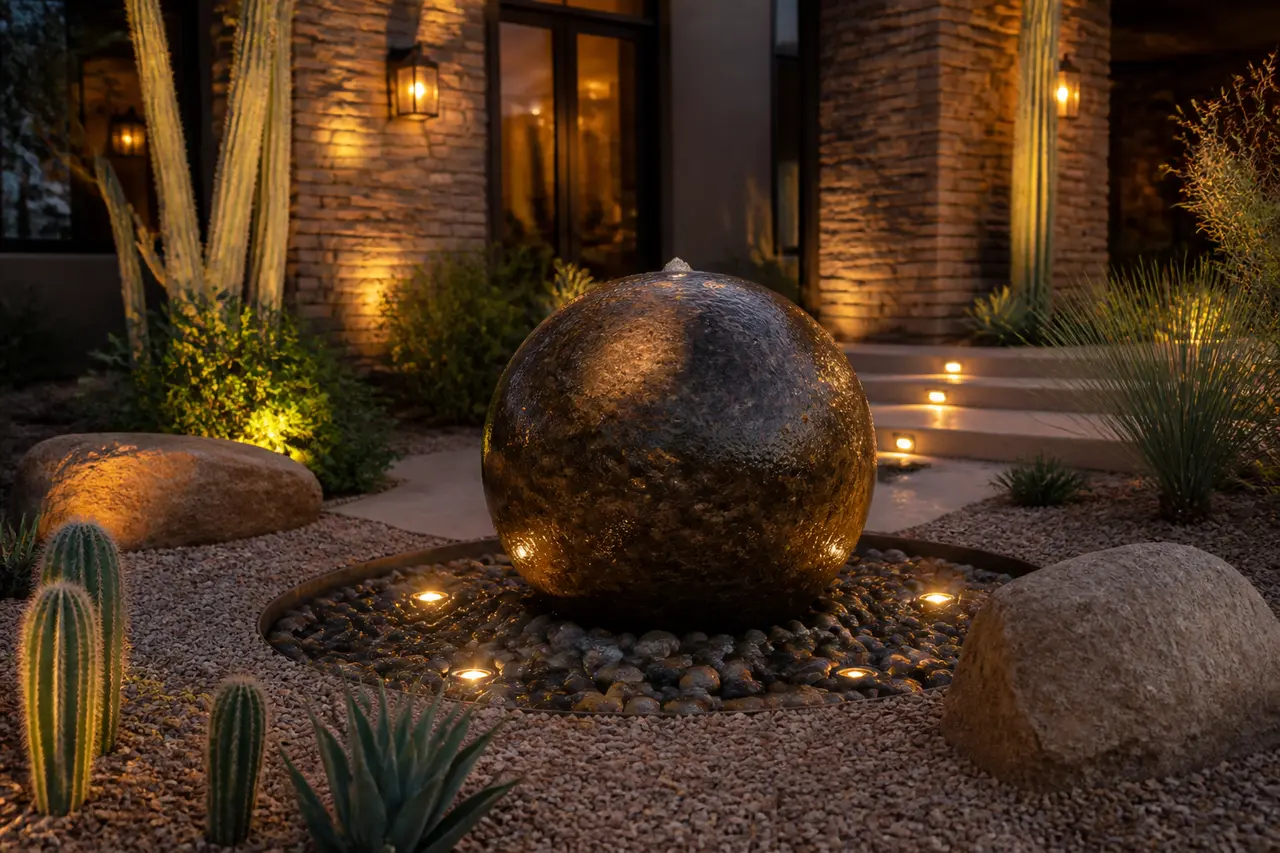
A standalone carved sphere or pillar with water running over a granite, basalt or travertine surface and returning to a concealed below-grade reservoir. Reservoir sizing, support, plumbing and service access are set in the approved design; a concealed reservoir reduces exposed open water but does not remove the need for routine maintenance or supervision.
Key features
- · Carved granite, travertine, or basalt sphere or pillar
- · Concealed below-grade reservoir sized in the approved design
- · Submersible lighting selected for its intended location
- · Grate and surround detailed for cleaning and pump service
- · A concealed basin can reduce exposed standing-water conditions, but it does not eliminate mosquito risk — routine maintenance and design decisions in the approved plan control that.
- · Auto-fill option
Equipment & systems
- · Small feature pump selected for the approved design
- · Submersible lighting selected for its intended location
- · Float-controlled auto-fill
- · Reservoir grate with debris filtration
How this water feature is planned
A carved stone element sits over a concealed reservoir, with water welling up and running down the stone before returning below grade — the easiest concept to place in a non-pool yard.
Object-first. The stone is a sculpture whether the water is running or not, which makes it a strong entry or courtyard focal point.
Soft and close-range. It works at an entry or a small courtyard rather than as sound across a large yard.
Often within reach of guests and children, so the surround, grate detail, edges and footing are reviewed in the approved design. Concealing the reservoir reduces exposed open water, but it does not remove the need for maintenance or supervision.
Small reservoirs need frequent top-off and periodic cleaning. Mineral film on stone is the most visible upkeep item.
Zones this concept reserves
- AStone element
The carved sphere, pillar or vessel that the water runs over
- BConcealed reservoir
Below-grade water storage and pump location, sized in the approved design
- CGrate and surround
The walkable surface over the reservoir and the visible stone or gravel around it
- DFill and service access
Top-off, cleaning and pump service without dismantling the surround
Finish and material zones
- Stone material and finish
- Granite, basalt or travertine read very differently wet, and show mineral film differently.
- Grate and reservoir cover
- The visible cover over the reservoir; it has to look intentional and still open for service.
- Surround material
- Rock, pebble or paving around the base that catches splash and carries the composition.
- Lighting treatment
- Whether the stone is lit at night and how those fixtures are reached.
Lock these before fabrication and ordering
- Stone form — sphere, pillar or vessel — and its concept envelope as a planning range
- Stone type and finish, and how it looks wet
- Placement on the entry axis or as a garden focal point
- Grate and surround materials
- Lighting approach at night
- Fill, cleaning and pump service access before the surround is set
Verified before anything is built
- Reservoir sizing, support and below-grade detailing set by the approved design
- Selected equipment documents, installation instructions and listings for every pump, light, valve and control — obtained before fabrication or ordering
- Stone handling, setting and support for the selected element
- Water supply, drainage path, electrical circuits and bonding where applicable — confirmed by the qualified trades in the signed scope
- Field-measured dimensions, finished elevations and grades, and reachable service access — confirmed on site
- AHJ, HOA and manufacturer requirements for this address and this scope — confirmed in writing before construction
Living with it — care and seasonal notes
- A concealed reservoir holds a limited amount of water — expect regular top-off, especially in summer.
- Mineral film builds on stone that is constantly wet; cleaning frequency depends on your water.
- The reservoir needs periodic cleaning and debris removal; the cover has to open easily for that.
Planning this feature in Arizona
- High summer evaporation on a small reservoir can require frequent top-off.
- Hard water marks polished stone quickly; the finish you pick determines how visible that is.
- Blown dust and debris settle into the surround and the reservoir, so cleaning access matters more than concealment.
This planning board is a concept-stage tool. It is not permit, engineering, hydraulic, waterproofing, electrical, fuel or gas, manufacturer-installation, animal-habitat, code-approval, safety-inspection, or construction documentation. Field measurements, selected manufacturer documents and listings, qualified trades and required engineering, AHJ and HOA review, approved documents, and the signed scope control the final build. No feature replaces active adult supervision around water.