
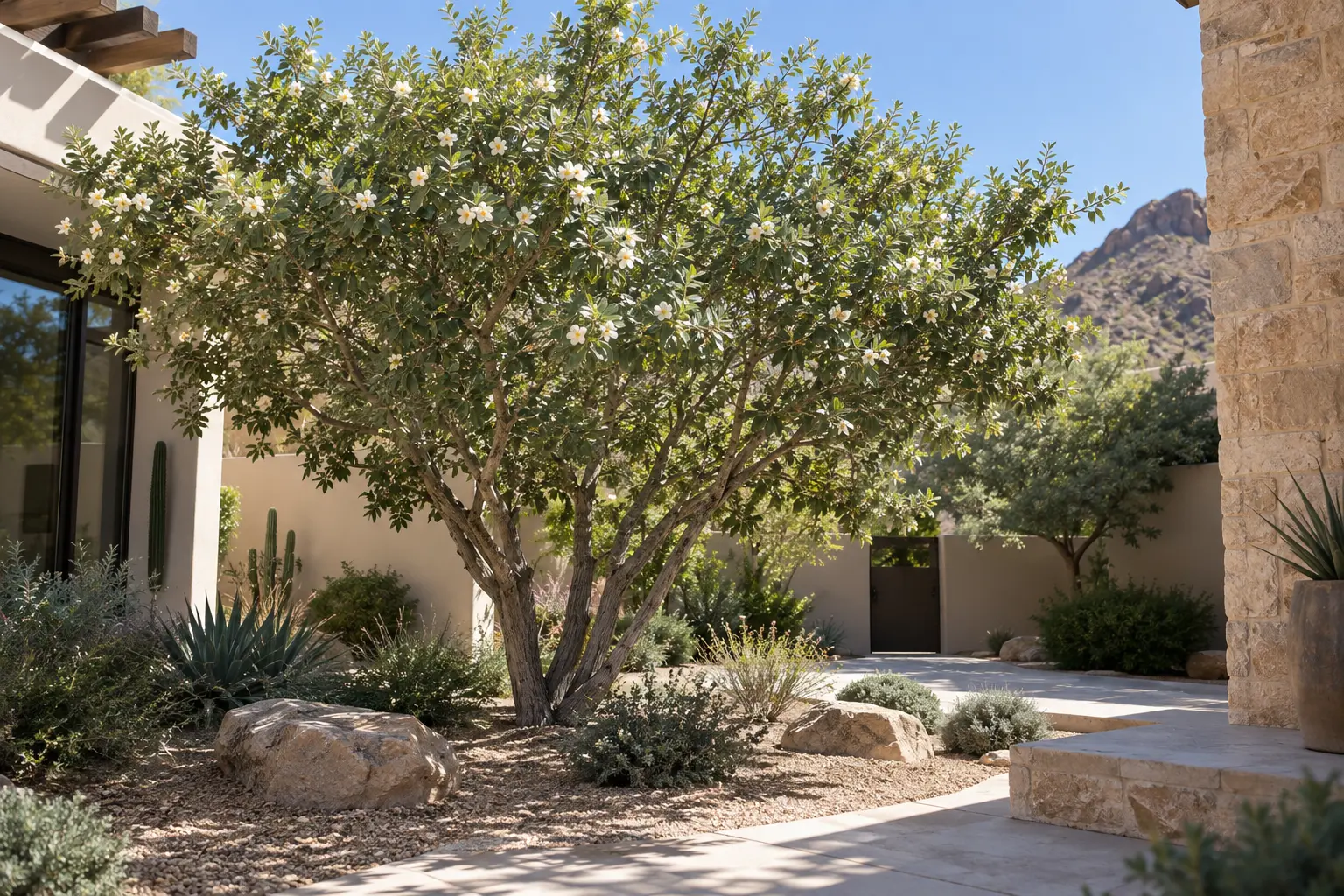
Texas Olive
Cordia boissieri
Texas Olive is a dense large shrub or small multi-trunk tree with recurring white flowers. Moderate water, cold response and flower, fruit and leaf cleanup belong in the plan.
Not sure if this plant belongs near your pool, wall, pavers, or foundation?
AE reviews microclimate, root intrusion risk, and soil compatibility.
Schedule: Deep, infrequent — typically every 10–21 days mature, more often in summer establishment.
Emitters: Multiple large emitters or bubblers placed out at the drip line, not at the trunk.
Encourages deep roots and long-term tree stability. AE designs irrigation to expand as the tree matures.
Arizona yards have very different microclimates. West-facing walls, glass, artificial turf, pavers, travertine, porcelain, and pool decking all increase reflected heat. AE considers these before confirming placement.
- Mind clearance from pool deck
- Mind clearance from walls
AE verifies pool deck, paver, foundation, wall, and utility clearances before final planting.
Quick Facts
- Plant type
- Tree
- Mature size
- Generally 10–15 ft tall and wide; training, cold and site conditions affect form
- Growth rate
- Slow to moderate
- Sun
- Full sun
- Water use
- Moderate
- Bloom season
- Recurring from spring into fall when conditions support it
- Flower color
- White funnels with yellow throats
- Foliage
- Gray-green to olive-green
- Evergreen / Deciduous
- Semi-evergreen
- Thorns / spines
- None
- Litter level
- Medium
- Pool area
- Use with care
- Pet/kid placement
- Use with care
- Maintenance
- Moderate
- Privacy value
- Medium
- Shade value
- Medium
- Native
- Desert-adapted
About Texas Olive
Cordia boissieri is native to southern Texas and northeastern Mexico, not Arizona. It naturally develops as a dense large shrub or small irregular multi-trunk tree rather than a fixed 10-by-10 box. Plan about 10–15 ft tall and wide, allowing training, water, cold and site to influence the final form. It is evergreen to semi-evergreen depending on cold and water, with slow-to-moderate growth. White funnel-shaped flowers with yellow throats can recur from spring into fall and can support visiting pollinators when present. Flowers, fruit and leaves produce moderate litter—not a clean or litter-free edge. This guide does not establish the fruit as edible or safe for people or pets.
Best uses: A large flowering shrub or small multi-trunk patio tree in an open bed with room for its irregular 10–15 ft spread
AE Designer Opinion
Design Uses
- Flowering multi-trunk courtyard accent
- Large informal shrub in an open desert bed
- Pollinator-supporting focal plant away from circulation pinch points
Care & Maintenance
- Plant in full sun and well-drained soil.
- Deeply irrigate during establishment, then use moderate, widely distributed root-zone irrigation with dry-down.
- Avoid daily shallow trunk watering and high-water lawn scheduling.
- Select durable stems and scaffolds gradually while preserving foliage and natural irregular character.
- Avoid topping, lion-tailing and repeated geometric shearing; collect flower, fruit and leaf litter as needed.
Common Homeowner Mistakes
- Treating the natural form as a fixed 10-by-10 box
- Calling moderate litter low or assuming fruit is edible
- Using daily shallow water or a high-water lawn valve
- Topping, lion-tailing or repeatedly geometric-shearing the canopy
Placement Warnings
⚠ Hardiness near 20°F is cautious planning context, not a survival guarantee; event duration, plant maturity, water status and microclimate affect injury. Pollinator use does not establish freedom from allergen concerns or ingestion safety. Roots, fruit and litter remain site dependent, so this profile does not promise harmless roots, safe fruit or zero mess.
- Allow the full 10–15 ft spread away from tight gates, narrow walks, walls and windows.
- Keep recurring flower, fruit and leaf drop away from pool circulation and pale paving when cleanup is unacceptable.
- Preserve root-zone soil and pruning access outside utility and foundation conflicts.
- Avoid trapping the mature plant between walls or repeatedly cutting it back to maintain an undersized space.
AE reviews final placement based on sun, irrigation, drainage, mature size, and overall design.
Pairs Well With
- Red Yucca
- Desert Spoon
- Damianita
- Trailing Rosemary
More Arizona Plants Like This


Ready to Build Your AE Plant Wishlist?
Add Texas Olive and your other favorites to your wishlist, then send it to the AE design team for the final plant palette.