

Foothills Palo Verde
Parkinsonia microphylla
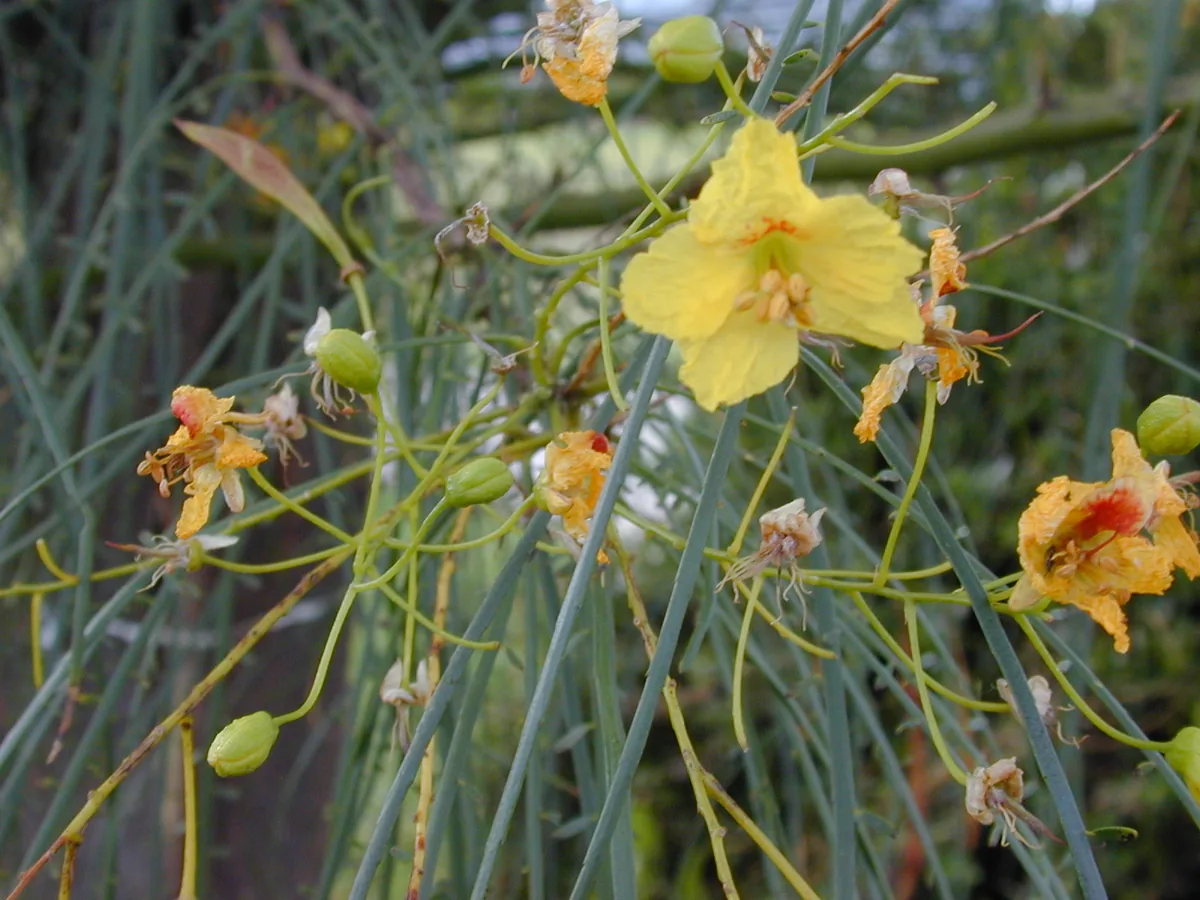
The desert's own palo verde: lime-green bark, feather-fine leaves, and a sulfur-yellow spring bloom on a tough 15-by-15-foot frame that asks almost nothing from your irrigation system.
Stan Shebs / Wikimedia Commons / CC BY-SA 3.0 — license
Not sure if this plant belongs near your pool, wall, pavers, or foundation?
AE reviews microclimate, root intrusion risk, and soil compatibility.
Schedule: Deep, infrequent — typically every 10–21 days mature, more often in summer establishment.
Emitters: Multiple large emitters or bubblers placed out at the drip line, not at the trunk.
Encourages deep roots and long-term tree stability. AE designs irrigation to expand as the tree matures.
Arizona yards have very different microclimates. West-facing walls, glass, artificial turf, pavers, travertine, porcelain, and pool decking all increase reflected heat. AE considers these before confirming placement.
- Mind clearance from pool deck
- Mind clearance from walls
AE verifies pool deck, paver, foundation, wall, and utility clearances before final planting.
Quick Facts
- Plant type
- Tree
- Mature size
- 15 ft tall, 15 ft wide
- Growth rate
- Slow to moderate
- Sun
- Full sun
- Water use
- Very low
- Bloom season
- Spring
- Flower color
- Sulfur yellow
- Foliage
- Lime green
- Evergreen / Deciduous
- Semi-evergreen
- Thorns / spines
- Mild
- Litter level
- Medium
- Pool area
- Use with care
- Maintenance
- Low
- Privacy value
- Medium
- Shade value
- Medium
- Native
- Sonoran native
About Foothills Palo Verde
Foothills Palo Verde is the tree you see holding the hillsides above Phoenix, and it brings that authentic Sonoran look into a designed yard better than almost anything else. It grows slowly and stays modest — roughly 15 feet tall and 15 feet wide at maturity — with a branchy, shrub-like structure that reads as sculpture rather than canopy. Water use is very low once it is established, and AMWUA rates it hardy to about 15°F, so West Valley winters are a non-issue. The spring flush of sulfur-yellow flowers is short, bright, and full of bees, birds, butterflies and hummingbirds. The tradeoffs are real and worth planning around: the branch tips are sharp, the tree drops flowers, small leaves and pods on a seasonal cycle, and its shade is filtered rather than deep. Plan for the full 15-foot spread on day one — this is a slow tree, and crowding it early is the mistake that shows up ten years later.
Best uses: Native Sonoran character in low-water front yards, decomposed-granite and boulder landscapes, small courtyard or accent tree, filtered shade over seating set back from the canopy
AE Designer Opinion
Design Uses
- Native Sonoran front yards and desert-modern entries
- Boulder and decomposed-granite planting beds
- Driveway corners and street-side accent planting
- Courtyard anchor where green bark shows against stucco or block
- Filtered shade over a gravel seating pocket set back from the trunk
- Pollinator-focused planting with spring color
- Low-water conversions replacing turf
Care & Maintenance
- Water deeply and infrequently; taper toward very low irrigation once established
- Deep-soak weekly through the first summer, then stretch intervals each season
- Prune for structure while young — light, intentional cuts, never shearing
- Do winter or early-spring pruning; avoid removing large amounts of canopy in peak heat
- Rake or blow seasonal flower and pod drop from pool decks, turf and hardscape
- Keep emitters out at the drip line rather than against the trunk
Common Homeowner Mistakes
- Planting it three feet from a walkway because the nursery specimen is still small
- Expecting fast shade from a slow, open-canopy desert tree
- Over-irrigating it on a lawn or shrub valve, which pushes weak, floppy growth
- Shearing the canopy instead of making thoughtful structural cuts when young
- Setting it at the pool edge where flower and pod drop becomes a weekly cleanup
Placement Warnings
⚠ Branch tips are sharp. Expect seasonal flower, leaf and pod litter. Mature spread reaches about 15 feet, so it is not a tight-space tree.
- Sharp branch tips — set back from walkways, patio edges, and any route people brush past
- Plan for a 15-foot mature spread before planting; it will not stay small forever
- Seasonal flower, leaf and pod litter lands on whatever sits beneath it
- Keep it away from pool coping and skimmers — debris in the water is an ongoing chore
- Not a good choice directly over play areas or kids' circulation paths
- Filtered shade only; do not place it expecting deep midday cover
AE reviews final placement based on sun, irrigation, drainage, mature size, and overall design.
Pairs Well With
- Brittlebush
- Baja Fairy Duster
- Damianita
- Totem Pole Cactus
More Arizona Plants Like This


Ready to Build Your AE Plant Wishlist?
Add Foothills Palo Verde and your other favorites to your wishlist, then send it to the AE design team for the final plant palette.