

Blue Palo Verde
Parkinsonia florida
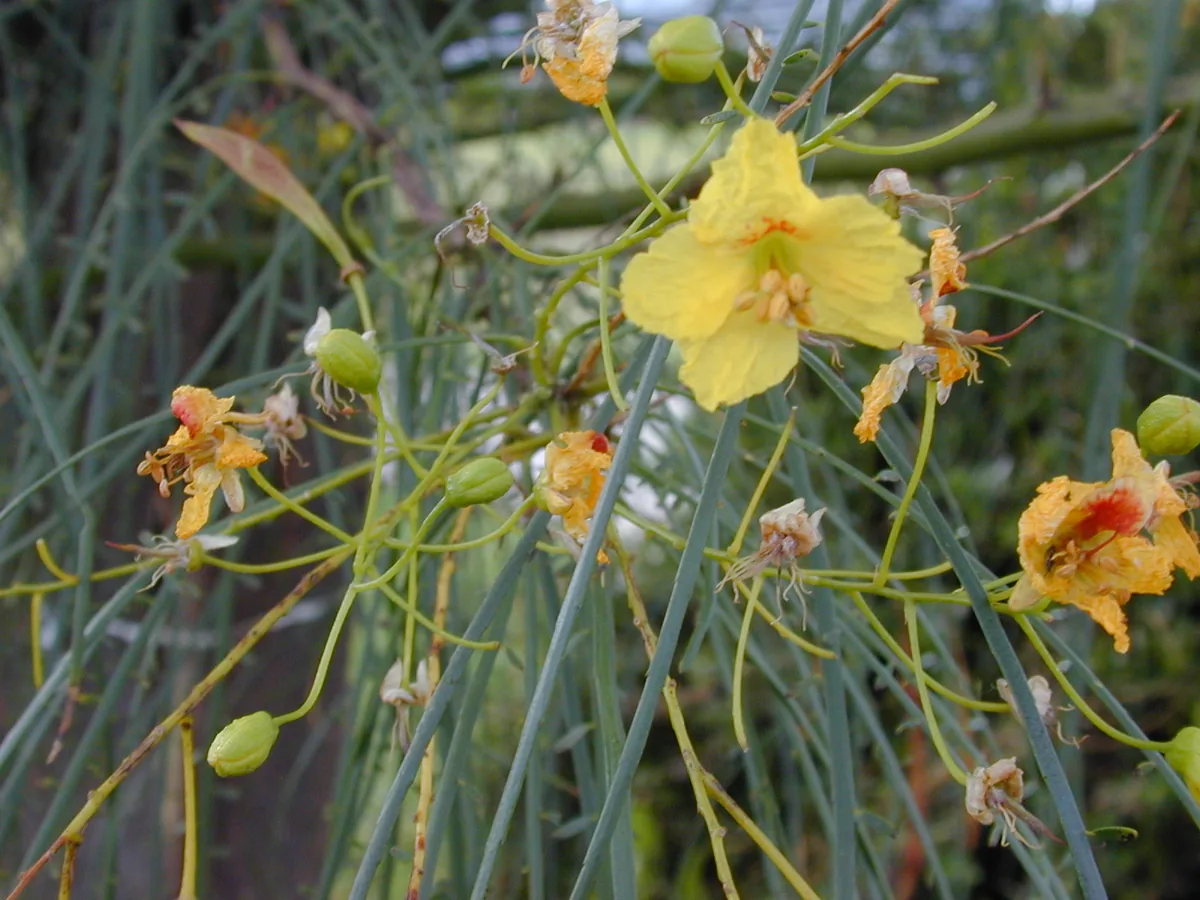
The defining Arizona native palo verde: smooth blue-green bark, a vase-shaped 30-foot canopy, and a spring bloom so heavy the whole tree turns bright yellow.
Stan Shebs / Wikimedia Commons / CC BY-SA 3.0 — license
Not sure if this plant belongs near your pool, wall, pavers, or foundation?
AE reviews microclimate, root intrusion risk, and soil compatibility.
Schedule: Deep, infrequent — typically every 10–21 days mature, more often in summer establishment.
Emitters: Multiple large emitters or bubblers placed out at the drip line, not at the trunk.
Encourages deep roots and long-term tree stability. AE designs irrigation to expand as the tree matures.
Arizona yards have very different microclimates. West-facing walls, glass, artificial turf, pavers, travertine, porcelain, and pool decking all increase reflected heat. AE considers these before confirming placement.
- Mind clearance from pool deck
- Mind clearance from walls
AE verifies pool deck, paver, foundation, wall, and utility clearances before final planting.
Quick Facts
- Plant type
- Tree
- Mature size
- 30 ft tall, 30 ft wide
- Growth rate
- Fast
- Sun
- Full sun
- Water use
- Very low
- Bloom season
- Spring
- Flower color
- Bright yellow
- Foliage
- Blue-green
- Evergreen / Deciduous
- Semi-evergreen
- Thorns / spines
- Mild
- Litter level
- Medium
- Pool area
- Avoid nearby
- Maintenance
- Seasonal pruning
- Privacy value
- Medium
- Shade value
- High
- Native
- Sonoran native
About Blue Palo Verde
Blue Palo Verde is the palo verde most people picture when they picture Arizona — a broad, vase-shaped native that grows along desert washes and shows up across the Valley in landscapes that have room for it. It is fast for a desert tree, reaching roughly 30 feet tall and 30 feet wide, and AMWUA rates it hardy to about 15°F on very low water once it is established. The blue-green bark photosynthesizes, which is why the tree looks alive even when it drops leaves in drought or cold; the foliage is fine and blue-green, and the habit reads as semi-evergreen rather than fully bare. Spring brings a short, spectacular flush of bright-yellow flowers that pulls in bees, birds, butterflies, hummingbirds and moths. Two things are non-negotiable when you plant one. First, the space: 30 feet of eventual spread is a lot of yard, and this tree does not forgive being tucked beside a wall or a driveway. Second, the cleanup: the spring flower drop is heavy, seed pods follow, and small thorns sit along the branches. The pollen is also on the allergenic side, which matters for some households. Plan for those honestly and you get a fast-growing, near-zero-water tree with more desert character than anything else in the palette.
Best uses: Fast filtered shade and iconic Sonoran character on properties with room for a 30-foot canopy — front yards, washes, boulder beds and open desert-modern backyards
AE Designer Opinion
Design Uses
- Fast filtered shade in open front yards and desert-modern entries
- Native wash and dry-riverbed planting with boulders and decomposed granite
- Wide backyard corners set well away from the pool deck
- Street-side and driveway-scale canopy on larger lots
- Pollinator-focused native planting with a strong spring show
- Turf conversions where a large, very-low-water canopy replaces irrigated lawn
Care & Maintenance
- Deep-soak infrequently and taper to very low irrigation once established
- Water at the drip line, not against the trunk, and widen the emitter ring as it grows
- Prune for structure in the first three to five years; thin, never top or shear
- Avoid removing large amounts of canopy in peak summer heat
- Rake or blow spring flower drop and later pod drop off hardscape, turf and pool decks
- Check limb attachments before monsoon season and reduce over-extended branches
Common Homeowner Mistakes
- Treating it as a patio tree and planting it 8 feet from the house or wall
- Placing it upwind of the pool and then fighting flower and pod litter every spring
- Skipping early structural pruning, which produces weak, over-long limbs that break in monsoon wind
- Running it on a lawn or high-frequency shrub valve, which forces soft growth and poor anchoring
- Shearing or topping the canopy instead of thinning to strong lateral branches
- Assuming semi-evergreen means it never drops — it sheds leaves under drought and cold stress
Placement Warnings
⚠ Plan for a 30-foot mature spread. Spring flower and pod drop is heavy and seasonal, small thorns sit along the branches, and the pollen is considered allergenic.
- Needs roughly 30 feet of clear spread — not a courtyard, side-yard or narrow-strip tree
- Keep well back from pool coping, skimmers and water features; spring drop is heavy
- Small thorns along the branches — set back from walkways, gates and patio edges
- Allergenic spring pollen matters for sensitive households; place it away from windows and main seating
- Fast growth on a wide canopy means structural pruning early, not a one-time trim
- Do not plant it directly over turf, artificial turf seams or a covered patio you want to stay clean
AE reviews final placement based on sun, irrigation, drainage, mature size, and overall design.
Pairs Well With
- Brittlebush
- Creosote Bush
- Ocotillo
- Damianita
More Arizona Plants Like This


Ready to Build Your AE Plant Wishlist?
Add Blue Palo Verde and your other favorites to your wishlist, then send it to the AE design team for the final plant palette.