

Texas Ebony
Ebenopsis ebano
A dense, dark-green evergreen tree that holds its screening all winter — slow to arrive, thorny up close, and one of the few trees that truly blocks a two-story view on very low water.
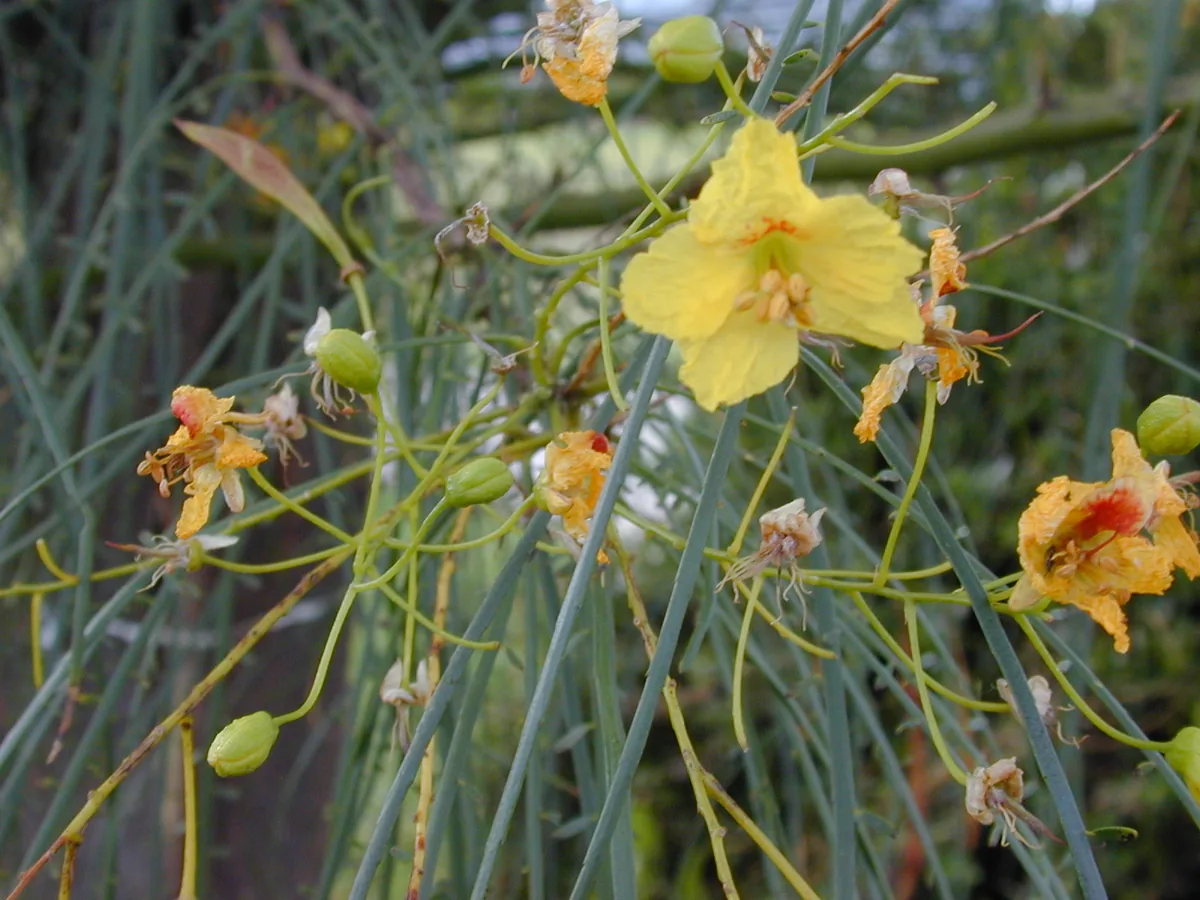
MartínezFlores / Wikimedia Commons / CC BY-SA 4.0 — license
Not sure if this plant belongs near your pool, wall, pavers, or foundation?
AE reviews microclimate, root intrusion risk, and soil compatibility.
Schedule: Deep, infrequent — typically every 10–21 days mature, more often in summer establishment.
Emitters: Multiple large emitters or bubblers placed out at the drip line, not at the trunk.
Encourages deep roots and long-term tree stability. AE designs irrigation to expand as the tree matures.
Arizona yards have very different microclimates. West-facing walls, glass, artificial turf, pavers, travertine, porcelain, and pool decking all increase reflected heat. AE considers these before confirming placement.
- Mind clearance from pool deck
- Mind clearance from walls
AE verifies pool deck, paver, foundation, wall, and utility clearances before final planting.
Quick Facts
- Plant type
- Tree
- Mature size
- 20 ft tall, 15 ft wide
- Growth rate
- Slow
- Sun
- Full sun
- Water use
- Very low
- Bloom season
- Late spring to early summer
- Flower color
- Cream to yellow
- Foliage
- Dark green
- Evergreen / Deciduous
- Evergreen
- Thorns / spines
- Sharp
- Litter level
- Medium
- Pool area
- Use with care
- Maintenance
- Low
- Privacy value
- High
- Shade value
- High
- Native
- Desert-adapted
About Texas Ebony
Texas Ebony earns its place in Valley backyards for one reason above all: it is genuinely evergreen and genuinely dense, so the privacy you buy in July is still there in January. AMWUA lists it as native to southern Texas and Mexico, hardy to about 20°F, and very low water once established, with a slow growth rate and a mature size around 20 feet tall by 15 feet wide. The form is irregular and sculptural rather than symmetrical, the foliage is small, dark green and medium-textured, and cream-to-yellow flowers appear in late spring into early summer, followed by thick woody pods. Two tradeoffs deserve a straight answer. The thorns are real and stiff — this is not a tree to brush past on a three-foot side yard path. And the growth is slow, so if you need screening this year, buy a larger box size and accept the cost rather than expecting speed. AMWUA also flags something many homeowners learn the hard way: the bark can sunburn if the tree is overpruned. Keeping the canopy dense is not just an aesthetic preference here, it is protection for the trunk and inner limbs.
Best uses: Year-round evergreen screening from two-story neighbors, dense shade over a patio set back from the canopy, and a dark-green anchor in low-water backyards
AE Designer Opinion
Design Uses
- Evergreen privacy screening against two-story neighbors
- Dense shade anchor in a low-water backyard
- Property-line and rear-yard massing where mature spread is available
- Dark-green backdrop for lighter desert foliage and stucco walls
- Courtyard or entry statement tree on larger lots, set back from circulation
- Wind and sight-line buffer along an open rear fence
Care & Maintenance
- Deep-soak infrequently; taper to very low irrigation once the tree is established
- Prune lightly and only as needed for clearance — keep the canopy dense
- Avoid hard interior thinning, which exposes bark to sunburn
- Do structural work in cooler months rather than peak summer
- Clean up pods and flower drop from hardscape, pool decks and turf
- Keep emitters at the drip line and expand the ring as the canopy widens
Common Homeowner Mistakes
- Planting a small container and expecting a privacy screen within a season or two
- Squeezing it into a three-foot side yard where the thorns catch everyone who walks past
- Hard-thinning the canopy for a lacy look, which exposes the bark to sunburn
- Over-irrigating an established tree on a shrub or turf valve instead of deep, infrequent soaks
- Ignoring the pod drop when it is planted at the pool edge
- Pruning heavily in peak summer heat instead of making light cuts in cooler months
Placement Warnings
⚠ Stiff thorns along the branches make placement critical. Growth is slow, so screening takes time, and AMWUA warns that the bark can sunburn if the tree is overpruned — keep the canopy dense and pruning restrained.
- Stiff thorns — keep it off walkways, gate swings, side-yard paths and play areas
- Set back from pool coping; pods and pruning debris are a nuisance in the water
- Slow growth means screening arrives over years, not seasons — size the container accordingly
- Do not overprune or hard-thin the interior; exposed bark can sunburn in Valley sun
- Plan for a 15-foot spread and a broad, irregular form rather than a narrow column
- Keep it clear of pool equipment, AC units and tight utility easements
AE reviews final placement based on sun, irrigation, drainage, mature size, and overall design.
Pairs Well With
- Texas Sage
- Green Hopseed Bush
- Red Yucca
- Damianita
More Arizona Plants Like This


Ready to Build Your AE Plant Wishlist?
Add Texas Ebony and your other favorites to your wishlist, then send it to the AE design team for the final plant palette.