
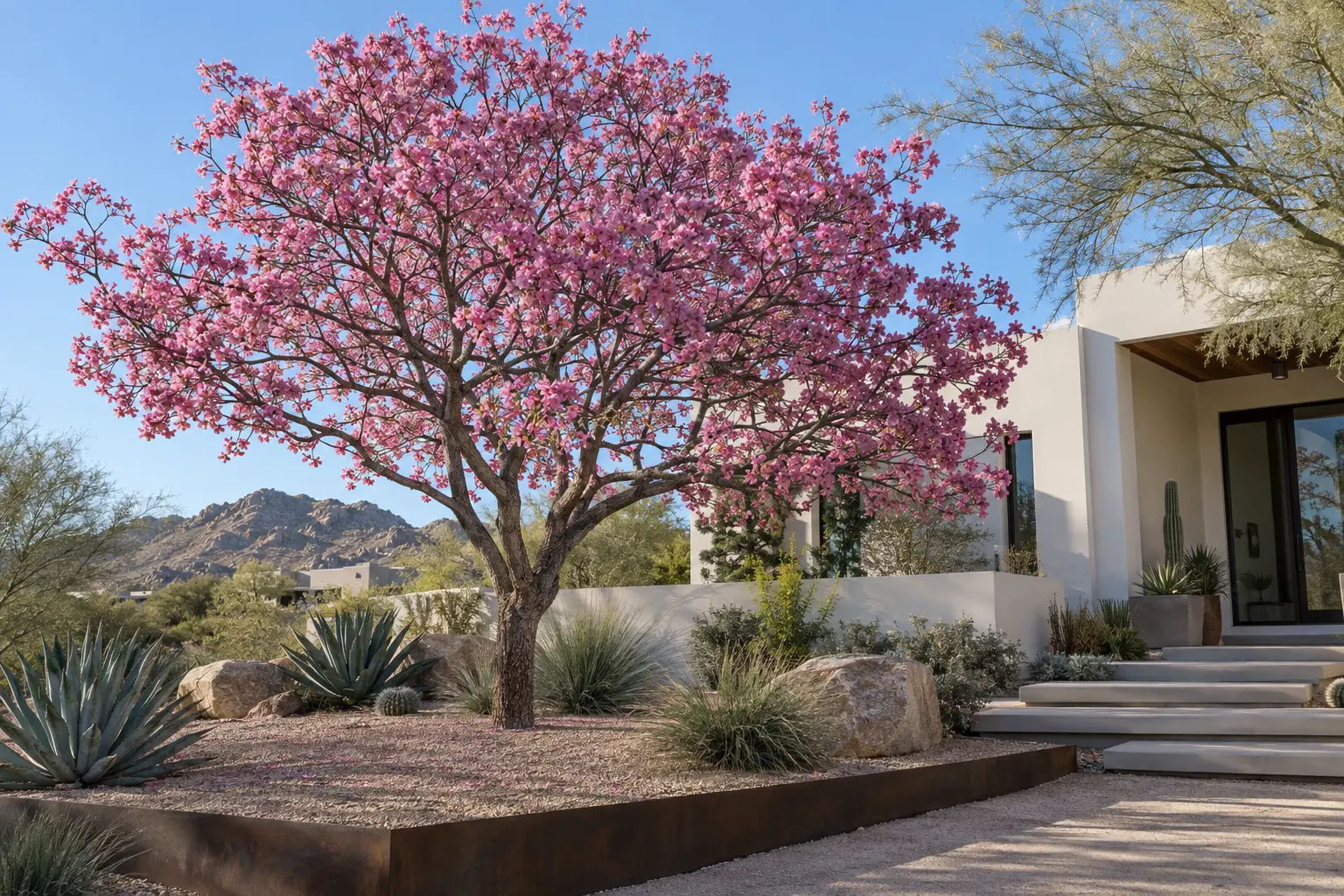
Pink Trumpet Tree / Pink Ipê
Handroanthus impetiginosus
Pink Ipê can deliver a remarkable bare-branch spring flower display, but identity, frost exposure, mature spread and real flower, capsule and leaf cleanup must drive placement.
Not sure if this plant belongs near your pool, wall, pavers, or foundation?
AE reviews microclimate, root intrusion risk, and soil compatibility.
Schedule: Deep, infrequent — typically every 10–21 days mature, more often in summer establishment.
Emitters: Multiple large emitters or bubblers placed out at the drip line, not at the trunk.
Encourages deep roots and long-term tree stability. AE designs irrigation to expand as the tree matures.
Arizona yards have very different microclimates. West-facing walls, glass, artificial turf, pavers, travertine, porcelain, and pool decking all increase reflected heat. AE considers these before confirming placement.
- Mind clearance from pool deck
- Mind clearance from walls
AE verifies pool deck, paver, foundation, wall, and utility clearances before final planting.
Quick Facts
- Plant type
- Tree
- Mature size
- Generally 20–35 ft tall and 15–30 ft wide in managed Phoenix landscapes; identity and site can produce larger trees
- Growth rate
- Moderate; varies with identity, climate and irrigation
- Sun
- Full sun
- Water use
- Low
- Bloom season
- Usually spring, before or with leaf flush; timing and duration vary
- Flower color
- Pink to magenta trumpets
- Foliage
- Green palmately compound foliage
- Evergreen / Deciduous
- Semi-deciduous
- Thorns / spines
- None
- Litter level
- High
- Pool area
- Avoid nearby
- Pet/kid placement
- Use with care
- Maintenance
- Seasonal pruning
- Privacy value
- Medium
- Shade value
- Medium
- Native
- Desert-adapted
About Pink Trumpet Tree / Pink Ipê
Handroanthus impetiginosus, familiar in older references as Tabebuia impetiginosa, is accepted by Kew and is native from Central Mexico through tropical South America—not Arizona. The nursery name “pink trumpet tree” is also applied to other Handroanthus or Tabebuia taxa, including H. heptaphyllus in some horticultural references, so verify the botanical identity, cultivar and provenance instead of transferring dimensions or cold claims between taxa. For design, use roughly 20–35 ft tall and 15–30 ft wide in managed Phoenix landscapes, while recognizing that identity, climate, irrigation and site can produce materially larger trees in favorable conditions. It is deciduous to semi-deciduous by climate. Pink-to-magenta trumpets commonly open on a mostly bare canopy before or with spring leaf flush; winter temperature and plant identity influence timing, intensity and a display that may be brief. Spent flowers, long dry capsules and seasonal leaves create genuine litter.
Best uses: A flowering front-yard or open-courtyard focal tree with room for a 15–30 ft canopy and seasonal cleanup
AE Designer Opinion
Design Uses
- Flowering front-yard focal tree
- Open courtyard specimen with generous soil volume
- Seasonal color away from pools and pale paving
Care & Maintenance
- Plant in full sun and well-drained soil; protect young trees from severe reflected heat when establishment conditions warrant.
- Establish with broad, deep root-zone irrigation, then water deeply and infrequently with dry-down; drought tolerance after establishment does not mean no water.
- Expand the irrigation footprint as the canopy grows and avoid daily shallow trunk watering.
- Develop one durable leader or well-spaced scaffolds early and retain balanced canopy weight.
- Do not top, lion-tail or use aggressive bloom-season pruning; collect flowers, leaves and capsules where they create conflicts.
Common Homeowner Mistakes
- Buying by the common name without verifying Handroanthus impetiginosus
- Using H. heptaphyllus dimensions as exact data for this taxon
- Watering shallowly at the trunk every day
- Topping, lion-tailing or pruning aggressively around bloom season
Placement Warnings
⚠ Young trees and exposed cold pockets can be damaged by frost; exact tolerance depends on taxon, provenance, maturity, event duration and microclimate, so this guide does not assign a universal minimum temperature. Root behavior and litter are site dependent, not a promise of harmless roots or a clean pool edge. Bark, teas, extracts, flowers, seeds and pods are not presented here for medicinal use or ingestion; this ornamental profile is not medical or edibility advice.
- Keep the mature canopy and root zone clear of pool coping, pale paving, walls, foundations and tight entries.
- Keep roofs, utilities and narrow side yards outside the expected canopy and preserve pruning and cleanup access.
- Place falling flowers, capsules and leaves where staining, slipping or pool-skimmer load can be managed.
- Provide broad irrigated soil rather than trapping the trunk in a small hardscape opening.
AE reviews final placement based on sun, irrigation, drainage, mature size, and overall design.
Pairs Well With
- Texas Sage
- Red Yucca
- Desert Spoon
- Blackfoot Daisy
More Arizona Plants Like This


Ready to Build Your AE Plant Wishlist?
Add Pink Trumpet Tree / Pink Ipê and your other favorites to your wishlist, then send it to the AE design team for the final plant palette.