
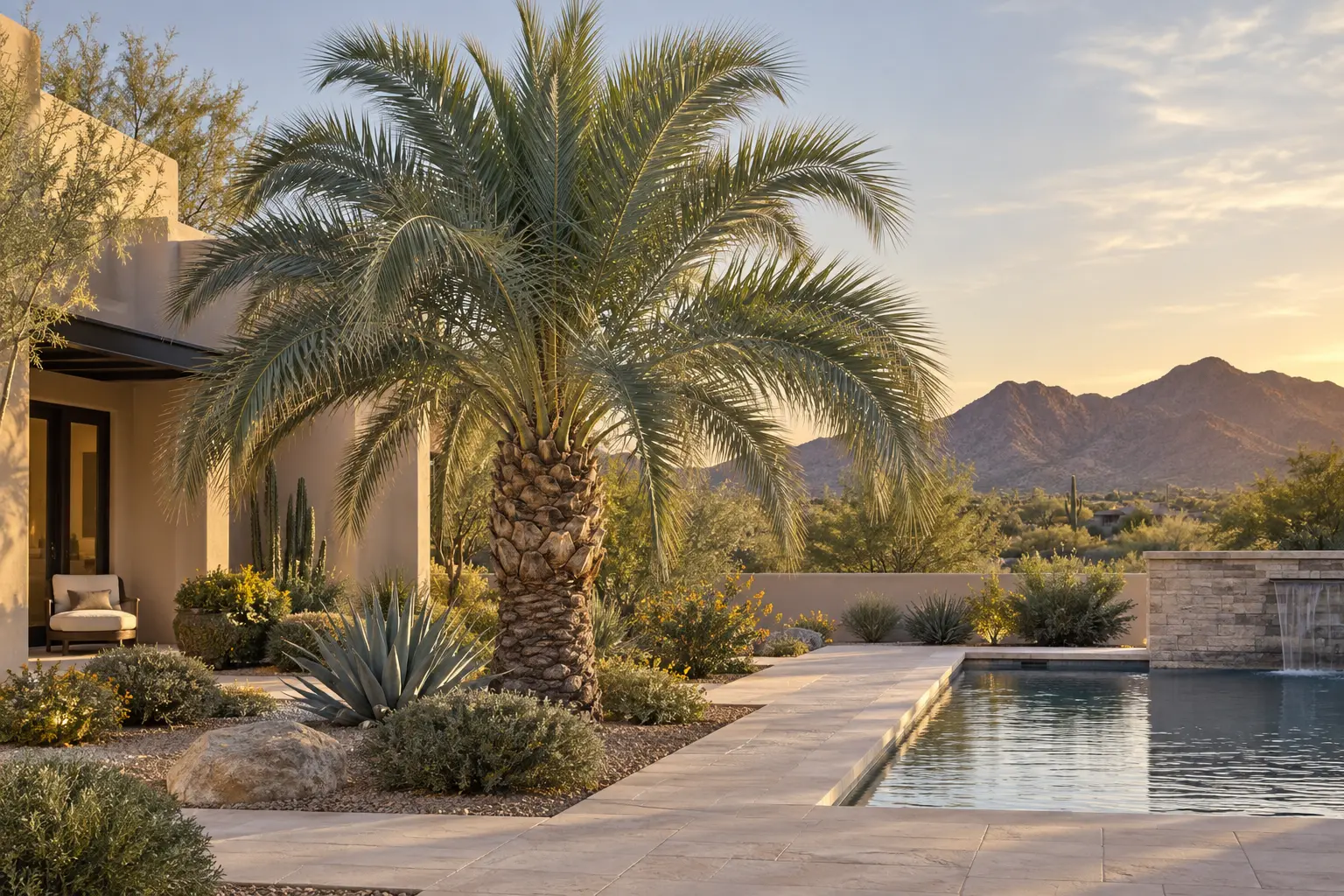
Pindo Palm / Jelly Palm
Butia odorata
Pindo Palm is a compact, cold-tolerant feather palm with blue-green recurving fronds, but thorned petioles and heavy aromatic fruit require deliberate clearance and cleanup.
Not sure if this plant belongs near your pool, wall, pavers, or foundation?
AE reviews microclimate, root intrusion risk, and soil compatibility.
Schedule: Deep, infrequent — typically every 10–21 days mature, more often in summer establishment.
Emitters: Multiple large emitters or bubblers placed out at the drip line, not at the trunk.
Encourages deep roots and long-term tree stability. AE designs irrigation to expand as the tree matures.
Arizona yards have very different microclimates. West-facing walls, glass, artificial turf, pavers, travertine, porcelain, and pool decking all increase reflected heat. AE considers these before confirming placement.
- Mind clearance from pool deck
- Mind clearance from walls
AE verifies pool deck, paver, foundation, wall, and utility clearances before final planting.
Quick Facts
- Plant type
- Tree
- Mature size
- Typically plan for 15–20 ft tall and 10–15 ft wide; old specimens may become larger
- Growth rate
- Slow
- Sun
- Full sun
- Water use
- Low
- Bloom season
- Late spring to summer; fruit follows when conditions allow
- Flower color
- Cream
- Foliage
- Gray-green to blue-green
- Evergreen / Deciduous
- Evergreen
- Thorns / spines
- Sharp
- Litter level
- High
- Pool area
- Avoid nearby
- Pet/kid placement
- Use with care
- Maintenance
- Seasonal pruning
- Privacy value
- Low
- Shade value
- Medium
- Native
- Desert-adapted
About Pindo Palm / Jelly Palm
Butia odorata is the accepted identity for the commonly cultivated pindo or jelly palm native to southern Brazil and Uruguay. Butia capitata remains common as a historical horticultural synonym or misapplied trade name, but it should not replace the accepted identity here. This is a nonnative, adaptable and relatively cold-tolerant palm for Arizona—not a Sonoran native. Its slow-growing single trunk supports a compact crown of strongly arching to recurving gray-green or blue-green pinnate fronds. Plan roughly 15–20 feet tall and 10–15 feet wide in residential design, while allowing that old specimens can become larger. The frond silhouette is the reason to use it; forcing that crown against walks, walls or a pool defeats the composition. Petiole margins have teeth or spines and need real contact clearance. Creamy flower clusters may be followed by heavy crops of aromatic orange-yellow fruit. That fruit has traditional jelly use when correctly identified and handled, but landscape fruit can fall, ferment, become slippery and attract wildlife or insects. In Phoenix, establishment requires regular deep irrigation. Once established it is drought tolerant, but a premium crown still needs low-to-moderate, well-spaced irrigation and drainage rather than neglect.
Best uses: A slow-growing feather-palm accent with room for its recurving crown, thorned petioles, fruit drop and safe maintenance access
AE Designer Opinion
Design Uses
- Blue-green feather-palm focal point in a broad planted island
- Cold-tolerant resort accent away from pool coping and circulation
- Layered subtropical composition with fruit cleanup planned
Care & Maintenance
- Plant in full sun to light shade with drainage, enough root-zone volume and clearance for the recurving crown.
- Provide deep regular establishment water, then low-to-moderate deep irrigation with dry-down according to heat, soil and appearance goals.
- Avoid daily shallow watering, chronically wet soil and unsupported reflected-heat exposure.
- Remove only dead or damaged fronds; do not over-prune healthy green fronds to manufacture an upright crown.
- Where litter control matters, qualified crews may remove flower or fruit stalks at a safe stage without damaging the growing point.
Common Homeowner Mistakes
- Calling the cultivated southern Brazilian and Uruguayan palm Butia capitata without explaining the historical trade-name issue
- Describing sharp petiole margins as mild or the fruiting palm as universally clean
- Daily shallow watering or chronic wet soil instead of deep irrigation with drainage
- Cutting healthy green fronds to force an upright silhouette
- Assuming aromatic landscape fruit carries a blanket food-safety guarantee
Placement Warnings
⚠ Hardiness around 10–15°F is approximate for established plants; age, cold duration, wind and microclimate change the outcome. Sharp petiole margins, crown spread and fallen fruit make blanket pool-, child- or pet-safe claims inappropriate. Edibility depends on correct identification and clean, untreated fruit; this profile does not establish that ornamental-landscape fruit is safe to eat. Fermenting fruit can become slippery and draw insects or wildlife.
- Keep the 10–15 ft crown and sharp petioles clear of walks, gates, play areas and routine maintenance routes.
- Do not place fruiting crowns directly over pool coping, patios, parking or other hardscape where fallen fruit becomes messy or slippery.
- Avoid the hottest unrelieved reflected-heat pocket if adequate root-zone volume and irrigation cannot be provided.
- Preserve safe access for dead-frond and optional flower or fruit-stalk removal.
AE reviews final placement based on sun, irrigation, drainage, mature size, and overall design.
Pairs Well With
- Mediterranean Fan Palm
- Red Yucca
- Deer Grass
- Texas Sage
More Arizona Plants Like This


Ready to Build Your AE Plant Wishlist?
Add Pindo Palm / Jelly Palm and your other favorites to your wishlist, then send it to the AE design team for the final plant palette.