
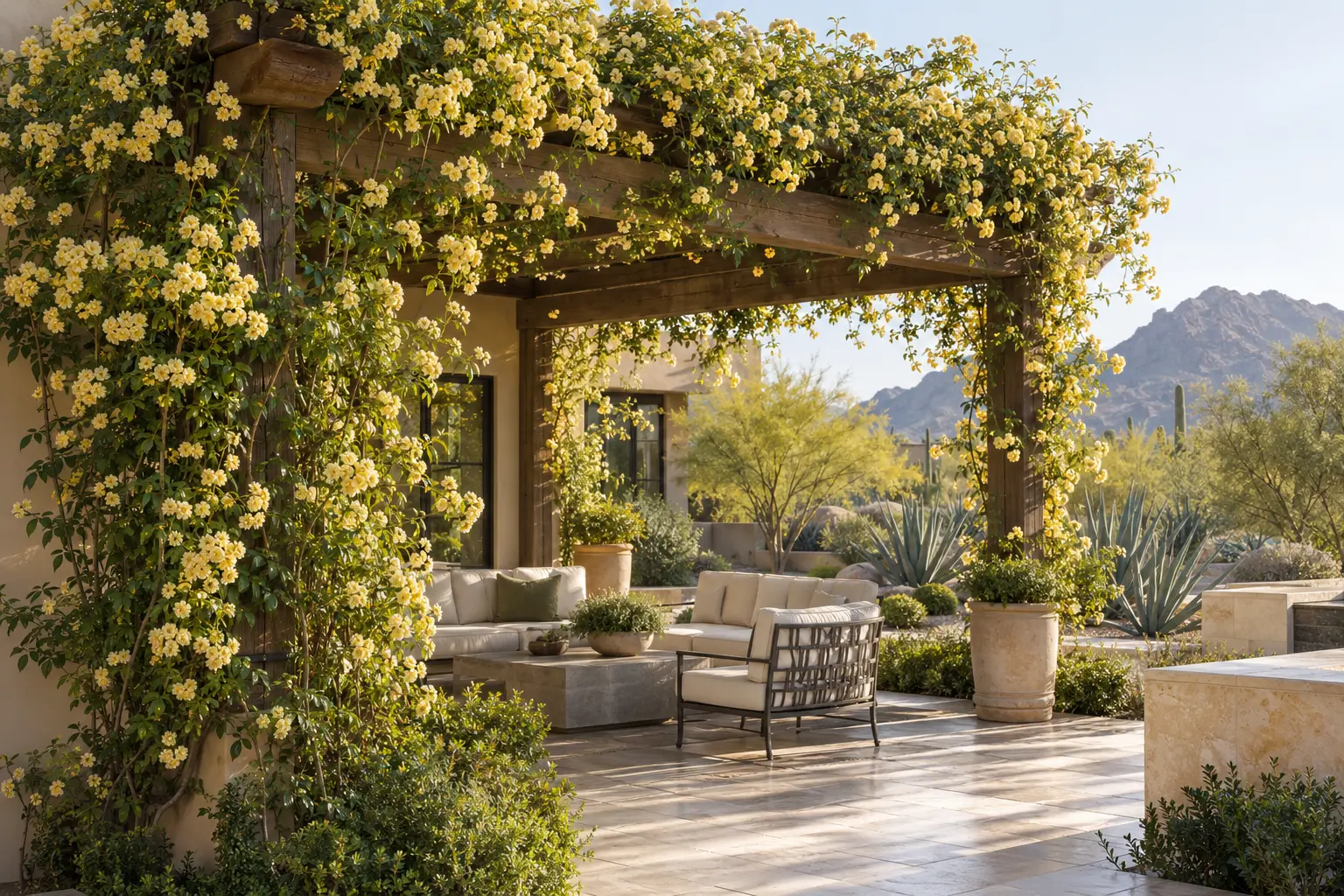
Lady Banks' Rose
Rosa banksiae
Lady Banks' Rose is a vigorous, long-lived scrambling rose that delivers one spectacular spring flush. It is essentially prickleless, and it is also far larger than most homeowners plan for.
Not sure if this plant belongs near your pool, wall, pavers, or foundation?
AE reviews microclimate, root intrusion risk, and soil compatibility.
Schedule: Twice-weekly in summer, weekly in shoulder seasons.
Emitters: 1–2 emitters per plant, monitored during heat waves.
Flowering perennials, citrus, and lush accents need more attention than true desert plants.
Arizona yards have very different microclimates. West-facing walls, glass, artificial turf, pavers, travertine, porcelain, and pool decking all increase reflected heat. AE considers these before confirming placement.
- Verify attachment surface
AE verifies pool deck, paver, foundation, wall, and utility clearances before final planting.
Quick Facts
- Plant type
- Vine
- Mature size
- Commonly 15-20+ ft of reach, approaching 40 ft on a large support, with roughly 6-10+ ft of lateral depth
- Growth rate
- Fast
- Sun
- Full sun
- Water use
- Moderate
- Bloom season
- One spectacular spring flush, usually several weeks; not continuous repeat bloom
- Flower color
- Pale yellow in the familiar double 'Lutea' form; white and other forms exist
- Foliage
- Glossy green
- Evergreen / Deciduous
- Semi-evergreen
- Thorns / spines
- None
- Litter level
- High
- Pool area
- Use with care
- Pet/kid placement
- Use with care
- Maintenance
- Seasonal pruning
- Privacy value
- High
- Shade value
- Medium
- Native
- Desert-adapted
About Lady Banks' Rose
Rosa banksiae is native to China, nonnative here but long cultivated and low-desert adapted. The familiar pale-yellow double form is R. banksiae 'Lutea'; white and other forms exist, so do not assume every plant sold is 'Lutea'. This is a vigorous, long-lived scrambling rose, not a self-attaching vine, and that distinction drives the whole design. Mature planning requires a substantial structure and generous volume: commonly 15-20+ ft of reach, capable of approaching 40 ft on a large support, with roughly 6-10+ ft of lateral depth depending on training. A light decorative trellis is not enough. Stems are essentially prickleless or thornless, but heavy woody canes can still snag, fall or overload an undersized support, so specify a structurally sound pergola, wall framework or fence that is independent of fragile finish materials. The main display is a spectacular once-yearly spring flush, usually lasting several weeks, rather than continuous repeat bloom. Established plants flower on older wood, so do major size correction promptly after bloom; later pruning removes the wood that would have carried the next cycle. Full sun to part shade both work, and in Phoenix site quality and irrigation matter: morning sun or a favorable exposure reduces reflected-heat stress, while too much shade reduces bloom. Moderate deep irrigation with dry-down is a safer planning category than low, so do not put it on a sparse cactus valve or in chronically wet soil. Semi-evergreen to evergreen behavior depends on winter cold, exposure and water; year-round screening and a perfectly clean pool canopy are not things this plant guarantees.
Best uses: Large structurally sound pergolas and shade structures; Long wall frameworks and substantial fence runs; Courtyard entry statement where mature woody mass fits
AE Designer Opinion
Design Uses
- Large structurally sound pergolas and shade structures
- Long wall frameworks and substantial fence runs
- Courtyard entry statement where mature woody mass fits
- Screening a long block wall with a built support
- Spring-focused resort-style planting with planned cleanup
Care & Maintenance
- Build a structurally sound support before planting, independent of fragile finishes.
- Irrigate deeply on a moderate schedule with dry-down; avoid a sparse cactus valve.
- Do major size correction promptly after the spring flush, not later.
- Tie and train canes; this rose does not attach itself.
- Inspect the structure and connections at least once a year.
- Plan spring petal, leaf and cane cleanup near paving and water.
Common Homeowner Mistakes
- Assuming every plant sold is the 'Lutea' form
- Treating it as a self-attaching vine
- Sizing the support for the nursery can instead of the mature plant
- Pruning late and removing the next spring's flowering wood
- Putting it on a sparse cactus valve and expecting a full canopy
Placement Warnings
⚠ This rose is essentially prickleless, but heavy woody canes can still snag, fall or overload an undersized support, so the structure is a safety item and not just a design choice. The familiar pale-yellow double form is 'Lutea'; white and other forms exist, so verify the label. The main bloom is a single spring flush on older wood, so pruning at the wrong time removes next year's flowers. Semi-evergreen to evergreen behavior varies with winter cold, exposure and water, and no rose of this size gives a perfectly clean pool canopy. Landscape plants are not food: avoid ingestion and use ordinary caution around any pesticides or fertilizers applied to them.
- Specify a structurally sound pergola, wall framework or fence, not a light trellis.
- Allow 15-20+ ft of reach and 6-10+ ft of lateral depth.
- Keep it beyond tight pool circulation, gates and roof edges.
- Keep canes clear of service equipment and utility access.
- Preserve ladder access for annual pruning and structural inspection.
AE reviews final placement based on sun, irrigation, drainage, mature size, and overall design.
Pairs Well With
- Texas Sage
- Autumn Sage
- Upright Rosemary
More Arizona Plants Like This




Ready to Build Your AE Plant Wishlist?
Add Lady Banks' Rose and your other favorites to your wishlist, then send it to the AE design team for the final plant palette.