
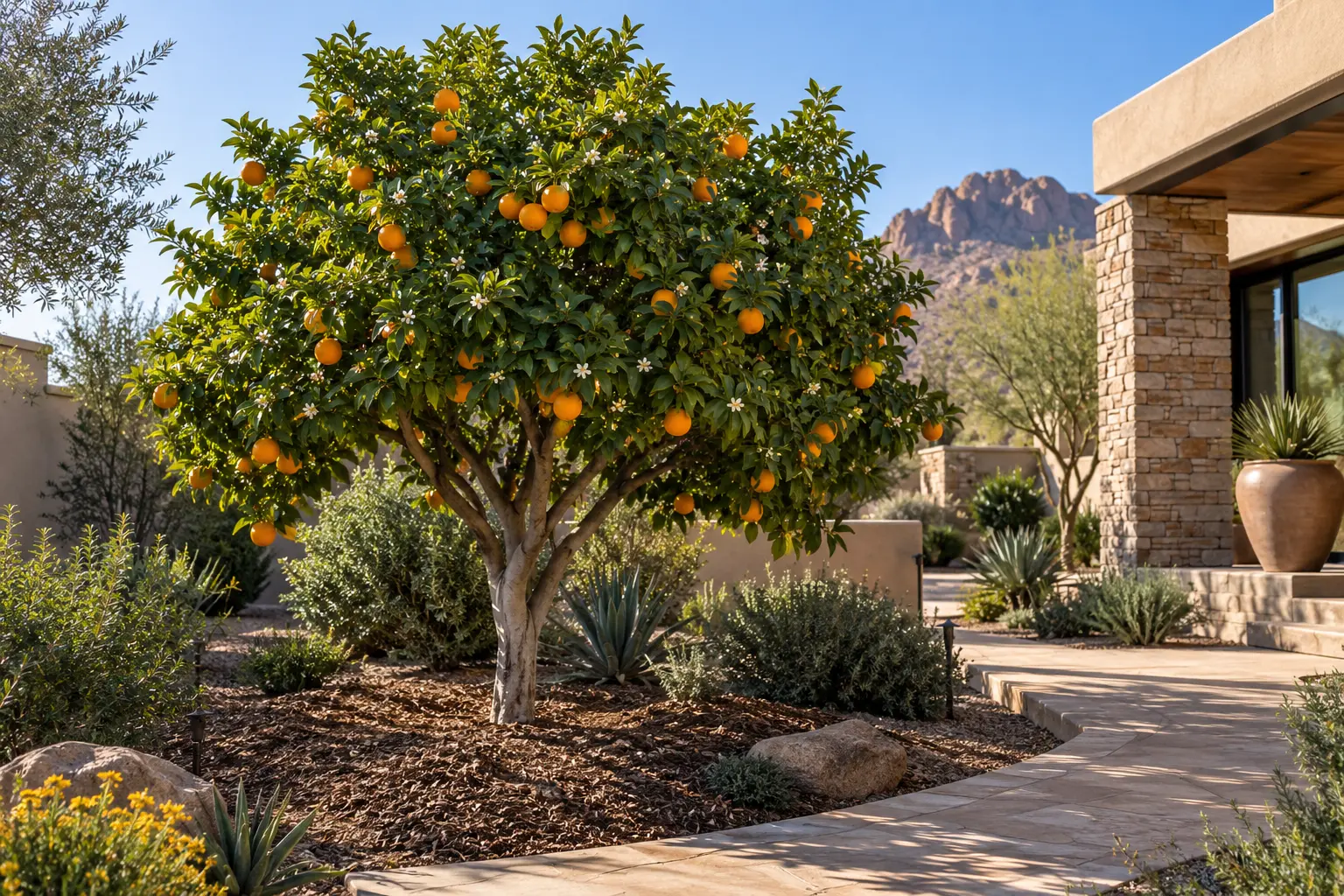
Citrus Tree
Citrus spp. and cultivated hybrids
This is a multi-species planning guide for grafted citrus, not one universal tree. Cultivar, rootstock, frost risk, irrigation, fruit drop, thorns and biosecurity all change the decision.
Not sure if this plant belongs near your pool, wall, pavers, or foundation?
AE reviews microclimate, root intrusion risk, and soil compatibility.
Schedule: Deep, infrequent — typically every 10–21 days mature, more often in summer establishment.
Emitters: Multiple large emitters or bubblers placed out at the drip line, not at the trunk.
Encourages deep roots and long-term tree stability. AE designs irrigation to expand as the tree matures.
Arizona yards have very different microclimates. West-facing walls, glass, artificial turf, pavers, travertine, porcelain, and pool decking all increase reflected heat. AE considers these before confirming placement.
- Mind clearance from pool deck
- Mind clearance from walls
AE verifies pool deck, paver, foundation, wall, and utility clearances before final planting.
Quick Facts
- Plant type
- Tree
- Mature size
- Many grafted residential trees are maintained at 8–15 ft; vigorous standard combinations can reach roughly 15–25 ft or more
- Growth rate
- Cultivar, rootstock, water and site dependent
- Sun
- Full sun
- Water use
- Moderate
- Bloom season
- Varies by citrus type and climate
- Flower color
- Usually white; details vary by type
- Foliage
- Glossy green; nutrient and salinity stress can alter color
- Evergreen / Deciduous
- Evergreen
- Thorns / spines
- Mild
- Litter level
- High
- Pool area
- Avoid nearby
- Pet/kid placement
- Use with care
- Maintenance
- Moderate
- Privacy value
- Medium
- Shade value
- Medium
- Native
- Desert-adapted
About Citrus Tree
Citrus is a complex Asian-origin group of species, long-cultivated hybrids and grafted rootstocks; “Mediterranean-adapted” describes a landscape association, not a botanical native range. This guide covers sweet orange, lemon, lime, mandarin or tangerine, grapefruit and related cultivated combinations without pretending they behave identically. Many residential grafted trees are maintained around 8–15 ft, while vigorous standard combinations can reach roughly 15–25 ft or more. Dwarfing labels do not erase root-zone, irrigation or harvest-access needs. Cold tolerance, thorn level and fruit season depend on scion, rootstock and microclimate; lemons and limes are generally more frost tender. Fruit, blossoms, leaves and some thorny growth create real maintenance. Select certified, correctly labeled nursery stock so the design, food-use plan and current plant-health rules begin with a known plant.
Best uses: A managed edible-landscape or courtyard tree with verified cultivar and rootstock, harvest access, broad irrigation and room for fruit cleanup
AE Designer Opinion
Design Uses
- Managed edible garden with harvest access
- Courtyard specimen with broad soil and irrigation volume
- Productive screen where fruit drop and monitoring are manageable
Care & Maintenance
- Plant certified, correctly labeled stock in full sun with the root flare and graft union above finished grade; do not mound mulch against the trunk.
- Wet the root zone broadly from the trunk area to just beyond the drip line and, where soil and drainage permit, about two feet deep; adjust frequency to age, soil, canopy, weather and method.
- Mature citrus is not watered daily: allow dry-down and expand emitters or the basin as the canopy grows.
- Use the current University of Arizona fertilization chart and product label for the identified species and measured tree size rather than a generic handful schedule.
- Investigate salinity or chlorosis from site evidence before choosing a remedy.
- Identify and selectively remove growth below the graft without damaging the trunk; do not top or hedge-cube the canopy.
- Monitor current Arizona and federal citrus pest guidance and use qualified help rather than homemade pesticide recipes.
Common Homeowner Mistakes
- Treating every Citrus type, cultivar and rootstock as interchangeable
- Burying the root flare or graft union or piling mulch against the trunk
- Watering mature citrus daily without root-zone dry-down
- Topping, hedge-cubing or stripping protective canopy
- Moving plant material without checking current quarantine guidance
Placement Warnings
⚠ Consume fruit only when the cultivar is correctly identified and the tree has not received landscape chemicals inconsistent with food use. This is not nutrition or medical advice. Frost response, thorns, fruit season and mature dimensions vary by cultivar, rootstock and site. Before moving citrus plants, budwood, cuttings, leaves or fruit with foliage, consult current Arizona Department of Agriculture and USDA APHIS rules; Asian citrus psyllid and huanglongbing are monitoring and quarantine concerns, not a basis for a fixed county rule or a DIY pesticide recipe.
- Keep fruit drop, staining and bee activity away from tight pool coping, pale paving and narrow entries when those consequences cannot be managed.
- Allow canopy, root-zone irrigation, harvest and pest-inspection access beyond walls, foundations and utility conflicts.
- Protect young or newly planted trees from severe reflected heat when site conditions warrant.
- Keep the graft union and root flare above finished grade and preserve airflow and access around the trunk.
AE reviews final placement based on sun, irrigation, drainage, mature size, and overall design.
Pairs Well With
- Upright Rosemary
- Trailing Rosemary
- Blackfoot Daisy
- Sweet Acacia
More Arizona Plants Like This


Ready to Build Your AE Plant Wishlist?
Add Citrus Tree and your other favorites to your wishlist, then send it to the AE design team for the final plant palette.