
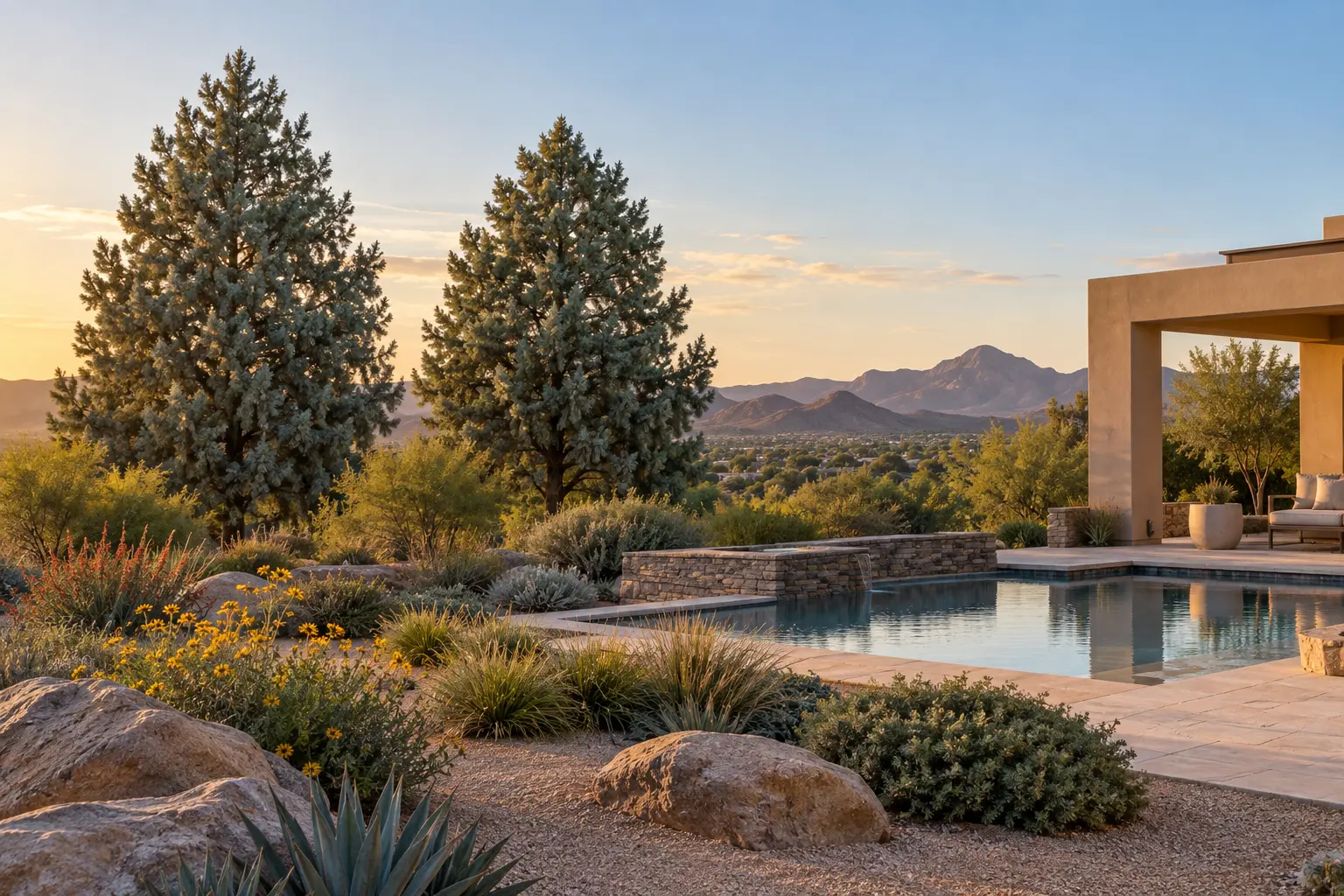
Arizona Cypress
Hesperocyparis arizonica
Arizona Cypress is a large southwestern mountain conifer—not a narrow no-water hedge—with blue-gray foliage, woody cones and serious space, irrigation and fire-planning requirements.
Not sure if this plant belongs near your pool, wall, pavers, or foundation?
AE reviews microclimate, root intrusion risk, and soil compatibility.
Schedule: Deep, infrequent — typically every 10–21 days mature, more often in summer establishment.
Emitters: Multiple large emitters or bubblers placed out at the drip line, not at the trunk.
Encourages deep roots and long-term tree stability. AE designs irrigation to expand as the tree matures.
Arizona yards have very different microclimates. West-facing walls, glass, artificial turf, pavers, travertine, porcelain, and pool decking all increase reflected heat. AE considers these before confirming placement.
- Mind clearance from pool deck
- Mind clearance from walls
AE verifies pool deck, paver, foundation, wall, and utility clearances before final planting.
Quick Facts
- Plant type
- Tree
- Mature size
- Plan about 30–50 ft tall and 15–25 ft wide in residential landscapes; old trees and selected forms vary
- Growth rate
- Moderate
- Sun
- Full sun
- Water use
- Low
- Bloom season
- Cones mature seasonally; cones are not flowers
- Flower color
- Inconspicuous reproductive structures; persistent woody cones
- Foliage
- Blue-green to gray-green; cultivar color varies
- Evergreen / Deciduous
- Evergreen
- Thorns / spines
- None
- Litter level
- Medium
- Pool area
- Avoid nearby
- Pet/kid placement
- Use with care
- Maintenance
- Seasonal pruning
- Privacy value
- High
- Shade value
- High
- Native
- Arizona native
About Arizona Cypress
Hesperocyparis arizonica, widely recognized in horticulture as Cupressus arizonica, is native to Arizona and the southwestern United States into northern Mexico, especially mountain canyons, slopes and woodland settings. It is not native to the hottest low-elevation Sonoran valley floor. In Phoenix, use it only with a deep, well-drained root zone and an intentional irrigation plan. Plan roughly 30–50 feet of height and 15–25 feet of width, while recognizing that old trees and selected forms vary. Blue-green to gray-green scale foliage, aromatic resinous growth and persistent woody cones define the tree; cultivar color and form make exact nursery identification important. Establish with consistent irrigation, then provide periodic deep water and dry-down. Drought tolerance does not make it a no-water Phoenix screen.
Best uses: A large evergreen specimen or distant screen on a spacious property with permanent canopy, root, fire-clearance and professional-access room
AE Designer Opinion
Design Uses
- Large-lot evergreen specimen
- Distant windbreak with fire-aware clearance
- Spacious screen with permanent canopy and service access
Care & Maintenance
- Establish with consistent deep irrigation, then provide periodic deep water with dry-down.
- Keep the root zone broad, well drained and free from daily shallow irrigation.
- Prune for structure while young and remove dead or damaged material selectively.
- Do not top, lion-tail, strip the live crown or hedge into a permanent small box.
- Use a qualified arborist for progressive dieback and mature-tree work.
Common Homeowner Mistakes
- Treating Cupressus arizonica and Hesperocyparis arizonica as different landscape trees
- Using it as a permanent narrow hedge
- Calling it a no-water Phoenix screen
- Promising root safety, no litter or fire safety
- Topping, lion-tailing or diagnosing progressive dieback from appearance alone
Placement Warnings
⚠ Established trees may tolerate temperatures around 0°F or below, but provenance, age, wind, soil moisture and event duration affect damage. In Phoenix, extreme heat, restricted soil volume and irrigation mismatch may matter more. Dense resinous foliage, cones, retained deadwood and dry litter can increase fire intensity; this tree is not fire-safe. Pollen may affect sensitive people. Progressive dieback can have several causes, including cypress canker or environmental stress, and warrants qualified arboricultural assessment rather than appearance-only diagnosis.
- Allow permanent setbacks from foundations, roofs, eaves, utilities, pools, walls and neighboring property.
- Do not install dense screening directly against a structure in a wildfire-prone setting.
- Provide deep soil volume and periodic deep irrigation without daily shallow watering or saturation.
- Plan professional pruning and diagnostic access before the tree becomes large.
AE reviews final placement based on sun, irrigation, drainage, mature size, and overall design.
Pairs Well With
- Desert Willow
- Bear Grass (Sacahuista)
- Deer Grass
- Texas Sage
More Arizona Plants Like This


Ready to Build Your AE Plant Wishlist?
Add Arizona Cypress and your other favorites to your wishlist, then send it to the AE design team for the final plant palette.