
Arizona licensed, bonded & insuredServing Arizona homeowners since 2005Peoria design showroomWritten, itemized project scopesProject-specific payment & warranty terms

Arizona pool site planning

Arizona 811 vs. Private Utility Locating Before Pool Excavation

Opening an Arizona 811 ticket is a required step, not a finish line. It notifies participating facility owners about the facilities they own. It does not locate the lines you or a previous owner installed, and it does not approve the pool.

Reviewed by David “Dave” Bell, Founder and Owner of AE Outdoor Living · Last verified September 14, 2026

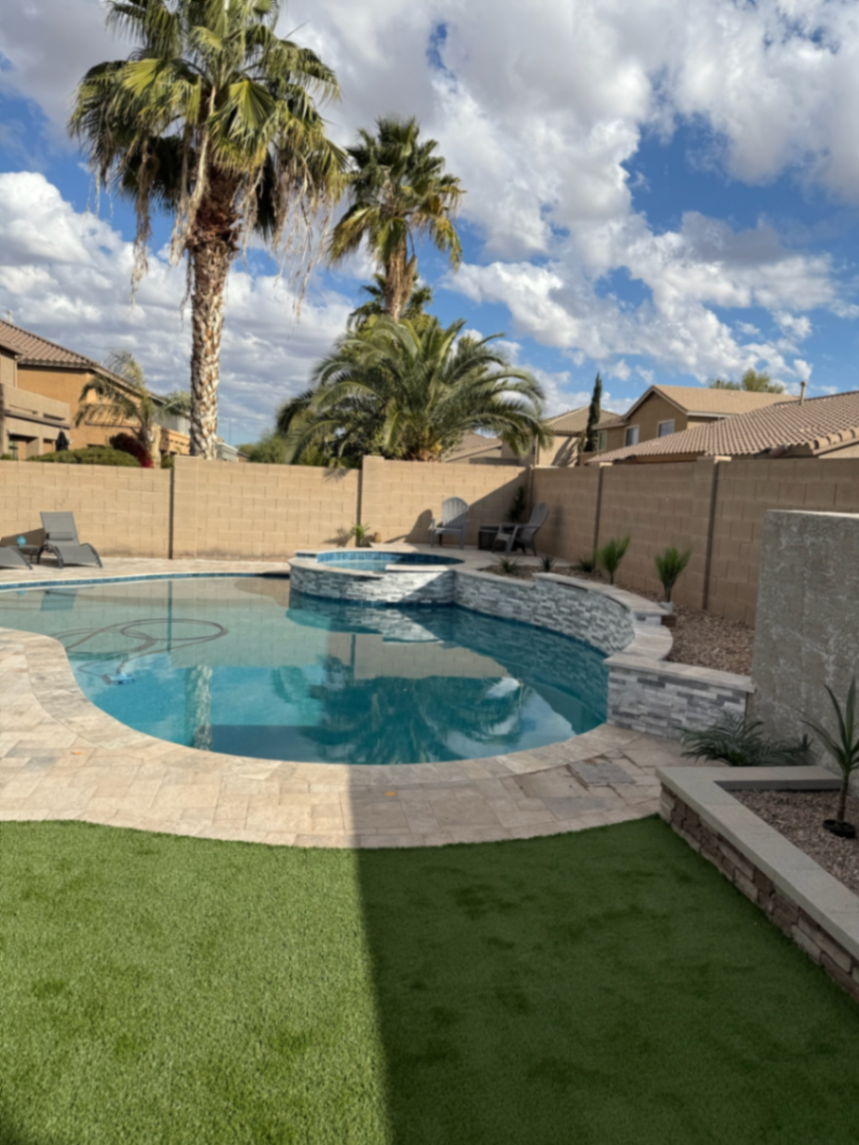
Completed AE Outdoor Living pool project in the Valley: a freeform pool and raised spa with travertine decking, turf and planters.
Completed AE Outdoor Living project. On any pool excavation, public facilities, possible private lines, equipment routing and the access path are questions to resolve before the first cut.

The direct answer

Two different jobs, both needed

Arizona 811 is the statewide notification center. You open a locate ticket for a defined dig area, and participating facility owners respond for the facilities they own and operate. Qualified private utility locating is a separate, arranged service that looks for privately owned lines on your property — the ones nobody else is responsible for marking. A pool excavation commonly needs both, and neither one is a permit.

Scope, side by side

What each process actually covers

Arizona 811 notification and member response

You define the dig area and open a ticket. The center notifies participating facility owners for that area. Each responds under its own process for the facilities it owns and operates, which is typically the distribution side of public utility service.

Arizona’s excavation notification requirements are set in statute. Read the current statute and the current ticket instructions rather than relying on what a crew remembers from a previous job.

Qualified private utility locating

A private locating service is hired for the property and looks for privately owned facilities using appropriate equipment and methods. It is arranged and paid for as part of the project, and its scope, methods and limitations are set by the written agreement with that provider.

On a pool excavation this matters because backyards can contain additions installed after original utility service, and many such on-property extensions may be privately owned. The examples in this guide are illustrative, not a complete list.

Commonly missed

Private lines we routinely find in Valley backyards

These are examples of privately owned facilities that frequently fall outside a facility owner’s response. This is not a complete or guaranteed list, and what exists on your property depends on its history.

  • A gas extension run to a barbecue island, fire pit or fire feature
  • Irrigation mainlines, valve wiring and drip laterals added or rerouted over the years
  • Low-voltage landscape and hardscape lighting circuits
  • Electrical, water or data lines serving a detached casita, shop, garage or shed
  • Existing pool or spa plumbing, bonding and equipment feeds from an earlier build or remodel
  • Septic tank, leach field or well components where the property is on them
  • Abandoned or undocumented lines from prior work that no one has a record of

If you know something was added — a firepit gas stub, a shed circuit, an old pool — say so before excavation. A homeowner site interview is one of the cheapest and most useful inputs to the locate plan.

Clear boundaries

A locate ticket is not approval to dig

“Arizona 811 was called” is not the same statement as “this excavation is safe and approved.” A ticket is one input among several. Specifically, a locate ticket is not:

Not a pool permit

The authority having jurisdiction issues permits and inspections for the approved scope. A ticket does not start, replace or satisfy that review.

Not an easement clearance

Recorded easements and their terms control what can be built where. Marking a facility does not grant permission to encroach on an easement.

Not utility authorization

Where a provider requires its own conflict review, relocation, clearance or authorization, that is a separate process controlled by the provider.

Not a survey

Locate marks do not establish property lines, setbacks or elevations. A boundary or topographic survey is a different professional scope.

Not a complete site record

Response is limited to the facilities a participating owner is responsible for. Private, abandoned and undocumented facilities can remain unmarked.

Not a depth guarantee

Marks indicate approximate horizontal position. No marking establishes exact depth, and depth can change with grading and later work.

Before excavation

The sequence that keeps a pool dig out of trouble

The order matters more than any single step. Each gate produces information the next one depends on.

  1. 01

    Define the dig area

    Establish the actual excavation footprint, including over-dig, spoil placement, equipment trenching, the access path and staging. A ticket describes an area, so the area has to be real before it is described.

  2. 02

    Open the required notice

    Open an Arizona 811 ticket for that defined area and follow the current official instructions on the ticket, including any required waiting period and marking of the proposed excavation area.

  3. 03

    Monitor official responses

    Track each member response and the ticket status. A ticket with unreturned or unclear responses is not a completed locate; follow the official process for resolving it.

  4. 04

    Keep marks and status current

    Marks fade, get graded off and expire. Keep them legible and the ticket current through the entire dig window, refreshing when the official process requires it.

  5. 05

    Identify likely private facilities

    Combine property records, as-built information where it exists, visible evidence on site and a homeowner interview about past additions to build a list of probable private lines.

  6. 06

    Arrange qualified private locating and safe exposure

    Where the design and construction team determines it is necessary, engage qualified private locating and use safe exposure or potholing methods to confirm position before mechanized excavation near a suspected facility.

  7. 07

    Resolve conflicts in the approved documents

    When a located facility conflicts with the layout, resolve it in the approved design and, where applicable, with the facility owner and the authority having jurisdiction. Do not resolve it informally in the field.

  8. 08

    Excavate only after all required gates

    Permits and approvals issued, locate process complete and current, private locating resolved, easement and clearance questions settled, and responsibilities documented.

Honest limits

What marking can and cannot establish

Locating is skilled work with real limits. No detection method guarantees that every buried object will be found, and no mark establishes an exact depth. Accuracy depends on the facility type and material, installation depth, soil and moisture conditions, surface conditions, congestion from nearby facilities, the records available and the method used. Non-conductive pipe, abandoned lines and undocumented work are the hardest cases, and they are common in backyards that have been remodeled more than once.

Treat marks as a planning aid that tells the crew where to slow down and expose carefully — not as a certified map of the underground.

Plain language

“Blue Stake” and Arizona 811

Plenty of Arizona homeowners, trades and even inspectors still say “Blue Stake,” and Arizona statute and the Arizona Corporation Commission describe the underground facilities notification framework. The statewide notification center people use today is Arizona 811. The name is not the point — the ticket is. If someone on your project says they “called Blue Stake,” ask which ticket number was opened, what dig area it describes and what its current status is.

Before you sign

Questions to ask your pool builder

  • Who defines the dig area, and does it include equipment trenching, the access path and spoil staging?
  • Who opens the Arizona 811 ticket, who monitors member responses, and who refreshes it if the schedule slips?
  • How will private facilities on my property be identified — records, as-builts, site interview, or all three?
  • Is qualified private locating included in the written scope, or is it an additional cost?
  • When is safe exposure or potholing used instead of mechanized excavation near a suspected line?
  • What happens to schedule and cost when a located facility conflicts with the approved layout?
  • Who carries responsibility and repair cost for damage to a marked line versus an unmarked private line?
  • Which permits, approvals, easement questions and utility clearances must be complete before excavation starts?

Plan the site, not just the pool

Arizona Pool Site Planning Series

These are six separate checks, not one universal pass/fail number. Each one is answered by a different authority, professional scope or document, and a clear answer on one does not settle the others. Work through the decision you are actually facing.

Common questions

Arizona 811 and private locating FAQs

What is the difference between Arizona 811 and private utility locating?

Arizona 811 is the statewide notification center. You open a locate ticket, and participating facility owners respond for the facilities they own and operate. Private utility locating is a separate service, arranged and paid for by the property owner or contractor, that looks for privately owned lines on the property. They answer different questions, and one does not substitute for the other.

Does an Arizona 811 ticket mean it is safe or approved to dig?

No. A locate ticket starts a notification and marking process. It is not a pool permit, an easement clearance, a utility authorization, a survey, or proof that every underground condition on the property is known. Excavation should begin only after the required permits, approvals, marks, private locating and any site-specific clearances identified by the design and construction team are resolved.

What kinds of lines might Arizona 811 not mark?

Facility owners generally respond for the facilities they own. Privately owned lines installed on the property commonly fall outside that response. Examples we see include a gas extension to a barbecue or fire feature, irrigation, low-voltage landscape lighting, lines serving a detached casita, shop or garage, existing pool or spa plumbing and equipment feeds, and septic or well components where applicable. Treat these as examples, not a complete or guaranteed list.

Is Blue Stake the same thing as Arizona 811?

Many Arizona homeowners and trades still say “Blue Stake,” and Arizona statute refers to underground facilities notification. The statewide notification center people use today is Arizona 811. If someone on your project says they called Blue Stake, confirm which ticket was opened, what it covers and what its current status is.

How long is a locate ticket good for before pool excavation?

Do not plan from a remembered number. Notice periods, ticket life, refresh and re-mark rules come from the current official instructions and the ticket itself, and they can change. Read the instructions and status on your actual ticket, keep marks legible and current through the dig window, and refresh the ticket when the official process requires it.

Who arranges private locating on a pool project?

Responsibility depends on the signed scope. Confirm in writing who opens the 811 ticket, who monitors member responses, who identifies likely private facilities from records and a site interview, who arranges qualified private locating, who performs safe exposure or potholing when the design and construction team determines it is necessary, and who resolves conflicts in the approved documents before excavation.

Can locating find every buried object and its exact depth?

No. No detection method guarantees that every buried object will be found or that any depth reading is exact. Locating accuracy depends on the facility type, material, depth, soil conditions, congestion, surface conditions and the method used. Non-conductive, abandoned, undocumented or poorly installed lines are especially difficult. Marks are a planning aid, not a certainty.

What should I ask my pool builder about utility locating?

Ask who defines the dig area, who opens and monitors the ticket, how private facilities on your property will be identified, whether qualified private locating is included in the written scope or is an extra, what happens when a conflict is found, who pays for damage to an unmarked private line, and which required permits, easements and clearances must be complete before excavation starts.

Does 811 handle easements or utility authorization for a pool?

No. Recorded easements and any required provider authorization are separate from the locate process. Marking a facility does not grant permission to build over, near or across it. Easement terms, the utility owner’s process and the authority having jurisdiction control whether a proposed layout is acceptable.

What happens if a private line is hit during pool excavation?

Stop work in that area and follow the emergency and notification procedures that apply to the facility involved, including contacting the facility owner and emergency services where there is any risk to life or property. Then resolve the repair, responsibility and schedule effect in writing. This is a good reason to settle private-line identification and cost responsibility before excavation rather than during it.

Source transparency

Official sources

Requirements and procedures change. The current statute, the current Arizona 811 instructions and ticket status, the facility owner’s process, the authority having jurisdiction, the approved documents and the signed scope control the actual project.

Keep planning

Related planning reading

Plan the site first

Bring us the address and what you know is buried out there.

AE can walk the property, build the dig-area and private-facility list with you, and identify which locating, permit and clearance steps belong in the written scope before anyone quotes an excavation date. Arizona 811, the facility owners, the authority having jurisdiction and any qualified locating or engineering professional control their own processes and findings.

AE Outdoor Living's contracting entity holds Arizona ROC licenses 211530, 340966, 341002 and 347738. Verify the contracting entity, classification and current status for your scope.

Start project planning
Related guides

Keep learning before you build.