
Arizona licensed, bonded & insuredServing Arizona homeowners since 2005Peoria design showroomWritten, itemized project scopesProject-specific payment & warranty terms

Arizona pool site planning

Do I Need a Survey or Soil Test for an Arizona Pool?

Not every Arizona pool needs every study. Survey, soils, engineering and locating answer four different questions, and your address decides which of them your project actually has to answer.

Reviewed by David “Dave” Bell, Founder and Owner of AE Outdoor Living · Last verified September 14, 2026

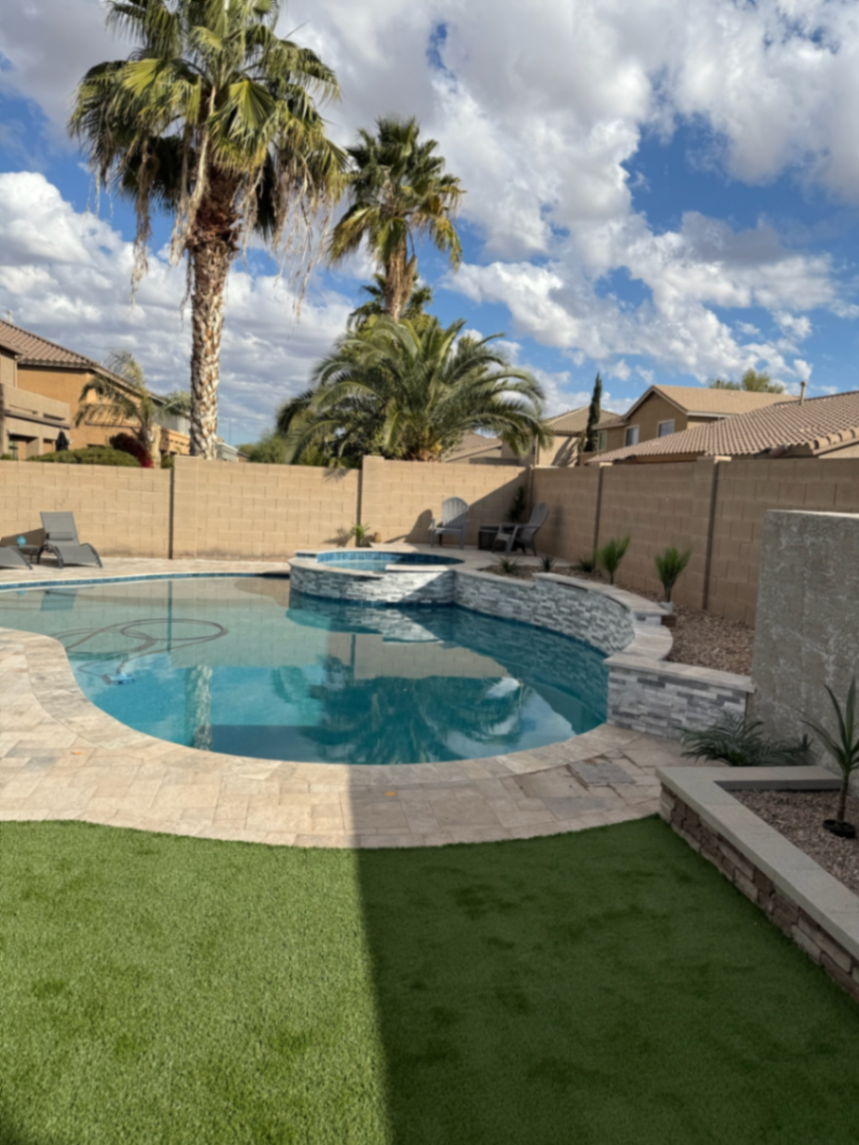
Completed AE Outdoor Living pool project in the Valley: a freeform pool and raised spa set into decking, turf and planters.
Completed AE Outdoor Living project. On every project, setbacks, elevations, soil conditions and structural design are property-specific questions settled before a footprint is fixed.

The direct answer

It depends on the property, and that is a real answer

A reliable answer on whether your pool needs a boundary survey, a topographic survey, a geotechnical investigation or site-specific engineering requires address-specific documents and site and design inputs. What controls it is the address, the authority having jurisdiction, recorded property conditions, slope, fill and retaining conditions, drainage constraints, the structural design and the scope you requested. Some projects need none of these additional survey, geotechnical or site-specific engineering scopes, and some need most of them.

Utility notification and locating are a different matter. Pool excavation has its own pre-excavation notification and locating process, governed by the current official instructions and the conditions on your property, and it is handled separately from the professional study scopes on this page. The useful move is to settle both tracks early, in writing.

Side by side

Five professional scopes, five different questions

People use “survey” and “soil test” loosely. Separating them is the fastest way to stop overpaying for the wrong study — or skipping the one that mattered.

Boundary survey

What it answers
Where your property lines actually are, and where a proposed pool, deck or structure sits relative to setbacks and recorded easements.
Who typically provides it
An Arizona-registered land surveyor.
What it does not prove
It does not establish soil behavior, elevations for drainage, structural adequacy, or the location of buried facilities.

Topographic / elevation survey

What it answers
The measured elevations across the yard: how much the site falls, where water currently runs, and what the pool, deck and any retaining conditions have to work with.
Who typically provides it
An Arizona-registered land surveyor, sometimes coordinated with the civil designer.
What it does not prove
It does not confirm property lines unless boundary work is included, and it does not evaluate soil or structural capacity.

Soils information / geotechnical investigation

What it answers
What the ground under the pool is made of: soil types, apparent fill, moisture behavior, and recommendations a designer or engineer can build from.
Who typically provides it
A qualified geotechnical firm working under an Arizona-registered professional engineer.
What it does not prove
It does not design the pool shell, establish property lines, or guarantee that conditions are uniform everywhere on the lot.

Site-specific structural / civil engineering

What it answers
How the pool shell, retaining conditions, raised elements or site structures are designed for this site, this layout and these loads.
Who typically provides it
An Arizona-registered professional engineer.
What it does not prove
It does not replace survey or soils inputs — it usually depends on them — and it does not substitute for the authority having jurisdiction's review.

Utility locating

What it answers
Approximate horizontal position of participating facility owners' facilities, plus privately owned lines when qualified private locating is arranged.
Who typically provides it
Arizona 811 member facility owners, plus a qualified private locating service for private lines.
What it does not prove
It does not establish property lines, elevations, soil behavior, easement rights, exact depth, or permission to dig.

Decision triggers

Conditions that commonly put a study on the list

These are common triggers, not universal requirements. Any one of them is a reason to ask the question early rather than assume.

  • Property lines or setbacks are uncertain, or the layout sits close to a line
  • Recorded easements cross or approach the proposed work area
  • Significant slope or elevation change across the yard
  • Retaining conditions — existing walls, proposed walls, or a raised deck condition
  • Disturbed or undocumented fill from earlier grading, a prior structure or a previous pool
  • Unusual soil conditions observed on site or known in the area
  • Drainage, wash, floodplain or other site constraints affecting where water goes
  • The authority having jurisdiction or an engineer of record instructs that a study be provided
  • Design loads or site structures — raised spas, elevated decks, kitchens, shade structures, glass barriers

A straight answer about a common rumor

Anthem and north Phoenix

We get asked constantly whether pools in Anthem or north Phoenix “always” require soil testing or extra engineering. There is no honest blanket rule for every property in those areas. Some parcels do carry additional review because of documented site conditions, community requirements or the specific design. Others do not.

The dependable approach is the same one we use on every address:

  • Identify the actual authority having jurisdiction for the exact address — city, town or county, which is not always what the mailing address suggests
  • Identify the community, HOA or master-planned association that also reviews the work
  • Request the address-specific written requirements from each of them
  • Pull recorded documents for the parcel, including plats and easements
  • Plan cost and schedule from those documents — not from what a neighbor was told during a different year, a different design or a different lot

Budget honesty

What preconstruction requirements can add

AE field observation: on complex or specially reviewed sites, combined survey, geotechnical, engineering, redesign and related preconstruction requirements can add roughly $8,000 to $20,000 to a project.

Read that as a broad AE planning observation, not a standard fee, a quote, a municipal fee schedule, a guarantee, or a claim that your site will incur it. It is a combined figure across several professional scopes and any redesign they trigger — it should never be attributed to a soil test alone. Plenty of straightforward Valley sites land nowhere near this range. Actual costs come from the providers you engage and the requirements your address produces.

Before the number is final

What to lock before the final pool price

  • The governing authority for your exact address, and its written requirements for this scope
  • Community, HOA or association review requirements and submittal expectations
  • Property lines and setbacks where the layout depends on them
  • Measured elevations and the drainage strategy for the finished yard
  • The soils and engineering inputs the structural design depends on
  • The utility locating plan, including whether qualified private locating is included
  • Who orders, holds the contract for, and pays for each study
  • What happens to price and schedule if a study returns a finding that changes the design
  • The written scope, exclusions and allowances that reflect all of the above

Plan the site, not just the pool

Arizona Pool Site Planning Series

These are six separate checks, not one universal pass/fail number. Each one is answered by a different authority, professional scope or document, and a clear answer on one does not settle the others. Work through the decision you are actually facing.

Common questions

Survey, soils and engineering FAQs

Do all Arizona pools need a survey and a soil test?

No. There is no honest blanket answer. What a specific project needs depends on the address, the authority having jurisdiction, recorded property conditions, slope and fill, retaining and drainage conditions, the structural design, and the scope you actually requested. Some Valley pools are permitted and built with none of these studies; others need several.

What is the difference between a boundary survey and a topographic survey?

A boundary survey establishes where your property lines are, which drives setbacks and easement questions. A topographic survey measures elevations across the site, which drives grading, drainage and any retaining design. They are different scopes and are sometimes ordered together, but one does not include the other unless it is written that way.

Is a soil test the same thing as engineering?

No. A geotechnical investigation gathers and interprets information about the ground and produces recommendations. Structural or civil engineering uses those recommendations, along with survey data and the proposed design, to produce a site-specific design. The engineer usually needs the soils input before the design can be finalized.

What commonly triggers a survey, soils or engineering requirement?

Common triggers include uncertain property lines or tight setbacks, recorded easements crossing the work area, significant slope or elevation change, retaining conditions, disturbed or undocumented fill, unusual soil conditions, drainage or floodplain constraints, and instructions from the authority having jurisdiction or the engineer of record. Design loads and site structures can trigger them as well. None of these apply universally.

Is soil testing required for every pool in Anthem or north Phoenix?

There is no honest blanket rule for every property in Anthem or north Phoenix. Some properties in those areas do carry additional review, and some do not. The correct step is to identify the actual authority having jurisdiction and the community or HOA for your exact address, obtain the address-specific written requirements, and plan from those documents rather than from neighborhood rumor.

How much can survey, soils and engineering add to a pool budget?

AE's field observation is that complex or specially reviewed sites can add roughly $8,000 to $20,000 in combined survey, geotechnical, engineering, redesign and related preconstruction requirements. That is a broad AE planning observation, not a standard fee, a quote, a city fee schedule, or a claim that your site will incur it. It should not be attributed to a soil test alone, and many straightforward sites land nowhere near it.

Who orders these studies — the homeowner or the builder?

It depends on the signed scope. Confirm in writing who orders each study, who holds the contract with the surveyor or engineer, who pays, who receives the deliverable, and what happens to schedule and price if a study returns a finding that changes the design. Leaving this undefined is one of the most common sources of mid-project cost surprises.

Can I skip the studies and start with a design?

You can start conceptual design earlier, and most homeowners do. What you should not do is treat an early design or early price as final before the property-specific inputs are known. If the layout depends on where the property line is, how much the site falls, or what the soil does, then those inputs decide whether the design and the number survive.

Does a survey prove there are no utilities in the way?

No. Survey and locating are different scopes. A survey can show recorded easements, which is useful, but it does not locate buried facilities. Utility locating through Arizona 811 and, where needed, qualified private locating is a separate step, and a locate ticket is not approval to dig.

What should be locked before I accept a final pool price?

Confirm the governing authority and its written requirements for your address, property lines and setbacks where they are in question, elevations and the drainage strategy, the soils and engineering inputs your design depends on, the utility locating plan, who pays for each study, and how a finding that changes the design affects price and schedule. Get all of it in the written scope.

Verification

Where to verify

Use these to confirm the professionals you engage and the recorded conditions on your parcel. For jurisdiction-specific permit requirements, start with our Arizona pool permit and HOA guide, then confirm directly with the authority having jurisdiction for your address.

Keep planning

Related planning reading

Find out what your address needs

Let’s answer this with documents, not guesses.

AE can help you identify the governing authority, pull the recorded conditions on your parcel, and map which survey, soils or engineering scopes your design actually depends on before a final number is set. The authority having jurisdiction, your HOA, and any registered surveyor or engineer control their own requirements and findings.

AE Outdoor Living's contracting entity holds Arizona ROC licenses 211530, 340966, 341002 and 347738. Verify the contracting entity, classification and current status for your scope.

Start project planning
Related guides

Keep learning before you build.