
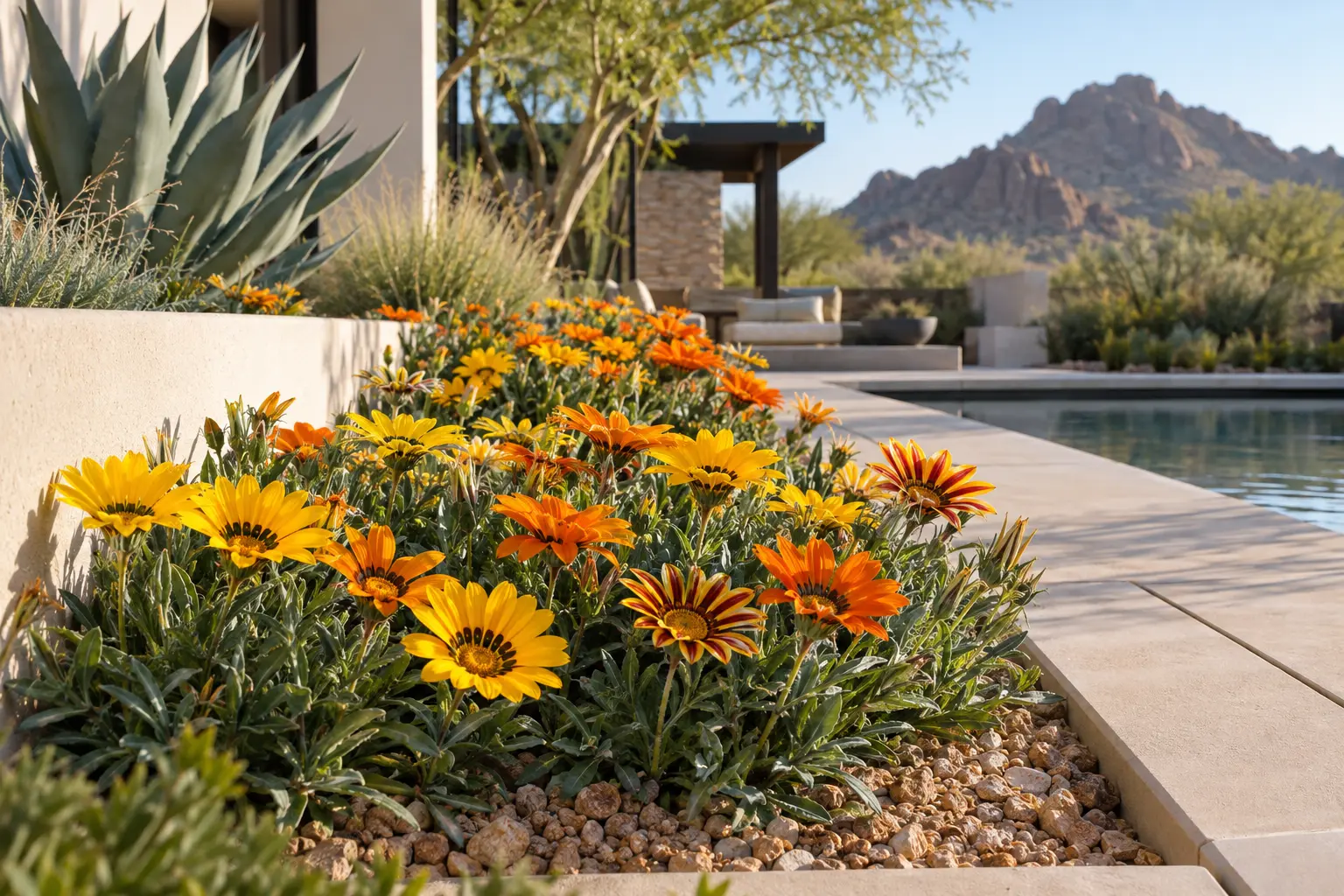
Gazania (Treasure Flower)
Gazania rigens
Gazania is a low, short-lived southern African daisy that behaves in Phoenix as a cool-season and shoulder-season color plant rather than a permanent groundcover. Treat it as a color ribbon you refresh, not a lawn substitute.
Not sure if this plant belongs near your pool, wall, pavers, or foundation?
AE reviews microclimate, root intrusion risk, and soil compatibility.
Schedule: Weekly to twice-weekly in summer, less in cooler months.
Emitters: 1–2 emitters per shrub adjusted seasonally.
Most desert-adapted shrubs prefer drying out between waterings.
Arizona yards have very different microclimates. West-facing walls, glass, artificial turf, pavers, travertine, porcelain, and pool decking all increase reflected heat. AE considers these before confirming placement.
- Low root impact
AE verifies pool deck, paver, foundation, wall, and utility clearances before final planting.
Quick Facts
- Plant type
- Groundcover
- Mature size
- Roughly 6-12 inches tall, 12-18 inches wide
- Growth rate
- Fast
- Sun
- Full sun
- Water use
- Low
- Bloom season
- Strongest broadly fall through spring, with possible later flowering where conditions suit
- Flower color
- Yellow and orange plus cultivar colors, frequently with dark basal eye markings
- Foliage
- Narrow green leaves, often with pale or silvery undersides
- Evergreen / Deciduous
- Semi-evergreen
- Thorns / spines
- None
- Litter level
- Low
- Pool area
- Good with placement
- Pet/kid placement
- Use with care
- Maintenance
- Seasonal pruning
- Privacy value
- Low
- Shade value
- Low
- Native
- Mediterranean-adapted
About Gazania (Treasure Flower)
Gazania rigens is the canonical name here, but nursery stock also includes selected cultivars and interspecific garden hybrids, so a plant label matters whenever color, habit or cold response matters; not every trade gazania is genetically identical straight G. rigens. The species is southern African coastal in origin and nonnative to Arizona. It is a low, short-lived perennial in suitable climates, and in the Phoenix low desert it most often functions as a cool-season or shoulder-season color plant, because peak-summer heat, irrigation mismatch and root disease can thin a stand. Plan honestly for roughly 6-12 inches tall and 12-18 inches wide for landscape selections, with cultivar and conditions affecting spread; this is not a large permanent groundcover. Narrow green leaves often carry pale or silvery undersides, and daisy-like flower heads about 3-4 inches across appear in yellow and orange plus cultivar colors, frequently with dark basal eye markings. Flowers close at night and may stay partly closed on cloudy days, which is normal rather than a defect. Performance in Phoenix is strongest broadly fall through spring, with possible later flowering where conditions suit; uninterrupted spring-through-fall bloom through extreme summer is not something we promise. Give it full sun for dense growth and the best flower opening. Irrigation is low to moderate here: let well-drained soil dry between deep irrigations, support establishment and containers deliberately, and never translate drought tolerance into no water. Chronic wet soil, poor drainage and daily shallow irrigation all increase crown and root-rot risk.
Best uses: Cool-season color ribbon along a walk or drive; Sunny container and planter edges; Small dry border where a seasonal refresh is acceptable
AE Designer Opinion
Design Uses
- Cool-season color ribbon along a walk or drive
- Sunny container and planter edges
- Small dry border where a seasonal refresh is acceptable
- Front-yard entry color in a low-water palette
- Temporary infill while slower woody plants establish
Care & Maintenance
- Water deeply and let well-drained soil dry between irrigations.
- Give establishment and container plantings deliberate irrigation support.
- Avoid daily shallow watering, poor drainage and chronically wet soil.
- Deadhead if appearance or reseeding matters.
- Remove tired growth lightly; do not scalp the crown.
- Replace a depleted stand rather than forcing it through summer with more water.
Common Homeowner Mistakes
- Treating every trade gazania as identical straight Gazania rigens
- Specifying it as a large permanent groundcover
- Expecting uninterrupted bloom through extreme Phoenix summer
- Watering daily and shallowly instead of deeply with dry-down
- Scalping the crown during cleanup
Placement Warnings
⚠ Nursery gazania spans straight Gazania rigens, selected cultivars and interspecific garden hybrids, so check the label when color, habit or cold response matters. This is a short-lived plant in the Phoenix low desert and should be budgeted as seasonal color with planned replacement, not a permanent groundcover. Chronic wet soil, poor drainage and daily shallow irrigation raise crown and root-rot risk. Bee visitation and spent flower heads make placement near barefoot pool circulation a conditional judgment rather than an automatic yes.
- Not a foot-traffic plant; keep it out of walked-on areas.
- Keep spent flower heads and bee activity out of tight barefoot pool circulation.
- Do not use it where permanent evergreen coverage is required.
- Avoid low spots and shared high-water valves.
- Allow room for a seasonal replacement cycle in the maintenance plan.
AE reviews final placement based on sun, irrigation, drainage, mature size, and overall design.
Pairs Well With
- Angelita Daisy
- Damianita
- Trailing Rosemary
More Arizona Plants Like This



Ready to Build Your AE Plant Wishlist?
Add Gazania (Treasure Flower) and your other favorites to your wishlist, then send it to the AE design team for the final plant palette.