
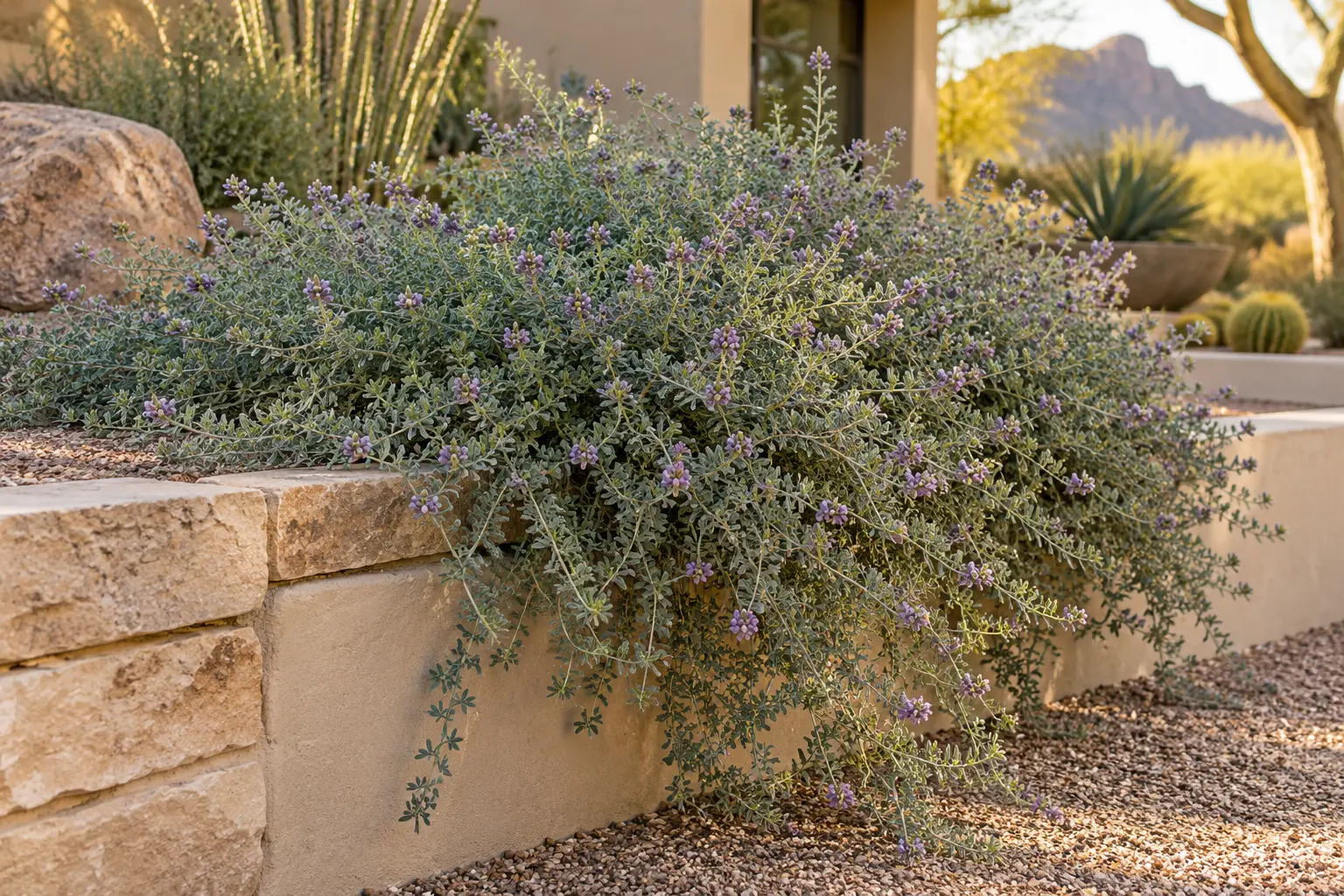
Trailing Indigo Bush (Dalea greggii)
Dalea greggii
Trailing indigo bush is Dalea greggii specifically, a Chihuahuan Desert native used here as a durable silver groundcover. Its real value is slope holding and wall spillover, and its real constraint is lateral reach.
Not sure if this plant belongs near your pool, wall, pavers, or foundation?
AE reviews microclimate, root intrusion risk, and soil compatibility.
Schedule: Weekly to twice-weekly in summer, less in cooler months.
Emitters: 1–2 emitters per shrub adjusted seasonally.
Most desert-adapted shrubs prefer drying out between waterings.
Arizona yards have very different microclimates. West-facing walls, glass, artificial turf, pavers, travertine, porcelain, and pool decking all increase reflected heat. AE considers these before confirming placement.
- Low root impact
AE verifies pool deck, paver, foundation, wall, and utility clearances before final planting.
Quick Facts
- Plant type
- Groundcover
- Mature size
- About 2 ft tall, 6 ft wide as a Phoenix planning size
- Growth rate
- Fast
- Sun
- Full sun
- Water use
- Low
- Bloom season
- Strongest in spring and early summer, with possible later bloom into summer and fall
- Flower color
- Tiny fuzzy purple pea-family clusters
- Foliage
- Silvery blue-green compound foliage
- Evergreen / Deciduous
- Semi-evergreen
- Thorns / spines
- None
- Litter level
- Low
- Pool area
- Good with placement
- Pet/kid placement
- Use with care
- Maintenance
- Seasonal pruning
- Privacy value
- Low
- Shade value
- Low
- Native
- Southwest native
About Trailing Indigo Bush (Dalea greggii)
Dalea greggii is best called trailing indigo bush, with Gregg dalea and Gregg's prairie clover as useful alternates; this is a species profile, not generic Dalea content. It is a Chihuahuan Desert native from the Southwest and northern Mexico, locally adapted in Phoenix but not a core Sonoran Desert endemic. Use roughly 2 ft tall by 6 ft wide as the practical design-planning size, while acknowledging that site and irrigation can produce a lower 4 ft spread or a wider 6-10 ft mat; understating its lateral reach is how this plant ends up on top of its neighbors. Trailing branches root at leaf nodes, which is exactly what makes it useful for slope and erosion control and for wall spillover, and also what lets it cross edging and engulf tight neighbors when mature spread is ignored. Tiny fuzzy purple pea-family flower clusters are strongest in spring and early summer, with possible later bloom into summer and fall depending on rain and irrigation; pollinator value includes bees and butterflies, and seeds and cover can support other wildlife. Full sun and reflected heat through light or filtered shade all work, though shade makes it leggy. Water use is low once established, with deep spring and summer irrigation spaced for dry-down. Well-drained rocky or gravelly soil is essential, and wet winter soil can cause rot. Around 10-15°F it is cautiously hardy. Leaf retention varies by climate and source, so describe it as evergreen to semi-evergreen in mild low-desert conditions with possible frost dieback rather than universally evergreen. Rabbits may browse it, which is a possible site issue rather than a guarantee of resistance or damage.
Best uses: Slope and erosion control where lateral spread is welcome; Wall spillover over block, stone or concrete edges; Large-scale silver groundcover massing in open beds
AE Designer Opinion
Design Uses
- Slope and erosion control where lateral spread is welcome
- Wall spillover over block, stone or concrete edges
- Large-scale silver groundcover massing in open beds
- Soft foreground against boulders and desert trees
- Low-water replacement for turf in non-traffic areas
Care & Maintenance
- Irrigate deeply through spring and summer on intervals spaced for dry-down.
- Plant in well-drained rocky or gravelly soil; wet winter soil can cause rot.
- Thin or selectively cut back after flowering or frost as needed.
- Edge seasonally where it crosses walks, drains or small neighbors.
- Site it in full sun or light shade; deep shade makes it leggy.
- Do not shear it repeatedly into a rigid pad.
Common Homeowner Mistakes
- Drawing it at 3 ft when a 6-10 ft mat is possible
- Calling it a Sonoran Desert endemic
- Planting it in poorly drained soil that stays wet in winter
- Promising evergreen foliage through every frost
- Shearing it into a rigid pad instead of thinning it
Placement Warnings
⚠ Trailing branches root at leaf nodes, so this groundcover can cross edging and engulf tight neighbors when mature spread is ignored. Leaf retention varies: evergreen to semi-evergreen in mild low-desert conditions with possible frost dieback, not universally evergreen. Wet winter soil can cause rot. Rabbits may browse it, which is a possible site issue rather than a guarantee of resistance or damage. Do not treat it as absolutely pool-, pet-, child- or maintenance-free.
- Plan the full mature mat, not the nursery container size.
- Keep it clear of narrow paths, gates and pool circulation.
- Do not let it cover drains, valves or cleanouts.
- Give small accent plants room; this mat will reach them.
- Expect active bees and butterflies during the spring display.
AE reviews final placement based on sun, irrigation, drainage, mature size, and overall design.
Pairs Well With
- Brittlebush
- Damianita
- Red Yucca
More Arizona Plants Like This


Ready to Build Your AE Plant Wishlist?
Add Trailing Indigo Bush (Dalea greggii) and your other favorites to your wishlist, then send it to the AE design team for the final plant palette.