Backyard Splash Pads in Arizona — A Smarter Option Than a Pool?
For families with toddlers, a splash pad delivers interactive water play without a conventional pool-depth basin — with lower long-term water use than a typical pool. It is not risk-free, so read the safety section before you scope one.
Why splash pads are trending in Phoenix
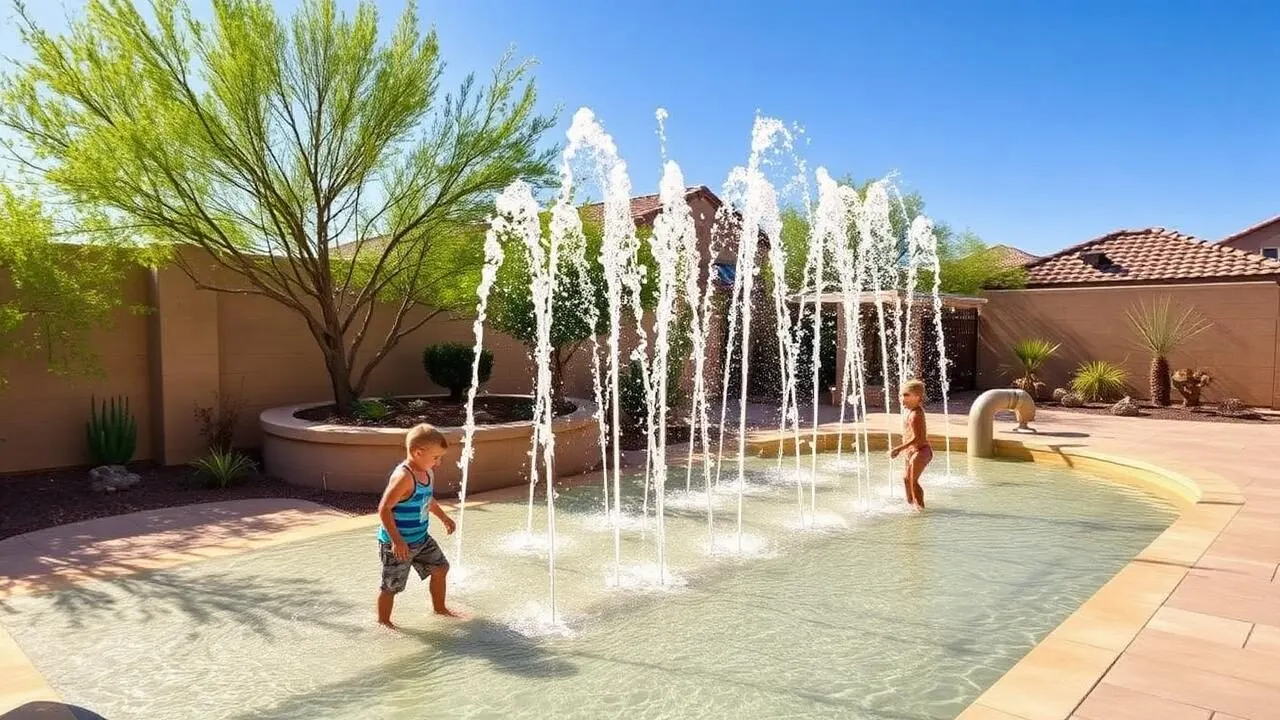
For families with kids under 6, a properly designed residential splash pad offers interactive water play without a conventional pool-depth basin. That can shift the risk profile — but it does not eliminate risk. Children still require attentive adult supervision (a designated Water Watcher), Arizona deck surfaces can get dangerously hot, and slips, waterborne illness, and equipment hazards are real. Add 110° summers and the appeal is obvious — cool, interactive water play right outside the back door, with safe operating practices built in from day one.
Safety — read this before you scope a splash pad
A splash pad is not a substitute for supervision. Never leave children unattended around an operating splash pad. Assign a designated, undistracted adult Water Watcher — infants and young children require especially close supervision. Check deck surface temperature before use in Arizona heat; the surface may not be cool. Do not use the splash pad when experiencing diarrhea, do not swallow the water, do not sit or stand directly on jets, and take regular restroom and diaper breaks. Recirculating systems require proper filtration, disinfection, chemistry monitoring and maintenance. Whether a barrier, permit or HOA approval is required depends on the design, water depth, municipality, HOA and current code interpretation (see ARS §36-1681); AE reviews each project against the local jurisdiction. Guidance based on CDC splash-pad safety and CPSC water-safety recommendations.
What a residential splash pad costs
See the Pricing Guide for the current published planning range; the written proposal controls the actual price. Drivers: pad size, number of jets/features, recirculating vs drain-to-waste system, and decorative concrete or paver finish on the deck. Recirculating systems cost more upfront and typically reduce ongoing water use vs drain-to-waste — actual utility impact varies by system, run time and use.
Drain-to-waste vs recirculating
- Drain-to-waste: cheaper install, sends water to sewer or landscape — best where water is cheap and use is occasional.
- Recirculating: filters and reuses water like a pool — higher install, generally lower operating water use, more appropriate for AZ.
- Which approach is appropriate is a project-specific decision — we scope it against the site, the design, and local requirements.
Footprint and design
A great residential pad is 200–600 sq ft. We design around jet patterns — arching jets, dump buckets, ground geysers, and bollard sprays. The deck slopes 1–2% toward a center drain, surfaced with slip-resistant textured concrete or porcelain pavers. Slip-resistant surfacing reduces — but does not eliminate — the risk of slips and falls on wet surfaces.
Maintenance reality
Recirculating pads use the same chlorine and filtration logic as a pool, in a smaller water volume. Maintenance follows the manufacturer instructions for the equipment actually installed: cartridge elements are cleaned and eventually replaced rather than backwashed, and chemistry checks, basket cleaning, nozzle inspection, and plumbing checks run on a cadence that varies with run time, water chemistry, debris load, and the signed equipment schedule. Neglecting sanitation or filtration can allow bacteria, algae or biofilm to grow — a documented risk factor in splash-pad-linked illness (CDC).