
How Paver Installation Should Actually Be Done in Arizona
Pavers don't fail because of the paver. They fail because of the base. Every settled patio, every wave in a driveway, every loose joint we get called out to repair traces back to one of three things: not enough ABC, no compaction, or the wrong joint sand.
This is how AE specs every paver job — patios, walkways, driveways, pool decks — and what to demand from any Arizona hardscape contractor before you sign.
In this guide+
- 01The AE paver spec (and why it's non-negotiable)
- 02Pavers, coping, and joint sand that hold up in Arizona
- 03How AE installs a paver project
- 04Real Arizona paver investment ranges
- 05How long an Arizona paver job actually takes
- 06Ask any paver contractor before signing
- 07Why most Arizona paver jobs fail early
The AE paver spec (and why it's non-negotiable)
David Bell, AE's owner, is the current president of the Southwest Hardscapes Association — 13 years on the board, 15 years involved. The spec below is the one he advocates for industry-wide, and the one every AE crew works to.
- ABC (aggregate base course) — 2–3" compacted under patios and walkways. 4–6" under driveways. Add depth for build-up or higher traffic.
- Sand bed — 1" of clean concrete sand, screeded flat, never deeper than 1". Thicker sand beds settle.
- Polymeric joint sand — applied to every joint, every job. It locks pavers, sheds water, and blocks weed germination. Generic mason sand is not a substitute.
- Quarter-minus is never used under pavers — it's our turf base material. Anyone speccing quarter-minus under pavers is using the wrong product.
- Edge restraint — concrete edge or rigid PVC edge spiked into the base at every free edge. No edge restraint, no install.
- Compaction — base compacted in lifts (multiple passes), then pavers compacted again after install with a plate compactor and protection mat.
Pavers, coping, and joint sand that hold up in Arizona
Arizona heat, monsoon, and pool chemistry are punishing. The brands and products below are what we install and stand behind.
- Concrete pavers — Belgard (Mega-Arbel, Dublin Cobble, Catalina), Pavestone (Anchor Diamond, Plaza Stone), and Acker-Stone (Cordova, Lugano). All three are solid Arizona-grade products with deep color through the body, not just on the surface.
- Travertine — French pattern (4-piece) honed and chiseled. Real travertine, not 'travertine-look' concrete. Sealed every 2–3 years.
- Porcelain pavers — 2 cm, rectified edges. Best for modern pool decks; lifetime color stability and zero sealing.
- Coping — bullnose travertine or porcelain, set to the bond beam before any deck pour. Never stamped concrete coping on a custom build.
- Polymeric joint sand — Techniseal NextGel or SEK Surebond HP. Activated with a fine mist, never a hose, never on a hot deck.
How AE installs a paver project
- Step 1Layout, elevations, and drainage plan
We pin the field, set elevations off the house and pool, and stake fall. Every paver field needs 1–2% fall away from the structure — flat decks pond and stain.
- Step 2Excavation to subgrade
Dig down for the paver thickness + sand bed + ABC depth. Subgrade compacted before base goes in.
- Step 3ABC base in lifts
ABC placed in 2" lifts, watered, and compacted with a 5,000-lb-class plate compactor between each lift. Density tested by feel and by stomp — if you can leave a footprint, it isn't compact.
- Step 4Sand screed
1" of clean concrete sand screeded between two rails. No walking on it after screed — every footprint becomes a low spot.
- Step 5Paver install
Pavers laid to pattern, cut at all edges with a wet saw, edge restraint set before grouting.
- Step 6Compaction and polymeric sand
Field compacted with a protection mat to seat pavers into the sand bed. Polymeric joint sand swept in, brushed, vibrated, then activated with a mist set.
- Step 7Walkthrough and 30-day check
Final clean, walkthrough with the homeowner, and a 30-day post-install touch-up included on every AE paver job.
Real Arizona paver investment ranges
Demolition, haul-off, drainage rework, retaining walls, and grading changes are separate line items. A real Arizona quote breaks them out — they should never be hidden inside per-sf pricing.
How long an Arizona paver job actually takes
- 1–2 wkDesign + material selection
Pattern, color, coping selections, drainage and elevation plan.
- 3–7 dDemo + base prep
Existing deck removed, subgrade prepped, ABC placed and compacted in lifts.
- 3–7 dPaver install + cuts
Sand screed, install to pattern, edge restraints, all field cuts.
- 1–2 dCompaction + polymeric sand
Final compaction, polymeric joint sand swept and activated.
- 30 dPost-install check
Touch-up sweep and walkthrough included on every job.
Ask any paver contractor before signing
- Exact ABC depth and material — and whether they use quarter-minus (red flag) or 1" minus aggregate base course.
- How they compact, in what lifts, and what equipment.
- Whether polymeric joint sand is included on every joint, and which brand.
- Brand, color, and pattern of paver in writing — not just 'concrete paver'.
- Edge restraint type and where it's installed.
- Drainage plan — how the field sheds water in monsoon, where it goes.
- Warranty terms for settlement, joint failure, and color shift.
Why most Arizona paver jobs fail early
- Quarter-minus under pavers — fails in monsoon, settles unevenly. It's a turf base, not a paver base.
- Sand bed deeper than 1" — turns into a hammock and the field waves within a season.
- Generic mason sand instead of polymeric — joints wash out in the first hard rain.
- No edge restraint — the field walks outward, joints open, weeds invade.
- Skipping post-install compaction — pavers don't seat, and you feel every joint with bare feet.
- No drainage plan on a pool deck — water sits, sealer fails, pavers stain.
Frequently asked
- What's the right base depth for pavers in Arizona?
- 2–3" of compacted ABC under patios and walkways, 4–6" under driveways, more for build-up or commercial traffic. Always topped with 1" of clean concrete sand and finished with polymeric joint sand. Quarter-minus is a turf base — never use it under pavers.
- Do I really need polymeric joint sand?
- Yes, on every joint, on every job. It binds the field, sheds water, and stops weed germination. Generic mason sand washes out in the first monsoon. The added cost is small relative to repairing a failed field.
- How much does a paver patio cost in Arizona in 2026?
- Plan on $14–$20/sf installed for a concrete-paver patio with proper base, $22–$30/sf for travertine, and $18–$28/sf for a paver driveway. Demo, drainage rework, and retaining walls are separate line items in any honest quote.
- Pavers or concrete for an Arizona pool deck?
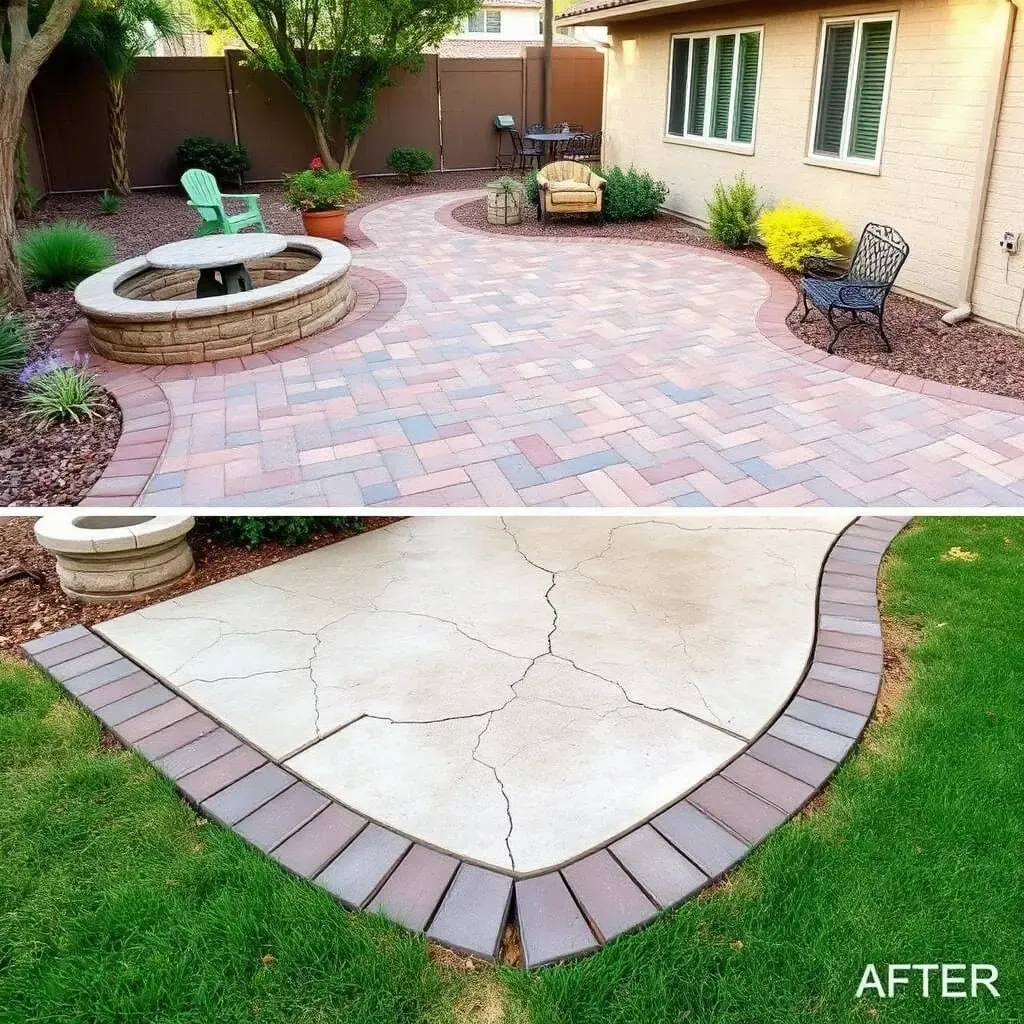
- Pavers. Concrete cracks under our heat cycle; pavers move with it. Individual pavers can be lifted and reset if a pool repair or settling ever happens. Stamped concrete on a pool deck is a 7–10 year decision; pavers are a 25+ year one.
- How long does a paver patio installation take?
- Most residential paver patios take 5–10 working days from demo to final compaction once we're on-site. Drainage rework, retaining walls, or large driveways extend the schedule. Design and material selection runs in parallel before mobilization.

David "Dave" Bell
Dave is the owner of AE Outdoor Living in Peoria, Arizona and the current president of the Southwest Hardscape Association — 13 years on the board, 15 years involved. He has designed and built outdoor environments across Greater Phoenix since 2005.