
Prepared by AE Outdoor Living. Reviewed by David Bell. Last reviewed: August 15, 2026.
How to Maintain a Residential Splash Pad in Arizona
Answer first: assign an undistracted Water Watcher, inspect the pad before every use, keep grates, jets, and the drainage path clear, follow the manuals for the equipment actually installed on your project, adjust for Arizona heat, dust, hard water, and monsoon debris, and stop use the moment water, surfacing, or anything electrical looks wrong. This guide is free, has no email wall, and is written for homeowners and the contractors who service their systems.
- AZ ROC 211530 · 347738 · 341002 · 340966
- Arizona-built since 2005
- President, Southwest Hardscapes Association
First, identify what kind of system you actually have
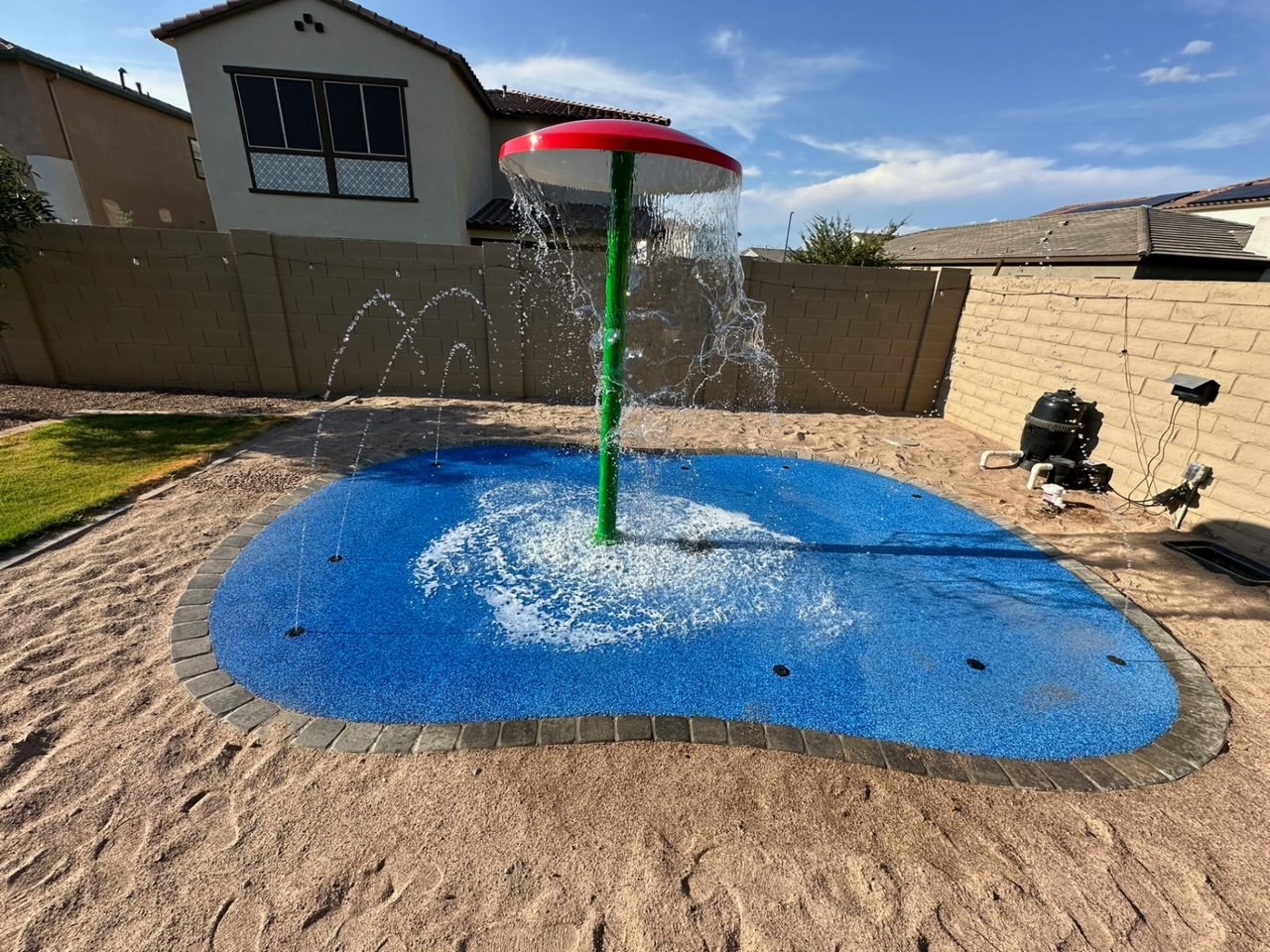
Before any maintenance advice applies, you need to know where the water goes. A recirculating design collects used water in a below-grade tank or basin and returns it through a pump, filtration, and a water-treatment device before it reaches the jets again. You will usually see an equipment area, a tank or vault access lid, and a treatment component. A fresh-flow or drain-away design does not return water to the jets. Used water goes to a designed drainage point, and there is generally no collection tank or treatment equipment on the project. Some projects sit between those descriptions or include site-specific drainage details. Do not assume. Read your approved plans and signed scope, and identify each component against its own manufacturer manual before you touch anything.
- Recirculating clue: tank or basin access lid, pump and filtration, a treatment or chlorination component
- Fresh-flow clue: no collection tank, water routed to a designed drainage discharge
- Either way: confirm against approved plans and manuals, not against a general article
- Write down the make and model of every component while you are out there
Before-each-use visual checks
Do this in daylight, with the system off, before anyone steps on the pad. Start with supervision, then work through the pad, the equipment, and the barrier.
- Water Watcher: one assigned adult, undistracted, for the whole time the pad is in use
- Deck: surface temperature and condition, cracks, lifted edges, hollow spots, trip edges at joints
- Jets and covers: caps, grates, and access covers present, secure, and free of obstruction
- Intended drainage: grates and the drainage path clear, water leaving the way the design intends
- Equipment area: visible leaks, unusual sounds, error indicators, breaker position
- Water condition, where it applies: clarity, odor, and a treatment component operating as documented
- Barrier and gate, where one serves the area: gate closes and latches on its own and the barrier is intact
Want a number for your own property?
Tell us the space and we'll come back with a real range for your site — no pressure, no "call for pricing."
Project-specific care — pump, filter, treatment, tank, jets, surface, drainage
Every item below is set by your own equipment and documentation. The point is knowing what to look at and who should touch it. Pump: keep the equipment area clear and dry, look and listen for leaks, vibration, or heat, and never run a pump that has lost prime or is running dry. Repairs belong to a technician, and a pressurized filter should never be opened by an owner. Filter: a cartridge element is removed and cleaned or replaced by the method in your manual — a cartridge filter is not backwashed. The trigger for service comes from your documentation and what you observe, not from a published interval. Chlorinator or treatment device: confirm it is operating as documented. Do not guess at chemistry, do not mix chemicals, and do not change a treatment design on your own — that belongs to your water-treatment design and a qualified professional. Tank and autofill: keep access lids secure, watch for debris entering the basin, and treat a continuously running autofill or a dropping level as a leak until it is proven otherwise. Jets: keep caps and housings clear and secure. Weak or uneven spray usually points upstream — debris, filtration, valve position, or level. Deck and surface: sweep and rinse when dust film is visible, inspect texture and joints, and keep the surface clear of anything that creates a trip edge. Surfacing may be specified as a slip-resistant material or finish, which is a material characteristic and not a guarantee — wet surfaces are still slippery and hot surfaces are still hot. Have cracks and lifted areas evaluated rather than patched blind. Drainage: the drainage path is part of the system. Keep it clear from the pad to its discharge or collection point, and have it evaluated if water is not leaving as designed.
Arizona-specific: heat, dust, hard water, and monsoon
Valley conditions change the workload, not the fundamentals.
- Blowing dust loads filtration and settles into surface texture faster than a mild climate
- Pollen and fine grit find their way into basins, sumps, and jet housings
- Monsoon storms deliver leaf litter, gravel, and mud in a single afternoon
- Hard water is common here — watch for scale or white deposits at jets, fittings, and the water line
- Heat is hard on pumps, seals, controls, and anything exposed at the equipment area
- Deck and surrounding hardscape get hot — check surface temperature before children are on them barefoot
- Inspect after a dust event or a storm before the next use, not only on your usual routine
Stop use and call a qualified professional
Turn the system off and keep children off the pad when any of these are present. These are not wait-and-see items, and none of them are owner repairs.
- Any electrical concern — a tripping breaker, a GFCI that will not hold, damaged covers, or exposed or wet wiring
- A pump that hums with no flow, runs dry, overheats, or leaks
- Water that is cloudy, discolored, strongly odorous, or visibly contaminated where water condition applies
- A treatment or chlorination component not operating as its manual describes
- Water that is not draining the way the system was designed to drain
- Cracked, lifted, or hollow surfacing, a trip edge, or a deck surface that is dangerously hot
- A loose, missing, or damaged grate, drain cover, or jet cap
- Unexplained water loss or a continuously running autofill
- Never open a pressurized filter, attempt electrical repair, mix chemicals, or reset a breaker repeatedly
Owner care versus qualified professional
The line is simple: owners observe, clean, and document. Licensed and qualified professionals service systems.
- Owner: visual inspection, debris removal, rinsing and sweeping, clearing grates, confirming covers and caps
- Owner: following the specific cleaning steps written in your own manufacturer manuals
- Owner: keeping a dated log of inspections, cleanings, and service visits
- Qualified pool or water-feature technician: water treatment, chlorinator or feeder service, pump, plumbing, tank, sump, and below-grade work
- Licensed electrician: any electrical work, including GFCI, bonding, and controls
- Appropriate licensed professional: drainage corrections, surface and substrate repair, and warranty-affecting service
Universal guidance vs. project-specific requirements
Universal — true for any residential splash pad
- Attentive supervision by an assigned, undistracted Water Watcher.
- Healthy water-play behavior: no one in the water while ill with diarrhea, take bathroom and diaper breaks, and keep drinking water out of the spray.
- Visual hazard checks before use, and keeping the pad off when something looks wrong.
- Keeping dated records of inspections, cleaning, and service.
- Following the exact manuals for the equipment actually installed on your project.
Project-specific — set by your own documentation
- Whether the system recirculates or sends water to a designed drainage point.
- Water chemistry and treatment design, and who adjusts it.
- Run time, and the triggers for filter service on your equipment.
- Tank, valve, autofill, and control configuration and settings.
- Seasonal protection and the drainage detail for your site.
- Permit, barrier, HOA, and insurer requirements, and warranty terms.
Approved plans, signed scope, manufacturer manuals, water-treatment design, and AHJ, HOA, and insurer requirements control. This guide is educational and is not legal advice.
Troubleshooting — symptom, possible cause, safe next step
Possible causes only. The right fix depends on your specific system, your approved plans, and your manufacturer manuals. When in doubt, the safe next step is to keep the pad off.
| Symptom | Possible cause | Safe next step |
|---|---|---|
| Jets are weak, uneven, or not spraying | Debris in a jet housing, a loaded filter element, a valve out of position, a low level in a tank-fed system, or a pump problem | Turn the system off, clear visible surface obstruction at the jet, and check your manufacturer manual. If it is not a surface obstruction, call your service professional |
| Pump hums with no flow, runs dry, is hot, or leaks | Loss of prime, low water level, an air leak on the suction side, or a failing seal or bearing | Shut the system down at the equipment and at the breaker and call a qualified technician. Do not keep running it and do not open a pressurized filter |
| Water is cloudy, has an off odor, or shows visible contamination (systems where water condition applies) | On a recirculating design: a loaded element, a treatment component not operating as documented, or a heavy organic and dust load. On a fresh-flow design: contamination at the source or in the delivery line | Stop use. Do not adjust chemistry by guesswork or mix chemicals — have the water-treatment design reviewed and serviced by a qualified professional |
| Autofill runs continuously or the level keeps dropping | A leak in the basin, plumbing, or a fitting, a stuck autofill valve, or evaporation combined with an unrelated loss | Note how fast the level drops, shut the system down, and have the tank, autofill, and plumbing leak-tested by a qualified professional |
| Unexpected pooling on the deck or slow drainage | A blocked grate, debris in the drainage path, settlement at a transition, or a drainage detail not performing the way it was designed | Keep the pad off, clear visible debris from grates, and have the drainage path and surface slope evaluated against your approved plans by a qualified professional |
| Surfacing is cracked, lifted, hollow-sounding, has a trip edge, or is dangerously hot | Substrate movement, water intrusion beneath the surface, wear at a joint or transition, or direct summer sun on an unshaded deck | Keep children off the affected area, shade or cool the surface before barefoot use, and have the surface and substrate evaluated before further use |
| Breaker trips, a GFCI will not reset, or wiring is exposed or wet | Moisture intrusion, a damaged cover or conduit, or an equipment fault | Stop use immediately, leave the circuit off, and call a licensed electrician or your service contractor. Do not reset the breaker repeatedly and do not attempt electrical repair |
Printable splash pad checklist
Free to print and post at the equipment area — no email required. Adjust it to match your own manufacturer manuals and approved plans.
Before use
- Assign one undistracted adult Water Watcher for the entire time the pad is in use
- Walk the whole surface in daylight with the system off
- Check deck temperature and surface condition before barefoot use
- Look for cracks, lifted edges, hollow spots, and trip edges at joints and transitions
- Confirm every jet, cap, grate, and access cover is present and secure
- Clear leaves, gravel, and debris from grates and the intended drainage path
- Look and listen at the equipment area for visible leaks or unusual sounds
- Where water condition applies, look at the water and confirm treatment is operating as your manual describes
- Check that any barrier and self-closing, self-latching gate serving the area works
When visible conditions or project documents call for it
- Rinse and sweep the surface when dust film or organic buildup is visible
- Service or replace the filter element by the method and trigger in your manual
- Inspect the tank or basin access, if your system has one, for debris and level
- Inspect the drainage path from the pad to its discharge or collection point
- Raise scale, white deposits, or staining with your service professional instead of guessing at a chemical
After Arizona dust or monsoon conditions, before next use
- Inspect and clear grates, jets, and any basin after a dust event
- Clear leaf litter, gravel, and mud after a storm before anyone uses the pad
- Re-check the drainage path for washed-in debris
- Look over the equipment area for storm damage, water intrusion, or a tripped breaker
- Record what you found and what you cleared, with the date
Stop use and call a qualified professional
- Any electrical concern, including a breaker or GFCI that will not hold or wet or exposed wiring
- A pump that hums without flow, runs dry, overheats, or leaks
- Water that is cloudy, off-smelling, or visibly contaminated where water condition applies
- Water that is not draining the way the system was designed to drain
- Cracked, lifted, hollow, or dangerously hot surfacing, or a loose or missing grate or cap
- Any water-treatment, chlorinator, plumbing, tank, sump, below-grade, or drainage work
Sources & last reviewed
Last reviewed: August 15, 2026. Written by AE Outdoor Living from primary sources and field experience. We do not copy other companies' content.
- CDC — Stay Healthy at Splash Pads — public health guidance on water-play illness prevention and healthy behavior.
- CPSC — report on persistent risk of childhood drowning — federal water-safety context for supervision around residential water features.
- Arizona Revised Statutes §36-1681 — the state pool barrier statute; your AHJ decides how it applies at your address.
- Pentair — pool filter product safety help center — manufacturer safety guidance for filter handling; applies only to that equipment.
Public-facility rules or another product's manual do not replace this residential project's approved design and the exact manuals for the equipment installed on it.
Common questions.
Why we publish this for free
AE shares the right way to plan, operate, and care for outdoor water features openly — with no email wall — even when the reader never hires AE. Better planning, better operation, and better care support safer, longer-lasting places where families connect and make memories, and that is worth more to us than gating a checklist. Nothing here is a sales promise: your own documentation and your AHJ decide what your system requires.
Related splash pad planning
- Residential splash pad cost guide — Arizona (installed planning range, cost drivers, and what is itemized in an AE proposal).
- Splash pad service page (how AE designs and builds residential splash pads in the Valley).
- Pool vs splash pad for young children (honest comparison for families deciding between the two).
Questions about your own splash pad?
Send us what you have — plans, equipment photos, or the manuals — and we'll help you understand what your specific system needs.
Get a Project-Specific Splash Pad PlanWhy this is an investment, not a cost.
An AE backyard is engineered to add daily livability and long-term home value. We publish honest ranges and build to code with a licensed and bonded Arizona crew. AE provides project-specific workmanship and manufacturer-warranty information in the signed agreement. Website summaries are for planning only.
- Licensed, bonded & insured in Arizona. ROC 340966 (R-62) · ROC 341002 (R-3) · ROC 347738 (KA-5) · ROC 211530 (CR-21). Most Arizona contracting work valued at $1,000 or more — or requiring a permit — must be performed by a properly licensed contractor, subject to statutory exemptions. Verify the legal entity, license status, and classification with the Arizona Registrar of Contractors.
- Real ranges, itemized scope. You see materials, finishes, equipment models, and a line-item budget before you sign — not a one-line "pool — $90,000."
Plan your investment with a designer.
Five minutes, a real range, and no sales pressure. Or vet any Arizona contractor (us included) before you spend a dollar.