
Glass deck and balcony railing, residential + commercial.
Pool fencing is one Sonoran Glass product. Deck railings, balcony guards, rooftop railings, view fences, and commercial guard rail are a separate engineered category with their own requirements, and they are separate engineered products — a guard or railing is not automatically a pool barrier, and pool-fence specifications do not carry over to it. Guard height, loads, glass build-up, spans, attachment and any engineering or permitting requirement are set by the approved design for that project, the substrate and geometry, the exposure, the adopted code, the project engineer, the manufacturer documentation and the authority having jurisdiction.
- AZ ROC 211530 · 347738 · 341002 · 340966
- Arizona-built since 2005
- President, Southwest Hardscapes Association
Frameless glass railing on a Scottsdale deck and balcony
Three original photos from one glass railing installation at a private Scottsdale residence, showing frameless glass panels and base-mounted hardware along the upper-level balcony/deck edge while surrounding construction was still in progress. The home, stucco and deck surfaces, water, windows, roof, neighboring properties and unfinished construction are site context, not AE scope. These photos are not published as pool-fence or pool-barrier evidence.
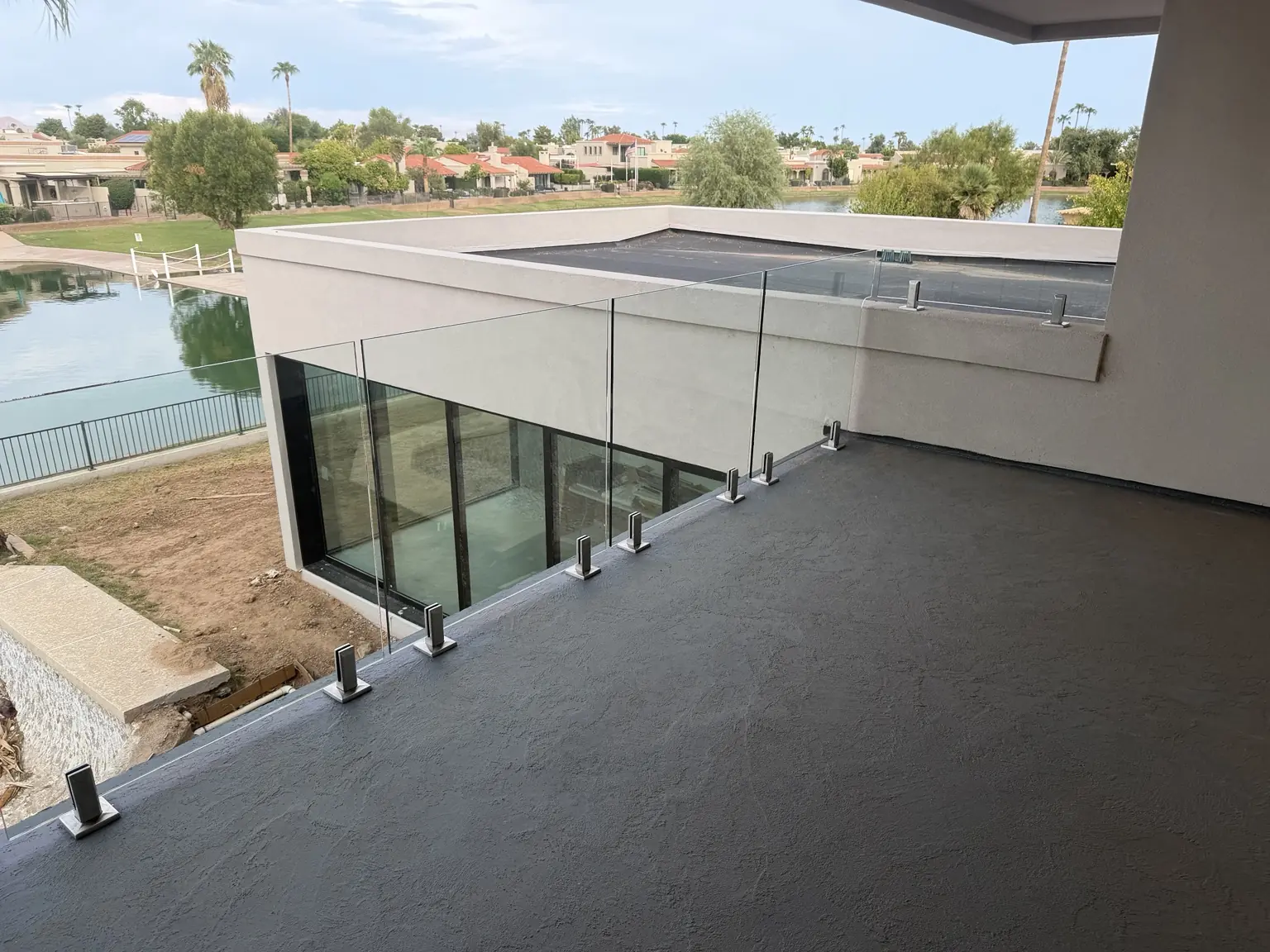
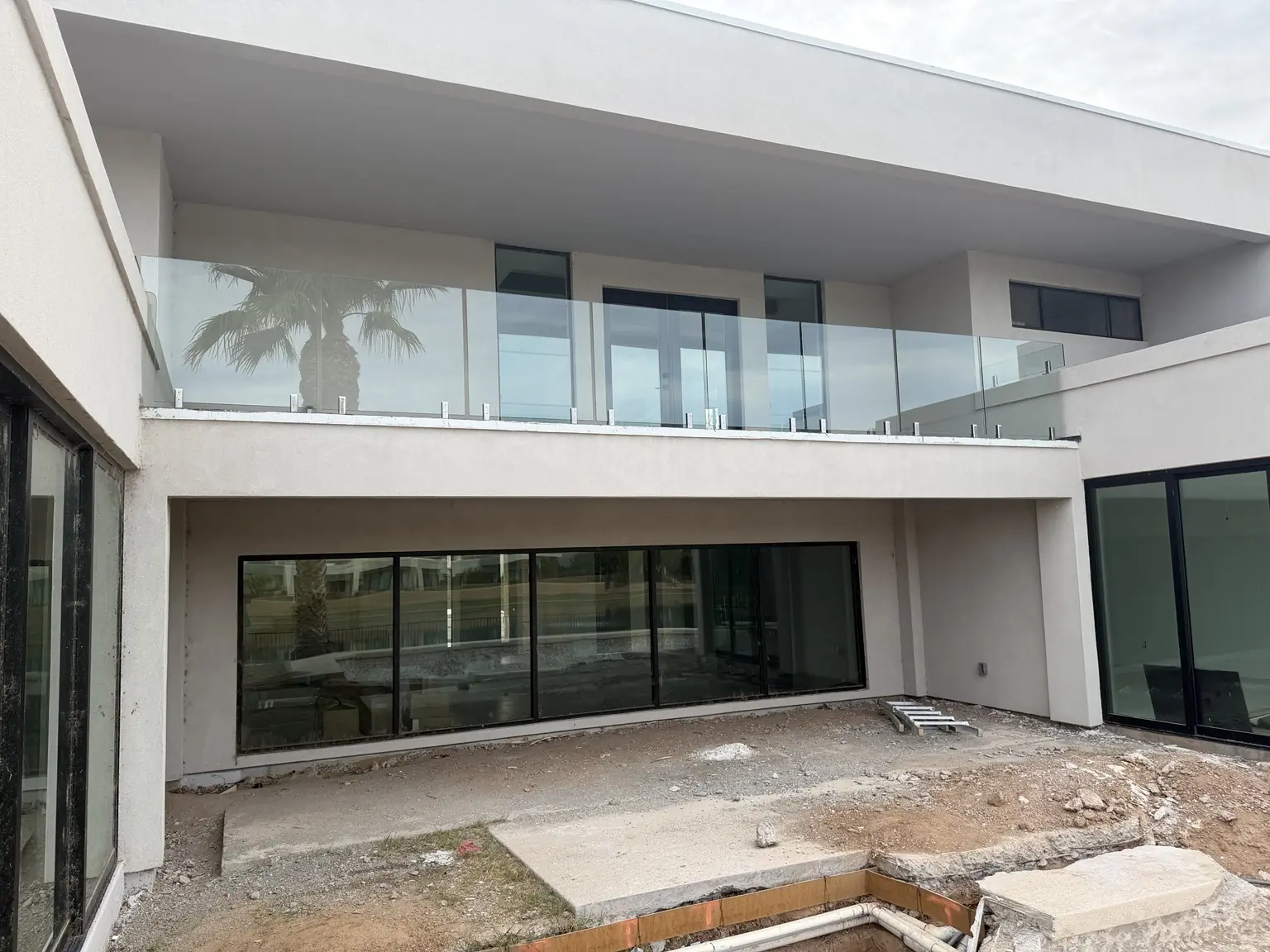
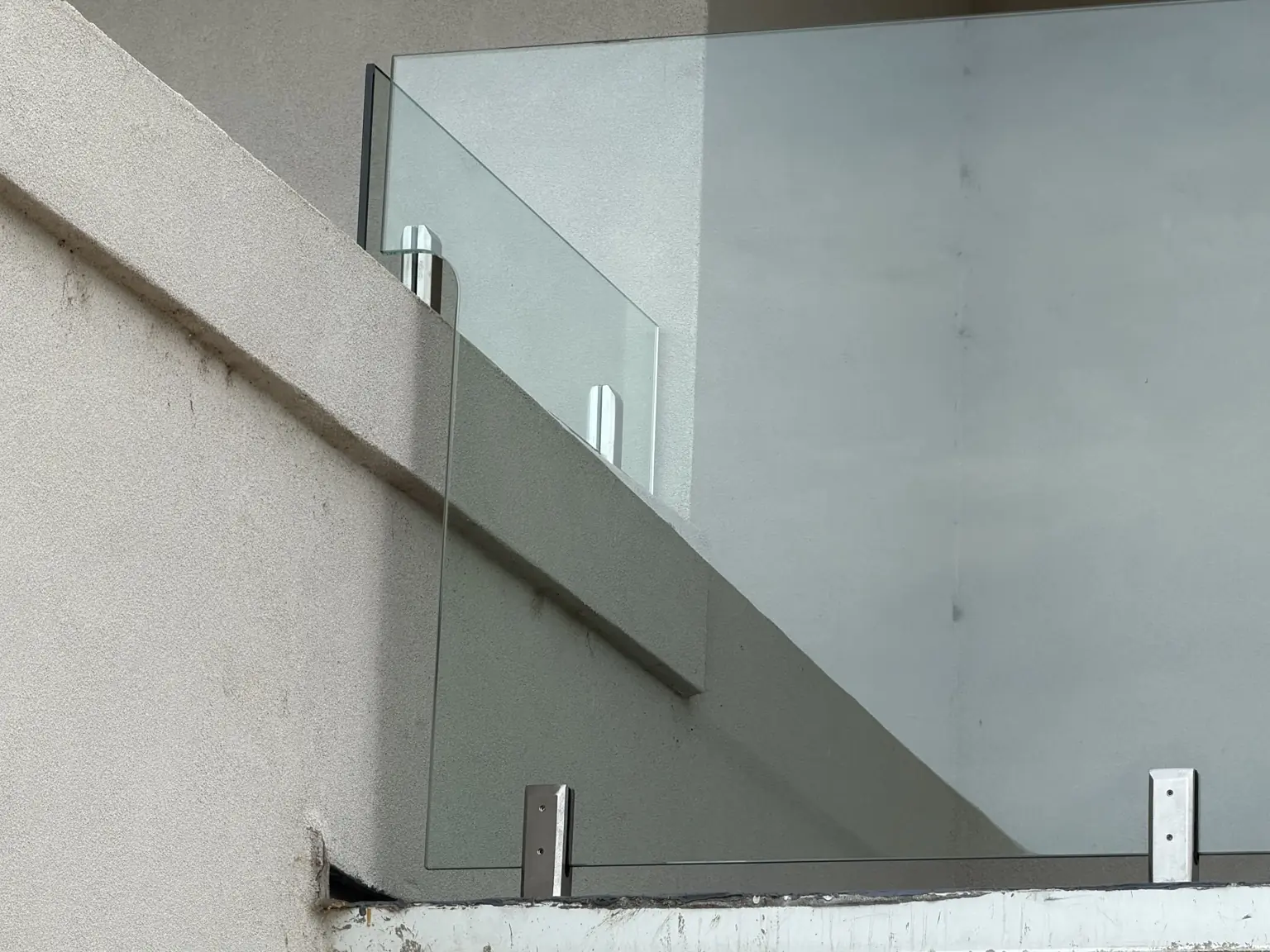
See the full Scottsdale frameless glass balcony railing project
See interior and exterior glass railings in progress in Phoenix’s Camelback Mountain area
Where it works
- Hillside and view-lot balconies (Paradise Valley, Fountain Hills, North Scottsdale, Anthem)
- Pool deck guards on elevated decks and infinity-edge pools
- Rooftop decks and lounges
- Stairway and landing guards inside the home
- Commercial: restaurant patios, rooftop bars, office terraces, multifamily balconies
Mounting options
- Fascia mount: panels attach to the face of the deck edge, where the approved engineering confirms the edge condition supports the connection
- Top mount: panels sit on top of the deck framing, where the approved detail and the project engineering support the attachment
- Standoff: point-fixed hardware; penetration count, spacing and pattern come from the approved engineering and the manufacturer's system
- Base channel: continuous metal channel; how the system carries load is defined by the manufacturer's documentation and the approved engineering
Want a number for your own property?
Tell us the space and we'll come back with a real range for your site — no pressure, no "call for pricing."
Top rail vs no top rail
No top rail is the 'infinity' look — uninterrupted glass with no horizontal line across the view. With a top rail, what the rail contributes structurally is defined by the approved engineering and the manufacturer's system, and it serves as a handrail only where specifically designed and approved for that function. Top rail and no top rail are configurations to evaluate; whether either is within AE's current offering for your project, and whether it is appropriate, is identified in the written proposal and controlled by the approved design, the selected system, the project engineering, the adopted requirements and the authority having jurisdiction. Glass build-up, spans, hardware and any engineering requirement are set by the approved design, the manufacturer documentation and the project engineering rather than by a default, and the adopted code and the reviewing authority determine what your project requires.
Cost (installed, Arizona)
- Railing and guard work is quoted project-specifically — there is no published per-linear-foot range for engineered railings or guards.
- The $225–$325 per linear foot planning range published elsewhere on this site is for glass pool fencing only; it does not apply to a railing or guard.
- Specialty glass systems, gates, upgraded glass and custom hardware are quoted after the layout, substrate and specifications are confirmed.
- Multi-story, rooftop, wind-exposed and engineered commercial installs are line-itemed on the written proposal.
Code + engineering
- Guard height and load criteria come from the adopted code edition and the reviewing authority — model-code references are a starting point, not a project approval
- Residential and commercial guards are designed to the criteria confirmed for the specific project
- Glass build-up, hardware system and dimensions, and finish are selected and documented by the approved design, the project engineering and the manufacturer's documentation
- Stamped engineering where the authority having jurisdiction, the project engineer or the approved design requires it — the requirement is determined project by project, including on commercial work and non-standard residential geometry
- The customer confirms requirements with the municipality/AHJ and, where relevant, the HOA; AE builds to the approved written scope and does not guarantee municipal, HOA, insurer or inspection acceptance
- A guard or railing is only a pool barrier when it is specifically designed and approved for that use
- Submittal and building-department coordination across Phoenix, Scottsdale, Mesa, Gilbert, Chandler, Paradise Valley and Fountain Hills is handled by AE where the signed scope assigns it to us; the reviewing department controls its own process, timing and acceptance
Commercial: how we work with GCs
- Sub to GC on tenant improvements, ground-up, and rooftop renovations, on the terms the contract sets
- Stamped engineering and shop drawings provided where the project requires them and where the written scope assigns them to AE; the engineer of record controls the engineering and the reviewing authority controls acceptance
- Coordination with structural, deck and waterproofing trades to the extent the signed scope and the project's coordination plan assign it to AE
- Insurance: the contract identifies the insurance and certificate requirements for the project and the documentation assigned to AE
- Warranty: manufacturer materials warranty per the manufacturer's current documentation, plus AE Outdoor Living workmanship terms as written in the signed scope
Common questions.
Have a balcony, deck, or commercial project?
Send us photos and rough measurements (and the GC contact if it's commercial). Where the work is within AE's current offering, we supply a field-verified written quote after the site review and identify the items that go to the project engineer and the authority having jurisdiction for review; those parties determine their own requirements and any acceptance.
Request a Railing QuoteWhy this is an investment, not a cost.
An AE backyard is engineered to add daily livability and long-term home value. We publish honest ranges and build to code with a licensed and bonded Arizona crew. AE provides project-specific workmanship and manufacturer-warranty information in the signed agreement. Website summaries are for planning only.
- Licensed, bonded & insured in Arizona. ROC 340966 (R-62) · ROC 341002 (R-3) · ROC 347738 (KA-5) · ROC 211530 (CR-21). Most Arizona contracting work valued at $1,000 or more — or requiring a permit — must be performed by a properly licensed contractor, subject to statutory exemptions. Verify the legal entity, license status, and classification with the Arizona Registrar of Contractors.
- Real ranges, itemized scope. You see materials, finishes, equipment models, and a line-item budget before you sign — not a one-line "pool — $90,000."
Plan your investment with a designer.
Five minutes, a real range, and no sales pressure. Or vet any Arizona contractor (us included) before you spend a dollar.