
Glass pool fence spigots: core-mount vs bolt-down in Arizona.
When a glass pool fence in Arizona needs repair, anchorage is one item to evaluate — alongside the substrate, the selected product, the installation, the project records and the approved detail. A core-mount spigot is set into a pocket below the deck surface; a surface-mount bolt-down system relies on its anchors and the substrate beneath the plate. What each assembly carries follows the selected manufacturer's system and the approved engineering. Here's the detail, with exploded views.
- AZ ROC 211530 · 347738 · 341002 · 340966
- Arizona-built since 2005
- President, Southwest Hardscapes Association
Core-mounted and bolt-down glass spigot systems
Core-mounted and bolt-down systems are two mounting approaches. The appropriate mounting method depends on the existing structure, deck construction, engineering, manufacturer requirements, applicable code, site conditions, and signed proposal.
- Core-mounted: a cylindrical stainless-steel spigot set into a core-drilled pocket with Rapid Set rapid-setting anchoring cement, so the spigot body is embedded below the deck surface per the approved pocket detail. What the assembly carries and how the load path performs come from the selected manufacturer's system and the approved engineering. Stainless-steel core-mount spigots are AE's standard mounting method on Sonoran Glass projects; bolt-down/surface-mount spigots are used only when necessary and supported by the approved project detail, and the specific hardware for your project is confirmed in the signed scope.
- Surface-mount bolt-down: a base plate that sits on top of the slab and is held by anchors into the material directly beneath it. Its performance depends on that substrate, the anchors selected and the approved detail.
Why glass can shift on a bolt-down install
Slab and joint behavior varies by the slab design, the construction, the environment and the condition of the deck, and no mounting method causes, prevents or universally responds to movement. A core-mount spigot is set into a pocket below the deck surface; a surface-mount base plate is fixed on the surface, so the anchors and the substrate under the plate are part of the load path. A lean on any specific install is not proof of one cause — the substrate, the selected product, the anchors, the installation, the loads and the maintenance history all belong in the evaluation, and the project records, substrate verification, the installed system documentation and the approved engineering carry more weight than appearance. Every location where movement or misalignment is observed, including at a gate-adjacent panel, is evaluated under that same project-specific process.
Want a number for your own property?
Tell us the space and we'll come back with a real range for your site — no pressure, no "call for pricing."
What determines whether an anchorage works
- Substrate: the concrete an anchor is set into is part of the assembly. Thickness, reinforcement, condition and edge distance are verified on site and evaluated by the approved engineering — they are not catalog values, and no universal minimum applies to every deck.
- Load criteria: model codes such as IRC R301.5 and IBC 1607.8 set guard loading criteria for code-rated guards. Which edition and which criteria apply is determined by the authority having jurisdiction and the project engineering. A pool barrier and an engineered building guard are different systems on different code paths; a system asked to serve both has to be specifically designed and approved for both, and a fence specification does not carry over to a guard.
- Load path: the two methods engage the structure differently — a base plate through anchors at the surface, a core mount through the embedment set in the approved pocket detail in structural concrete or an approved footing. What each transfers on a specific project comes from the selected manufacturer's documentation and the approved engineering, not from a general comparison.
- Post-tensioned slabs: AE will not drill a post-tensioned slab without the homeowner's documented written permission plus documented tendon locating — an appropriate professional scan or X-ray, or clear professional marking. A homeowner's recollection or guess is not adequate. Where practical, AE normally recommends an approved separate footing outside the post-tensioned slab; qualified scanning, the engineering and the approved structural detail control.
- Pavers are not structural anchorage: a paver, its bedding sand and its base course cannot carry spigot loads. Coring continues into verified structural concrete or an approved footing beneath, and thin, unreinforced or unknown slabs require a site review and an approved detail before any hole is drilled.
- Evidence of a problem: cracking around anchor heads, a panel out of plumb, or hardware that moves under hand pressure all warrant inspection rather than a re-torque.
Stainless hardware selection for glass pool fence spigots
- Hardware can be exposed to chlorides, mineral deposits and other contaminants from chlorinated or salt-water splash and site conditions such as sunscreen, dust and fertilizer overspray; exposure varies by property.
- Austenitic grades such as 304 and duplex grades are different products, and how any of them holds up depends on the specific hardware, the exposure, water chemistry, the installation and the maintenance it receives rather than on a fixed ranking. Ask for the manufacturer documentation for the grade being proposed.
- Plated materials such as chromed zinc depend on the plating; how a plated product performs in a given environment comes from the manufacturer's documentation for that product.
- Our current Sonoran Glass standard is Duplex 2205 stainless-steel spigots, selected for pool environments; the manufacturer documentation for the supplied product states its properties and care requirements.
- The specific spigot, wedge, and fastener metallurgy on your project is confirmed in the signed proposal, and dissimilar-metal detailing follows the manufacturer's documentation and the approved design.
Minimum 1/2-inch tempered safety glass for pool fence panels
- Deflection and panel sizing: engineered performance for any specific panel comes from the manufacturer's data and the project engineering, not from a general thickness rule.
- Edges and clamping: glass edges and the clamped zone are handled per the fabrication documentation and the hardware manufacturer's instructions for the selected system.
- Tempered glass is a safety glazing product: if it breaks it is designed to come apart into relatively small pieces rather than the large shards associated with annealed glass. Pieces can still be sharp and can still cause injury, so damaged glass should be isolated and replaced.
- Have the written scope state glass thickness, the safety-glazing designation and the requirement for a permanent tempered-glass identification mark before fabrication is released — then verify that permanent mark on each panel as it is delivered and installed.
- AE's current Sonoran Glass fence minimum is 1/2-inch tempered safety glass.
Side-by-side: core-mount vs bolt-down spigot comparison
- Anchorage — Core-mount: spigot embedded in a core-drilled concrete pocket set with Rapid Set rapid-setting anchoring cement. Bolt-down: anchors into the material directly under the base plate.
- Hardware grade — Core-mounted (AE Sonoran Glass standard spec): Duplex 2205 stainless-steel spigots. Either method: ask which alloy and grade the written scope names, and for the manufacturer documentation.
- Glass spec — AE minimum on either method: 1/2-inch tempered safety glass with a permanent tempered mark. Either method: confirm thickness, safety-glazing designation and marking in writing before fabrication.
- Suitability — Core-mount: AE's standard where structural concrete is present or an approved footing is built. Bolt-down: used where the approved project detail and conditions support it.
- Appearance — Core-mount: no surface base plate. Bolt-down: the base plate sits at the deck; how much plate and fastening remains visible depends on the selected manufacturer's cover design. Polaris SpigotSM, for example, includes a cover ring.
- Serviceability — Either method: rinse, squeegee, and service hardware as the manufacturer instructions, exposure and inspection findings indicate.
- Total installed cost — Either method: quoted per project after the layout, substrate and approved detail are confirmed. Coring, footings, restoration and hardware selection all move the number, and long-term outcomes on either method depend on the product, anchors, substrate, engineering and maintenance.
AE's core-mount installation baseline
- Layout marked from the approved drawing — spigot centers, gate posts, panel widths, expansion gaps.
- Core-drill pockets sized and set per the approved detail for that project's substrate — AE's baseline is a 5-inch core-drilled hole with 4-inch embedment into verified structural concrete or an approved footing, not into ABC, sand or a compacted paver base. Substrate suitability is project-specific and verified on site.
- Vacuum the pockets clean — no concrete dust, no standing water.
- Rapid Set rapid-setting anchoring cement placed in the pocket, spigot seated plumb and held while it sets, per the manufacturer instructions and approved detail.
- Cure to the manufacturer's instructions before glass is loaded.
- Panels set with stainless-steel wedges and rubber liners, torqued to manufacturer spec — not by feel.
- At least 1/2-inch tempered panels with the permanent tempered mark and polished edges.
- Self-closing, self-latching gate hardware where the run is acting as pool barrier. Gate hardware is quoted separately and confirmed in the signed proposal.
- Panels are field-measured and individually sized after approval; cuts, holes, notches and edgework are completed before tempering, and a tempered panel cannot be field cut afterward.
- No barrier, gate or hardware detail replaces active adult supervision — designate an undistracted adult Water Watcher whenever children are in or near water.
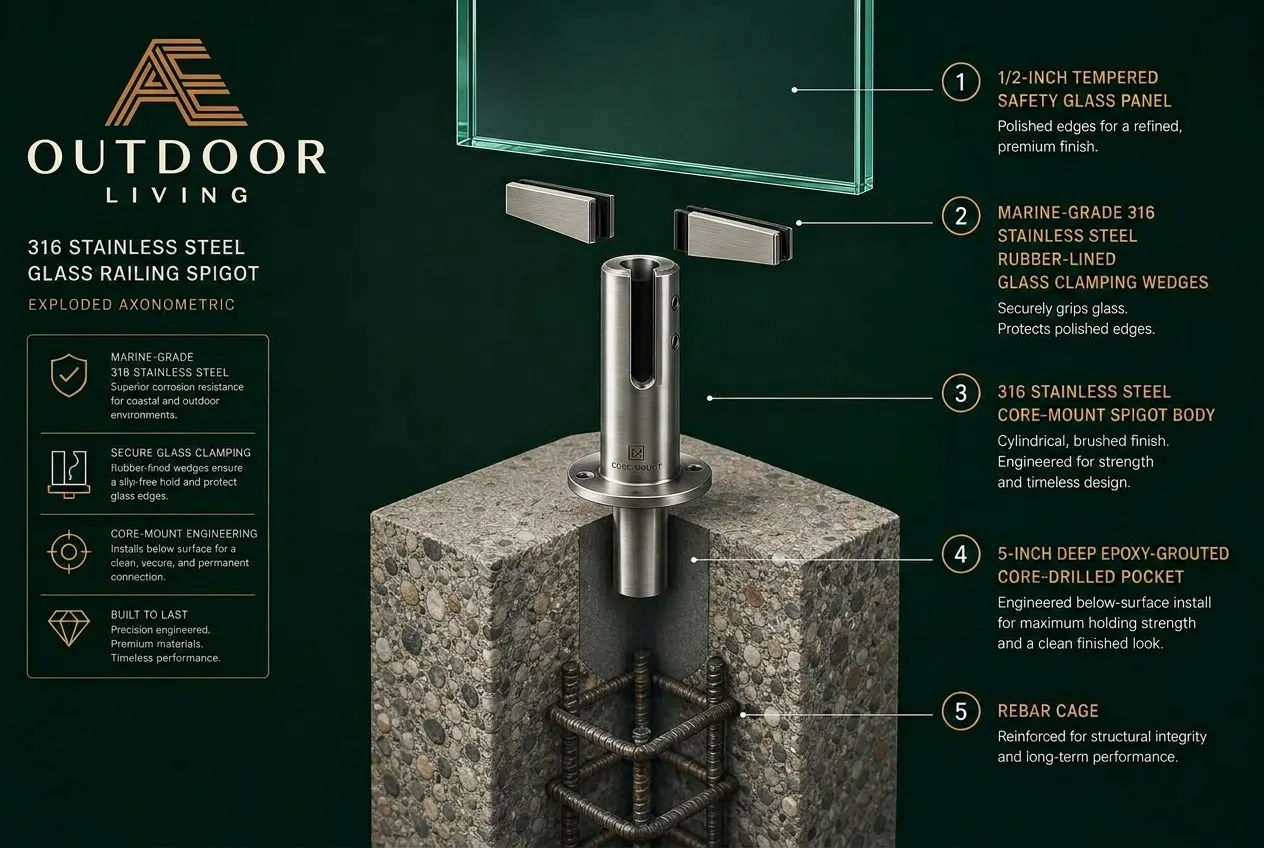
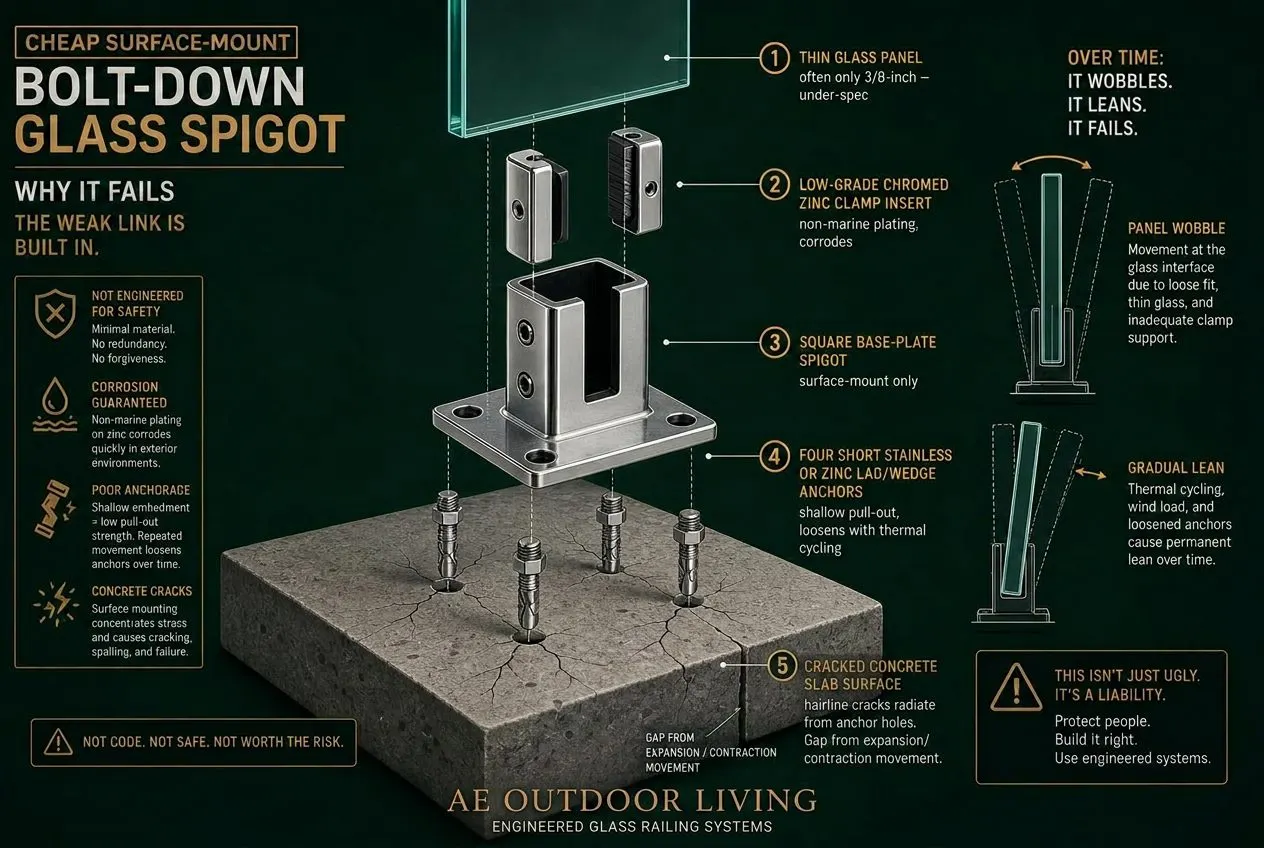
The drawings show different mounting geometry. Capacity, load distribution, corrosion detailing and how an assembly behaves as a deck moves cannot be inferred from that geometry — they follow the selected manufacturer system, that manufacturer's documentation and the approved engineering for a specific project. Service life on any specific system depends on the installed products, manufacturer documentation, site conditions and care.
Named manufacturer examples
Polaris SpigotCD is a core-drilled Duplex 2205 model; Polaris SpigotSM is its surface-mount 2205 model with a cover ring. The CRL US catalog also lists round core FWCR12PS and round surface FWCR22PS. FHC documents separate FFC1/FFC2 surface and FFC3/FFC4 core families. These examples are not interchangeable installation specifications; check the selected glass, gaskets, supporting structure and approved detail.
Manufacturer pages reviewed October 4, 2026; review date is not a claim about their publication dates.
Common questions.
Keep comparing
Duplex 2205 stainless-steel hardware, project-specific anchoring, project-specific code path.
Which company supplies panels, hinges and fixed-panel supports.
Polaris, CRL and FHC model-specific selection checks.
System choice before hardware choice.
When each actually makes sense.
Have a leaning glass fence assembly? Or planning one?
Send a few photos of the base plates or the proposed location. Photos can support preliminary observations only — they cannot show what is under the finish, and they cannot establish a cause. Where review of this work is part of AE's current offering, a written scope or proposal identifies the visible observations, the site, record and substrate verification still required, the responsibilities assigned to each party, and the items controlled by the manufacturer documentation, the project engineering and the authority having jurisdiction.
Get an Honest Spec & QuoteWhy this is an investment, not a cost.
An AE backyard is engineered to add daily livability and long-term home value. We publish honest ranges and build to code with a licensed and bonded Arizona crew. AE provides project-specific workmanship and manufacturer-warranty information in the signed agreement. Website summaries are for planning only.
- Licensed, bonded & insured in Arizona. ROC 340966 (R-62) · ROC 341002 (R-3) · ROC 347738 (KA-5) · ROC 211530 (CR-21). Most Arizona contracting work valued at $1,000 or more — or requiring a permit — must be performed by a properly licensed contractor, subject to statutory exemptions. Verify the legal entity, license status, and classification with the Arizona Registrar of Contractors.
- Real ranges, itemized scope. You see materials, finishes, equipment models, and a line-item budget before you sign — not a one-line "pool — $90,000."
Plan your investment with a designer.
Five minutes, a real range, and no sales pressure. Or vet any Arizona contractor (us included) before you spend a dollar.