
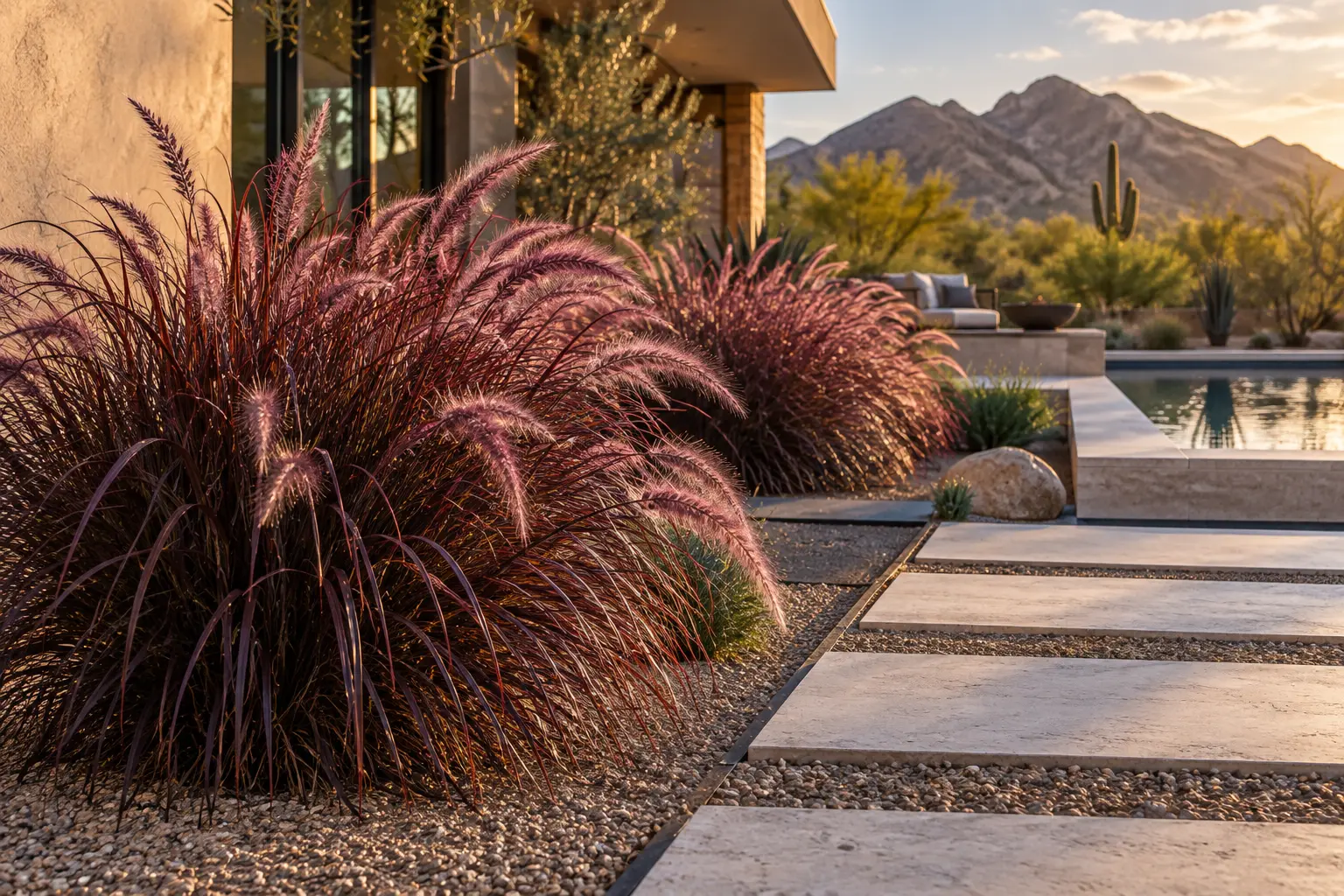
Purple Fountain Grass
Cenchrus setaceus 'Rubrum'
Purple Fountain Grass is the selected 'Rubrum' cultivar—valued for burgundy foliage and arching plumes, but dependent on correct labeling, winter cleanup and fire-aware placement.
Not sure if this plant belongs near your pool, wall, pavers, or foundation?
AE reviews microclimate, root intrusion risk, and soil compatibility.
Schedule: Weekly to twice-weekly in summer, less in cooler months.
Emitters: 1–2 emitters per shrub adjusted seasonally.
Most desert-adapted shrubs prefer drying out between waterings.
Arizona yards have very different microclimates. West-facing walls, glass, artificial turf, pavers, travertine, porcelain, and pool decking all increase reflected heat. AE considers these before confirming placement.
- Low root impact
AE verifies pool deck, paver, foundation, wall, and utility clearances before final planting.
Quick Facts
- Plant type
- Grass
- Mature size
- Commonly about 3–4 ft tall and 3–4 ft wide in flower
- Growth rate
- Fast
- Sun
- Full sun
- Water use
- Low
- Bloom season
- Warm season into fall
- Flower color
- Purple-tan arching inflorescences
- Foliage
- Burgundy to purple in strong sun
- Evergreen / Deciduous
- Semi-evergreen
- Thorns / spines
- None
- Litter level
- Medium
- Pool area
- Good with placement
- Pet/kid placement
- Use with care
- Maintenance
- Seasonal pruning
- Privacy value
- Low
- Shade value
- Low
- Native
- Desert-adapted
About Purple Fountain Grass
This guide covers Cenchrus setaceus 'Rubrum', familiar in horticulture as Pennisetum setaceum 'Rubrum', not unlabeled or straight green fountain grass. The underlying species lineage is native to Africa and southwestern Asia; this selected purple cultivar is not an Arizona native. Straight green Cenchrus setaceus is a serious Arizona invasive and fire-fuel problem. 'Rubrum' is widely described as sterile or very low-fertility and treated differently by invasive-plant references, but purchase only a correctly labeled, vegetatively propagated cultivar. Remove green reversions or unexpected seedlings and do not assume every purple-looking grass is equivalent. In sun it commonly reaches about 3–4 feet tall and wide in flower. Deep low-to-moderate irrigation with dry-down supports a premium Phoenix appearance; more water drives more growth and maintenance.
Best uses: A burgundy warm-season accent in sunny beds with irrigation control, winter-cutback access and clearance from pools and ignition sources
AE Designer Opinion
Design Uses
- Burgundy contrast mass
- Warm-season movement beside modern hardscape
- Sunny accent with planned winter reset
Care & Maintenance
- Confirm the nursery label reads Cenchrus setaceus 'Rubrum' or the accepted horticultural synonym.
- Water deeply during establishment, then use low-to-moderate irrigation with dry-down.
- Monitor and remove green reversions or unexpected seedlings.
- Leave the fall display if desired, then cut dead foliage near the crown in late winter before new growth.
- Wear gloves and eye protection during dry-foliage cleanup.
Common Homeowner Mistakes
- Buying unlabeled fountain grass instead of vegetatively propagated 'Rubrum'
- Treating the invasive green species and purple cultivar as interchangeable
- Promising identical burgundy color in shade or through winter
- Keeping the crown constantly wet
- Repeatedly shearing the living summer clump into a hard ball
Placement Warnings
⚠ Frost can brown or kill top growth, and severe freezes may kill the crown; winter appearance and perennial return depend on microclimate and event severity. Dry foliage can cut skin, airborne cleanup debris can irritate, and accumulated dry biomass can carry fire. Even correctly labeled 'Rubrum' requires fire-aware placement and monitoring for reversions or unexpected seedlings.
- Keep mature plumes and dry winter foliage away from pools, grills, fire features and ignition zones.
- Allow the full 3–4 ft spread outside narrow entries and circulation.
- Use a valve schedule that permits deep watering and root-zone dry-down.
- Maintain access for one late-winter cutback without damaging neighboring plants.
AE reviews final placement based on sun, irrigation, drainage, mature size, and overall design.
Pairs Well With
- Brittlebush
- Red Yucca
- Deer Grass
- Texas Sage
More Arizona Plants Like This


Ready to Build Your AE Plant Wishlist?
Add Purple Fountain Grass and your other favorites to your wishlist, then send it to the AE design team for the final plant palette.