

Pink Muhly Grass
Muhlenbergia capillaris
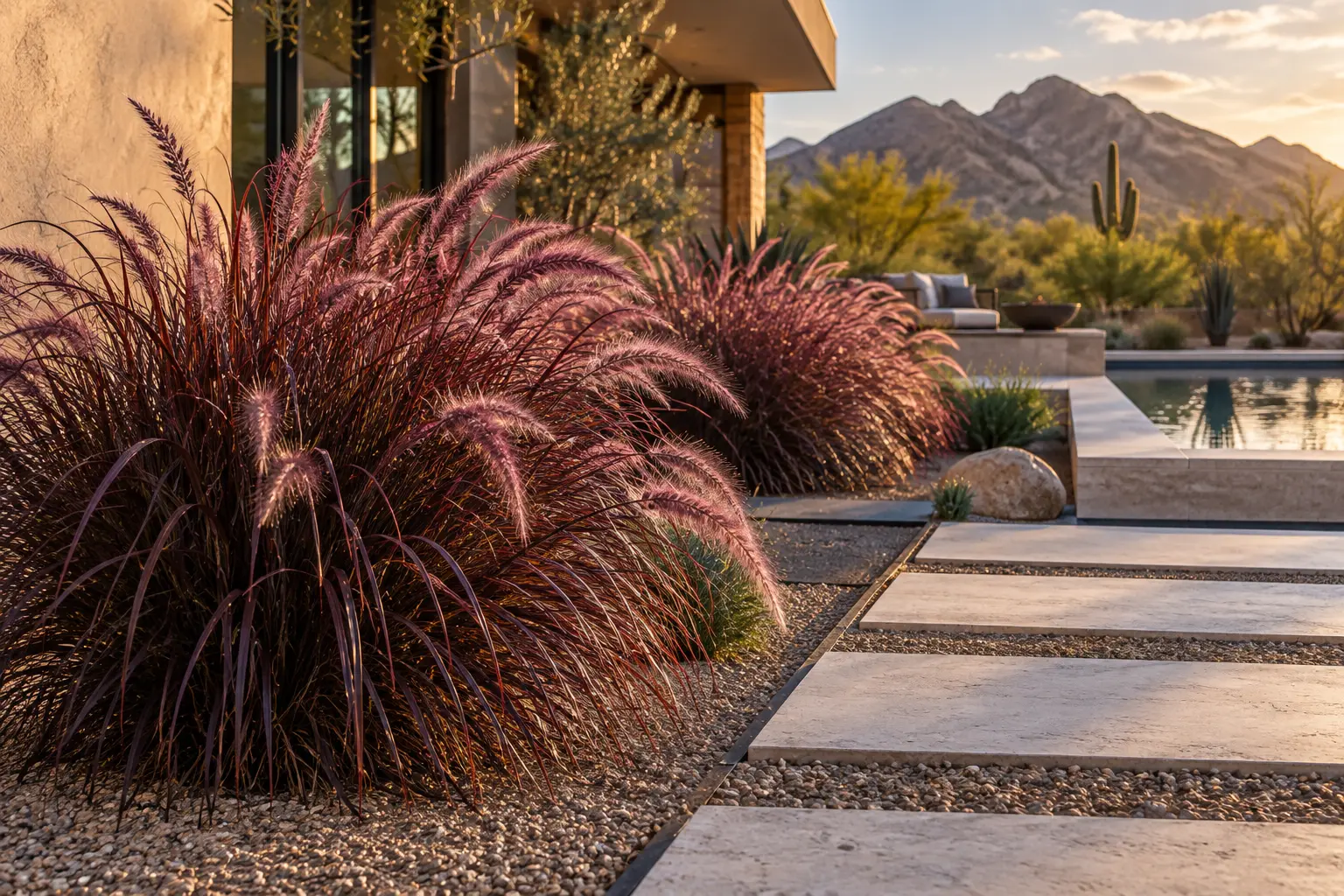
Pink Muhly Grass is a warm-season eastern U.S. native that brings an airy pink fall haze to Phoenix, followed by honest straw-brown dormancy, cutback debris and periodic rejuvenation.
Not sure if this plant belongs near your pool, wall, pavers, or foundation?
AE reviews microclimate, root intrusion risk, and soil compatibility.
Schedule: Weekly to twice-weekly in summer, less in cooler months.
Emitters: 1–2 emitters per shrub adjusted seasonally.
Most desert-adapted shrubs prefer drying out between waterings.
Arizona yards have very different microclimates. West-facing walls, glass, artificial turf, pavers, travertine, porcelain, and pool decking all increase reflected heat. AE considers these before confirming placement.
- Low root impact
AE verifies pool deck, paver, foundation, wall, and utility clearances before final planting.
Quick Facts
- Plant type
- Grass
- Mature size
- Usually around 3 ft tall and wide in combined foliage and flower effect
- Growth rate
- Moderate warm-season growth
- Sun
- Full sun
- Water use
- Moderate
- Bloom season
- Late warm season into fall
- Flower color
- Airy pink-to-rose panicles; seed-grown color varies
- Foliage
- Green in season, straw-brown in winter dormancy
- Evergreen / Deciduous
- Semi-deciduous
- Thorns / spines
- None
- Litter level
- Medium
- Pool area
- Use with care
- Pet/kid placement
- Use with care
- Maintenance
- Seasonal pruning
- Privacy value
- Low
- Shade value
- Low
- Native
- Desert-adapted
About Pink Muhly Grass
Muhlenbergia capillaris is native primarily to the southeastern and eastern United States, not Arizona, though it performs in suitable Arizona landscapes. Pink Muhly Grass is the useful primary common name here. Named selections such as 'Regal Mist' must be chosen by label; this species profile does not collapse into the separate public Regal Mist profile, and seed-grown M. capillaris should not be assumed cultivar-identical. It is a warm-season clumping perennial grass, usually around 3 feet tall and wide in its combined foliage and flower effect. Airy pink-to-rose panicles rise above the leaves in the late warm season and fall. Winter straw-brown foliage and dormancy are normal, so it is not evergreen screening or year-round pink color. Full sun produces the strongest flower display and form. Give each clump air movement and enough room for the haze effect; excessive shade or crowding weakens flowering and creates floppy growth. In Phoenix, water use is low to moderate rather than zero. ASU guidance supports deep weekly to biweekly summer irrigation for a robust appearance depending on soil and exposure, with closer establishment monitoring and complete drainage and dry-down. Do not use daily shallow drip, saturate the crown or assume a cactus irrigation schedule fits every site. Phoenix heat and ordinary winter cold are generally tolerated in a suitable location, but reflected heat, poor drainage, water stress and plant age can reduce density. Zone alone cannot guarantee performance. Dry foliage and thatch accumulate, and ASU notes clumps may need division, rejuvenation or replacement after roughly 2–4 years rather than remaining permanently low maintenance.
Best uses: A sunlit mass or drift with room for a roughly 3-ft foliage-and-flower effect, air movement, summer irrigation and winter cutback access
AE Designer Opinion
Design Uses
- Sunlit fall-color mass
- Soft transition beside hardscape with debris clearance
- Warm-season texture in a separately judged irrigation zone
Care & Maintenance
- Monitor establishment closely, then irrigate deeply about weekly to biweekly in summer when site conditions require it.
- Allow drainage and dry-down; avoid daily shallow drip and crown saturation.
- Cut old foliage down firmly in late winter before new growth begins; do not burn it.
- Remove dry material from the crown and maintain ignition-source clearance.
- Evaluate thinning clumps for division, rejuvenation or replacement after roughly 2–4 years.
Common Homeowner Mistakes
- Calling the species Arizona native
- Treating every seed-grown plant as the named 'Regal Mist' selection
- Promising evergreen screening or year-round pink flowers
- Using daily shallow irrigation or saturating the crown
- Skipping late-winter cutback and long-term division or replacement
Placement Warnings
⚠ Wind-blown seedheads, dry foliage, seasonal cutback debris, pollen and insects make pool and fire-feature placement conditional. Dry thatch can carry fire, so maintain clearance from structures, equipment and ignition sources and never burn the clump. This grass is not promised sterile, allergy-safe, pet-safe, no-litter or permanently vigorous.
- Provide full sun, air movement and roughly 3 ft of width for each mature clump.
- Keep dry foliage and seedheads away from fire features, structures and equipment.
- Set back from pool edges where wind-blown seed and cutback debris conflict with cleanliness.
- Do not combine it automatically with a cactus valve; match deep summer irrigation to soil and exposure.
AE reviews final placement based on sun, irrigation, drainage, mature size, and overall design.
Pairs Well With
- Deer Grass
- Red Yucca
- Damianita
More Arizona Plants Like This


Ready to Build Your AE Plant Wishlist?
Add Pink Muhly Grass and your other favorites to your wishlist, then send it to the AE design team for the final plant palette.