
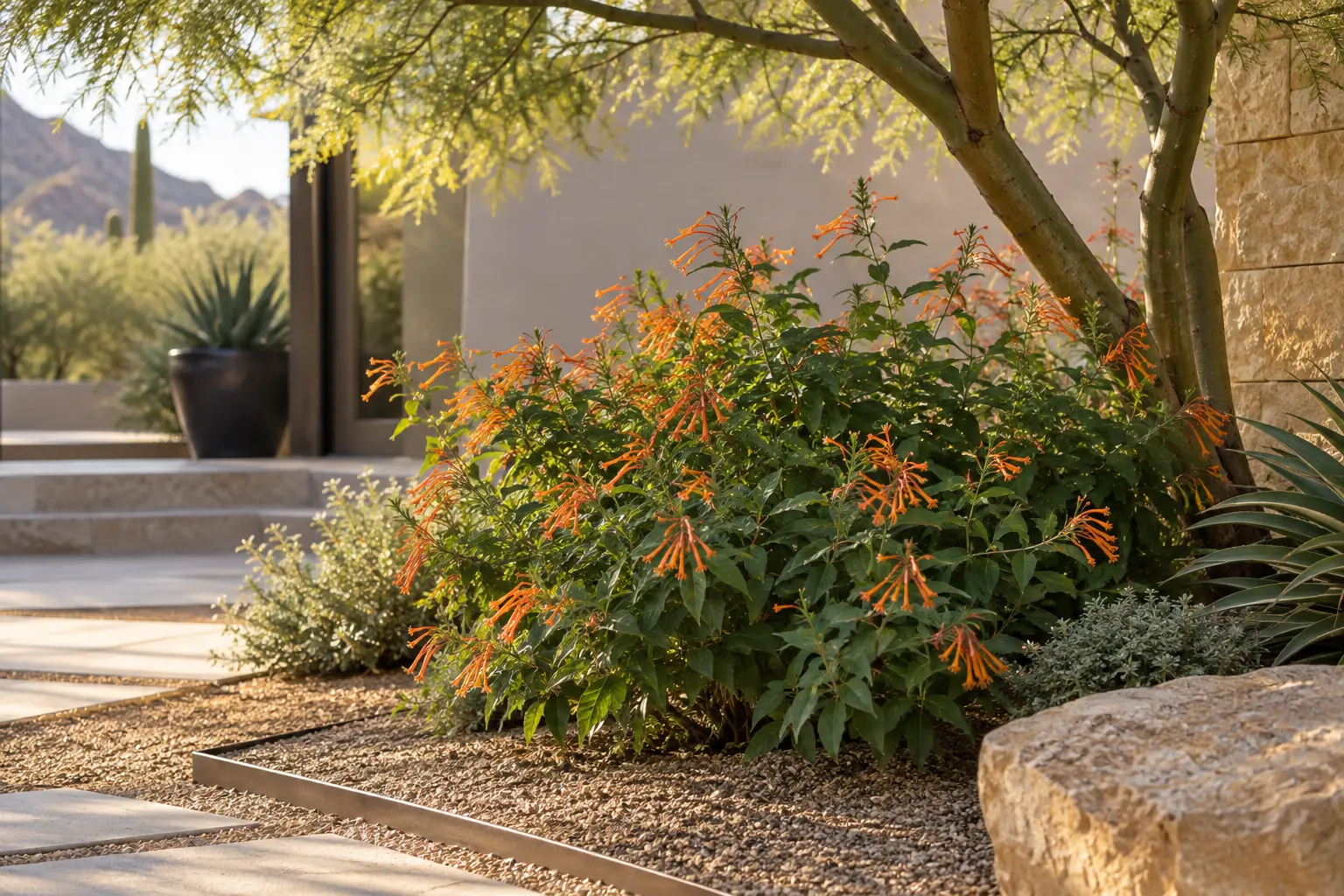
Mexican Honeysuckle / Muicle
Justicia spicigera
Mexican Honeysuckle is a soft 3–5 ft Acanthaceae shrub—not a true honeysuckle—with orange tubes, filtered-shade flexibility and a need for deliberate irrigation and frost protection.
Not sure if this plant belongs near your pool, wall, pavers, or foundation?
AE reviews microclimate, root intrusion risk, and soil compatibility.
Schedule: Twice-weekly in summer, weekly in shoulder seasons.
Emitters: 1–2 emitters per plant, monitored during heat waves.
Flowering perennials, citrus, and lush accents need more attention than true desert plants.
Arizona yards have very different microclimates. West-facing walls, glass, artificial turf, pavers, travertine, porcelain, and pool decking all increase reflected heat. AE considers these before confirming placement.
- Low root impact
AE verifies pool deck, paver, foundation, wall, and utility clearances before final planting.
Quick Facts
- Plant type
- Flowering Perennial
- Mature size
- Typically 3–5 ft tall and 3–5 ft wide in protected Phoenix sites
- Growth rate
- Moderate
- Sun
- Part sun
- Water use
- Moderate
- Bloom season
- Much of the warm season, with intermittent bloom possible in mild conditions
- Flower color
- Orange
- Foliage
- Medium green
- Evergreen / Deciduous
- Semi-evergreen
- Thorns / spines
- None
- Litter level
- Low
- Pool area
- Good with placement
- Pet/kid placement
- Use with care
- Maintenance
- Seasonal pruning
- Privacy value
- Low
- Shade value
- Low
- Native
- Desert-adapted
About Mexican Honeysuckle / Muicle
Justicia spicigera is an Acanthaceae shrub rather than a true honeysuckle in the genus Lonicera. Mexican honeysuckle, muicle and firecracker bush are useful common names, but traditional-use language should not be mistaken for medical or food-safety guidance. The species is native from Mexico through parts of Central America, the Caribbean and northern South America. It is a warm-climate-adapted nonnative in Arizona, not a Sonoran native. In protected Phoenix landscapes it forms a soft, rounded evergreen-to-semi-evergreen shrub roughly 3–5 feet tall and wide, though frost or severe heat and water stress can thin or defoliate it. Medium-green ovate leaves support narrow tubular orange flowers through much of the warm season, with intermittent bloom possible in mild conditions rather than guaranteed year-round color. Full sun to part or filtered shade can work, but morning sun with filtered afternoon shade often gives the most polished low-desert result. Full reflected west heat demands excellent root-zone volume and irrigation management and may still scorch or thin foliage. This is a low-to-moderate-water shrub: establish it with regular deep irrigation, then water deeply with dry-down. It is not a no-water desert shrub and should not share the leanest cactus valve.
Best uses: A soft orange-flowering shrub in protected courtyards or under light canopy with its own low-to-moderate irrigation zone and edging access
AE Designer Opinion
Design Uses
- Protected Phoenix courtyard color
- Layer beneath open desert-tree canopy
- Orange-flowering transition between architecture and low-water planting
Care & Maintenance
- Plant in full sun to part or filtered shade; favor morning sun and afternoon protection for a polished Phoenix appearance.
- Establish with regular deep irrigation, then water deeply with dry-down on a low-to-moderate schedule matched to exposure and soil.
- Do not combine it with the leanest cactus irrigation if the root zone cannot receive adequate water.
- After cold risk or a bloom cycle, selectively prune and remove old woody stems as needed rather than continuously shearing flowering tips.
- Monitor edges and remove unwanted suckers or rhizomatous spread while growth is manageable.
Common Homeowner Mistakes
- Treating an Acanthaceae shrub as a true Lonicera honeysuckle
- Calling it a Sonoran native or no-water desert shrub
- Promising uninterrupted year-round flowers or certain hummingbird visits
- Putting it in unrelieved reflected west heat without root-zone support
- Shearing flowering tips continuously or presenting traditional uses as medical or ingestion advice
Placement Warnings
⚠ Hardiness around 25–28°F is approximate. Frost may burn or kill top growth, while recovery from established roots depends on the plant, event and site. Tubular flowers can support hummingbirds and other nectar visitors, but visitation is conditional. Favorable sites may allow suckers or rhizomatous spread, so retain edging access. Traditional dye and medicinal uses are cultural context only: this landscape profile is not medical guidance and does not establish safe ingestion. Do not treat the plant as categorically edible, pet-safe, child-safe or free from allergen concerns.
- Keep the 3–5 ft width and pollinator traffic out of narrow paths and barefoot pool circulation.
- Provide morning sun or filtered afternoon shade where intense reflected west heat would stress foliage.
- Place on a compatible low-to-moderate irrigation zone rather than the leanest cactus valve.
- Retain edging and selective-pruning access where suckers or rhizomatous spread are possible.
AE reviews final placement based on sun, irrigation, drainage, mature size, and overall design.
Pairs Well With
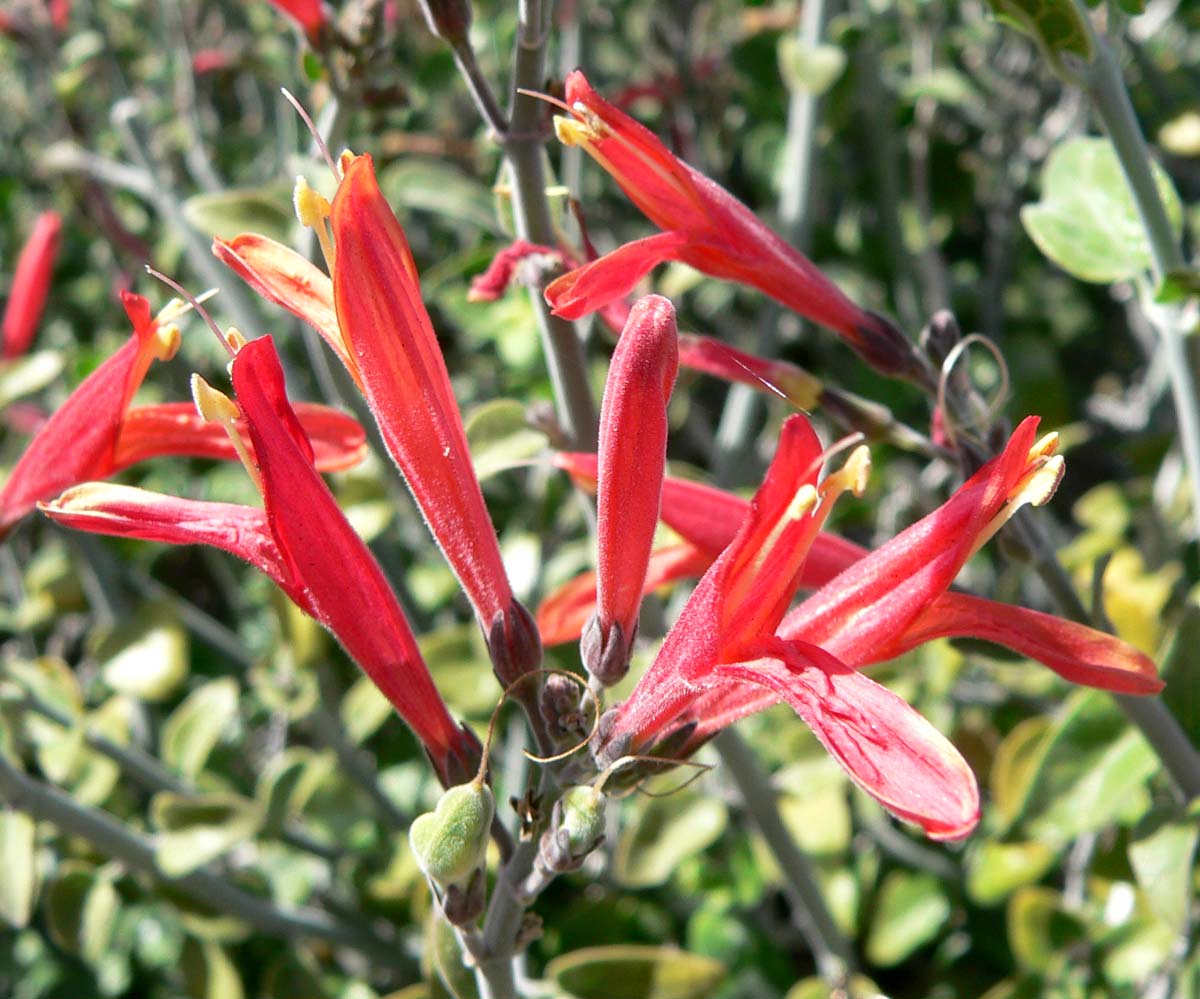
- Chuparosa
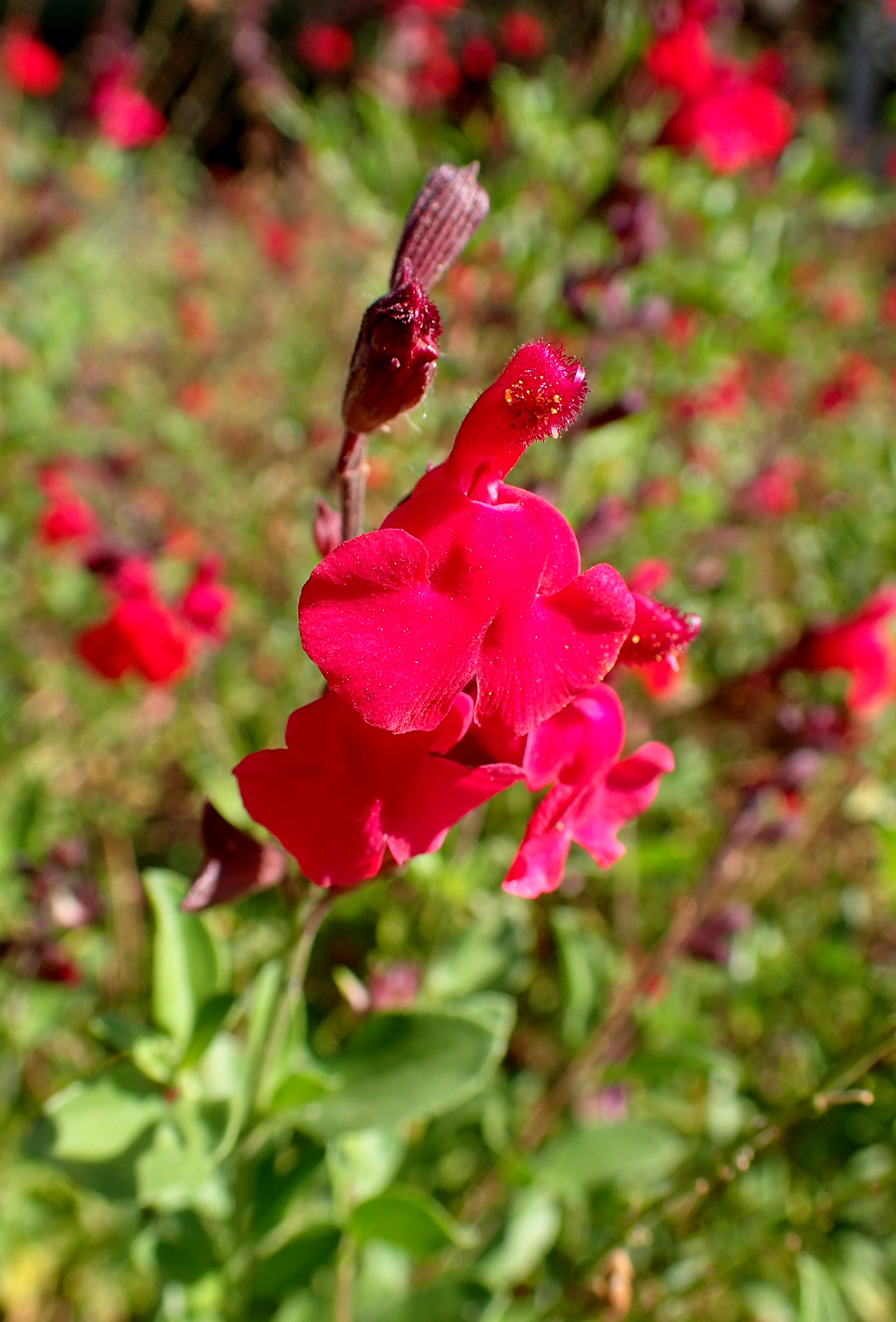
- Autumn Sage
- Texas Sage
- Deer Grass
More Arizona Plants Like This



Ready to Build Your AE Plant Wishlist?
Add Mexican Honeysuckle / Muicle and your other favorites to your wishlist, then send it to the AE design team for the final plant palette.