Splash Pad vs Pool in Arizona — Full Comparison (Cost, Safety, Ages, Water, Maintenance)
If your kids are under 6, a splash pad may genuinely be a better fit than a pool — lower investment, no conventional pool-depth basin, and a fraction of the water bill. It is not risk-free. Here's the full side-by-side from a builder who installs both.
The short answer
A pool is the right answer for families whose kids are 6+ and will actually swim laps, host pool parties, or use a spa for therapy. A splash pad is often the right answer for families with toddlers and preschoolers, smaller yards, HOA-restricted lots, or anyone who wants interactive water play without a conventional pool-depth basin and the four-figure summer water bill. Both can be beautiful. Neither is automatically safer — attentive adult supervision is required around either — and it's a fit question, not a status question.
We build both. This guide is the honest side-by-side we walk every family through in the design studio.
Side-by-side at a glance
Use this as the cheat sheet. Each row is expanded in the sections below with real Arizona numbers.
- Investment (installed): Splash pad — see the Pricing Guide for the current published planning range · Pool $75K–$180K+
- Footprint: Splash pad 200–600 sq ft · Pool 600–1,500+ sq ft
- Water-depth basin: Splash pad no conventional pool-depth basin (attentive adult supervision still required) · Pool contained body of water with real drowning risk (leading cause of death for AZ kids 1–4)
- AZ pool barrier law (ARS §36-1681): Splash pad requirements depend on design, depth, municipality, HOA and current code · Pool 5-ft fence + self-closing/self-latching gate required per statute
- Water use per season: Splash pad 3K–15K gal recirculating · Pool 18K–25K gal fill + 8K–15K gal/yr evaporation
- Monthly operating cost (summer): Splash pad $40–$120 · Pool $180–$450
- Maintenance time: Splash pad ~15 min/week · Pool 2–4 hrs/week DIY or $140–$220/mo service
- Best ages: Splash pad 1–8 · Pool 6 through adult
- Build time: Splash pad 3–5 weeks · Pool 10–16 weeks
- Permits/HOA: Splash pad typically simpler, sometimes allowed where pools aren't (verify per jurisdiction) · Pool always permitted, often HOA-restricted
- Resale impact (Phoenix metro): Splash pad neutral to slight positive · Pool +5–8% in most AZ submarkets
Investment — what each one actually costs in Arizona
Splash pad investment: see the Pricing Guide for the current published planning range; the written proposal controls the actual price. The low end is a small pad with a modest jet count, simpler equipment, and a basic broom-finish concrete deck; the high end is a larger pad with more features and arches, a fuller water system with filtration, and decorative pavers or stamped concrete.
Pool installed range in the Valley: $75K–$95K for a small play pool, $100K–$140K for a typical family pool with spa and tanning ledge, $150K–$250K+ for larger freeform or vanishing-edge builds with premium finishes and full deck.
The honest comparison: a fully built recirculating splash pad with a real deck lands around the cost of a single high-end pool feature — a swim-up bar, a spa upgrade, a baja shelf with bubblers. For a lot of families with young kids, the question isn't 'pool or splash pad,' it's 'splash pad now, pool in 6 years when the kids can swim.'
Safety — why families consider splash pads, and what still applies
Drowning is the leading cause of death for Arizona children ages 1–4. Maricopa County's Drowning Prevention Coalition tracks child drownings and near-drownings every year. Most involve a pool the family or a neighbor owns. A 5-foot pool barrier with a self-closing, self-latching gate (ARS §36-1681) is required by law — and it isn't enough by itself. Layered protection (barrier + door alarms + pool cover + swim lessons + a designated adult Water Watcher) is the standard.
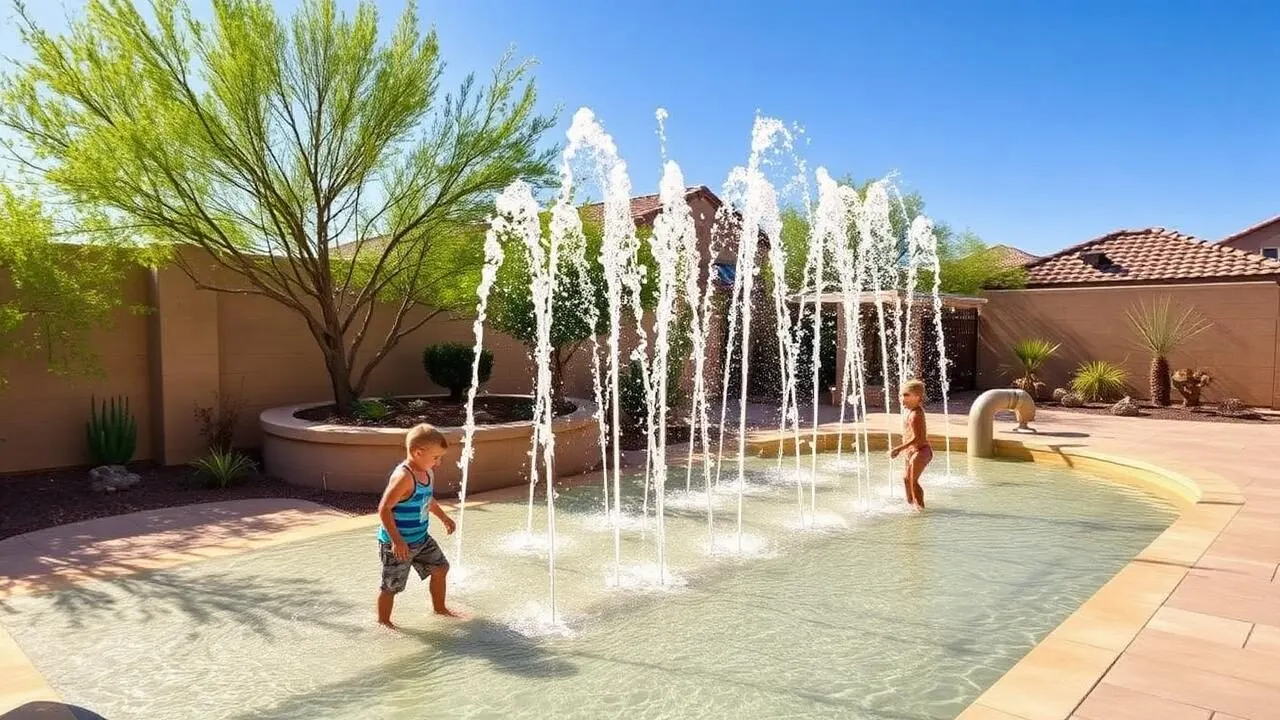
A properly designed residential splash pad generally avoids a conventional pool-depth basin. The deck slopes to a hidden catch basin, water is recirculated under a grate, and there is typically no deep standing water on the play surface. That can shift the risk profile — but it does not make a splash pad risk-free. Children still require attentive adult supervision. Real risks include slips and falls on wet surfaces, hot deck temperatures in Arizona summer, waterborne illness (e.g., Cryptosporidium — CDC), swallowing water or water entering the nose, inadequate drainage, and mechanical, electrical or jet-related hazards. Whether a barrier is required depends on design, water depth, the municipality, HOA rules and current code interpretation — we verify on every permit pull.
If your youngest is under 5, splash pads are worth an honest conversation — but the answer is never 'no supervision needed.' A designated, undistracted adult Water Watcher whenever water is on, plus safe operating practices, apply either way.
Best ages — match the feature to who's actually using it
Splash pads can be a great fit for kids roughly 1 through 8 with attentive adult supervision. Toddlers play in shallow moving water and chase jets under a Water Watcher's eye — never leave a young child unattended near operating water. 4–6 year-olds run through arches and dump-buckets for extended sessions with breaks for hydration, restroom checks, and surface-temperature checks in Arizona heat. By 9 or 10 many kids age out — which is often when they're ready to actually swim in a pool.
Pools earn their cost when kids are confident swimmers (usually 6+), when teenagers will host friends, when adults swim laps or use the spa for back/joint therapy, or when the household genuinely entertains around water. A pool that gets used twice a summer is the most expensive lawn ornament in the neighborhood.
A common AE pattern: families build the splash pad in years 1–6, then convert or expand into a pool when the youngest is swimming. We plan the yard layout up front so the splash pad deck integrates into the eventual pool deck — no demo, no waste.
Splash pads for pets and multi-use outdoor living
Splash pads aren't just for kids — they're one of the best water features you can add for dogs. A recirculating pad gives dogs a cool place to play and drink in July without the drowning risk of a pool. No chlorine burns, no fur in the filter, no anxiety about a senior dog falling in. We've installed pads specifically for households with multiple large dogs, and the wear holds up fine on paver or stamped concrete surfaces built to our standard spec.
Beyond pets, a splash pad functions as a multi-use patio when the water is off. The same surface that shoots jets in summer is a solid entertaining deck for fall cookouts, a yoga space in spring, or a fire-pit ring in winter. Add a shade sail or pergola overhead and you've got usable outdoor square footage 10 months a year — something a pool can't offer without a separate deck investment.
For families who want water play and usable patio space in one footprint, the splash pad is essentially a hardscape patio with a party mode. That's a flexibility pool decks simply don't have.
Water and energy — Arizona is a desert, this matters
A pool holds 18,000–25,000 gallons. In Phoenix summer, evaporation alone is 8,000–15,000 gallons a year — every gallon of which is on your water bill. Add backwashing, splash-out, and the occasional drain-and-refill and you're paying for 20K+ gallons of water annually, plus 400–700 kWh/month to run the pump, heater, and (if you have one) chiller.
A recirculating splash pad uses 3,000–15,000 gallons across an entire season — most of it the initial fill plus replacement for evaporation and splash-out. The pump runs only when the pad is on (typically a wall timer or push-button), and total summer electric load is usually under 100 kWh/month. Non-recirculating (drain-to-waste) pads use far more water and aren't something we install in Arizona — recirculation is the standard.
If water bills, sustainability, or HOA water-budget rules are a factor, the splash pad wins this category by a wide margin.
Maintenance — your real weekly time commitment
Pool: brushing walls, skimming, emptying baskets, testing and balancing chemistry, backwashing the filter, checking equipment. DIY is 2–4 hours a week done right. Pool service in the Valley runs $140–$220/month for weekly visits. Plaster resurface every 8–12 years ($6K–$12K). Pump and heater replacements every 8–15 years.
Splash pad: rinse the deck, check the basin filter weekly (5 minutes), tablet-feed or in-line chlorinator keeps water sanitized, winterize the pump if you're at elevation. Roughly 15 minutes a week. No resurfacing. Pump replacement every 10–15 years.
If 'I don't want a second job' is on your list, the splash pad delta is real — you're getting back 8–15 hours a month.
Permits, HOAs, and the AZ pool barrier law
Pools in Arizona require a permit in every municipality, plus a 5-foot pool barrier with a self-closing, self-latching gate per ARS §36-1681. Many HOAs add additional restrictions: setback rules, equipment-screen rules, no-pump-noise hours, even outright pool bans in some condo or patio-home communities.
Residential splash pads are usually permitted as a water feature rather than a pool. Whether a barrier is required — and whether the project is treated as a pool under local code — depends on the design, water depth, municipality, HOA and current code interpretation. Splash pads are not automatically permit-exempt or barrier-exempt in Arizona; we pull and verify on every job. Homeowners should also confirm with their insurance carrier, since insurance treatment is not automatic either.
Resale and appraisal
In the Phoenix metro, a well-built pool typically adds 5–8% to home value and is expected at certain price points ($800K+ in most submarkets). Below that, it's roughly neutral — recouped at sale but not a multiplier.
Splash pads don't have decades of comp data behind them yet. Appraisers usually treat them as a quality landscape feature (slight positive) rather than a pool equivalent. The trade-off: they don't scare off buyers who specifically don't want a pool (young families, retirees, snowbirds), so they expand your buyer pool rather than narrow it.
When a splash pad is the smarter call
Pick the splash pad if any of these are true: your youngest is under 6, your yard is under ~1,500 sq ft of usable space, your HOA restricts pools, you don't want a fence cutting your yard in half, you don't want a 4-figure summer water bill, or you genuinely don't see your household using a pool more than once a week.
When a pool is still the right call
Pick the pool if: kids are 6+ and swimming, you want a spa for therapy or year-round use, you entertain around water, you swim for fitness, or you're at a price point where a pool is expected at resale. A pool you'll actually use is one of the best investments you'll make in your home. A pool you won't is the most expensive mistake on this list.
The hybrid path most families don't know about
You can build the splash pad now and plan the pool in. We design the deck, equipment pad, gas, electric, and drainage so that in 5–8 years, when the kids are swimming, the pool drops into the space the splash pad currently occupies with no wasted hardscape and no replumbing of the main lines. That's a conversation worth having on day one — it costs almost nothing extra now and saves $20K–$40K of demo and rework later.
You can also integrate a splash pad into the pool itself
A lot of families assume it's splash pad OR pool. It isn't. One of our favorite builds in Arizona is a pool with an integrated splash pad — a wide tanning ledge (baja shelf) at 6–9 inches of water with deck-mounted jets, bubblers, and arches built right into the shelf or the surrounding coping. Toddlers play in ankle-deep water on the shelf with all the splash-pad fun (jets, dump-buckets, arches), while older kids and adults swim in the deep end three feet away. One yard, one equipment pad, one fence — both experiences.
Common integrated configurations: bubblers in the tanning ledge (most popular, ~$1.5K–$3K per pair), deck jets that arc water across the pool ($2K–$5K per pair), a dump-bucket or rain curtain over the spa wall ($4K–$10K), and a full splash zone built into the shelf with 4–6 ground jets and an arch ($8K–$18K added to the pool build). All of it runs off the pool's existing filter and pump — no separate splash-pad system needed.
The hybrid build wins for families with a 2-year-old AND a 9-year-old, for households that entertain both grandkids and adults, and for anyone who wants the splash-pad wow factor without giving up a swim pool. Honest trade-off: the tanning-shelf splash zone is not a full standalone splash pad — kids are playing on a shelf above the pool, so adult supervision is still pool-grade. But for many families, it's the best of both.
If you're already building a pool, adding splash features to the shelf during construction is dramatically cheaper than retrofitting later — the plumbing has to be in the gunite before the shell shoots. Bring it up at the design meeting, not after dig.
FAQs — splash pads, pools, pets, kids, and the questions we get every week
These are the real questions families ask in our design studio. If yours isn't here, ask it on the consult — we'd rather answer it honestly than pretend it doesn't matter.
- Are splash pads safe for toddlers? Splash pads generally avoid a conventional pool-depth basin, which can reduce certain water-depth risks — but no water-play area is risk-free. Children still require attentive adult supervision (a designated Water Watcher); kids can slip on a wet deck, Arizona surface temperatures can climb, and waterborne illness is a real concern. We spec slip-resistant finishes (never 'non-slip') and never use polished concrete for splash decks.
- What safety practices does AE recommend at a home splash pad? Never leave children unattended. Assign a designated undistracted adult Water Watcher — especially for infants and young children. Check deck surface temperature before use. Do not use the splash pad when experiencing diarrhea, do not swallow the water, do not sit or stand directly on jets, and take regular restroom and diaper breaks. Maintain filtration, disinfection and chemistry per system design. Guidance based on CDC splash-pad safety and CPSC water-safety recommendations.
- Are splash pads safe for dogs and pets? They can be a great summer feature for dogs — recirculated water, no deep pool basin, no fur in a pool skimmer. Large-breed and senior dogs may benefit. Attentive supervision, hydration, and surface-temperature checks still apply.
- Will chlorinated splash-pad water hurt my dog's coat or paws? Splash pads typically run lower chlorine levels than pools because the water isn't held as standing volume. Rinse with the hose after long sessions if you want to be cautious; talk to your veterinarian about your specific dog.
- Can a splash pad share equipment with my pool? Sometimes — depends on layout, code, and bather load. Often cleaner to use the pool's tanning ledge for splash features (bubblers/jets) rather than wiring a separate splash pad into pool plumbing. We engineer the right approach per site.
- How loud is a splash pad? Quieter than a pool with a waterfall. Recirculating pumps run 50–60 dB at the equipment pad — about the level of a refrigerator. Jet noise on the deck is playful water sound, not mechanical. HOA noise complaints are rare.
- Do I need a fence around a splash pad in Arizona? It depends. ARS §36-1681 sets minimum enclosure standards for contained bodies of water. Whether a specific residential splash pad requires a barrier — or is treated as a pool under local code — depends on the design, water depth, the municipality, HOA rules and current code interpretation. Splash pads are not automatically permit-exempt or barrier-exempt; we verify per municipality on every permit pull.
- Can a splash pad freeze in winter? In the Valley, rarely an issue. At higher elevations (Prescott, Flagstaff, Payson) we winterize the pump and blow out the lines like a pool. Adds one service visit a year.
- What's the lifespan of a splash pad? Deck and plumbing: 25+ years if built on our standard ABC base spec. Pump: 10–15 years. Jets/nozzles: replaceable consumables, $20–$80 each, swap every 5–10 years.
- Can I add a splash pad to an existing pool yard? Yes. Two options: (1) add bubblers and deck jets to an existing tanning ledge if the pool plumbing has unused returns, or (2) build a standalone splash pad on a different part of the yard with its own equipment. Both are common retrofits.
- Will a splash pad affect my homeowner's insurance? Insurance treatment is not automatic. Pools trigger surcharges in most AZ policies; splash pads may be treated differently, but coverage and premium impact vary by carrier, jurisdiction and policy language. Call your carrier to confirm before you build.
- What about mosquitoes? A properly designed recirculating pad keeps water moving through the system and drainage; a drain-to-waste rig with pooled runoff, inadequate drainage or a fouled basin can create standing water and a mosquito breeding site. We build recirculating systems with sealed basins and specified drainage — regular inspection and maintenance are still required.
- Can older kids actually use a splash pad, or do they age out? They run through it on hot days through about age 10–12, then it becomes ambient fun rather than the main event. The patio function (entertaining, fire pit, dining) extends the value for the next 20 years regardless.
- Does a splash pad add resale value? Slight positive in most submarkets, neutral in a few. It also doesn't repel buyers who don't want a pool — that's a real advantage if you might sell to a young family or retirees.
- Can I heat a splash pad? Yes — same gas or electric heaters used on pools. Most clients don't bother because Arizona water hits 85°+ for 6 months naturally, but for shoulder seasons a heater extends the use window meaningfully.
What AE includes either way
Permits and HOA submittals handled in-house. Real recirculating equipment (not drain-to-waste pads). ABC base, sand bed, and polymeric joint sand on every paver deck per our standard spec — 2–3" for patios and walkways, 4–6" for driveways. Written care guide and in-person orientation at fill. Aftercare check-ins at 30, 90, and 365 days. President of the Southwest Hardscapes Association on every job — David has been on the board 13 years.