Arizona Outdoor TV Buying Guide — Outdoor-Rated vs Indoor, Brightness, Shade, and What to Actually Buy
Outdoor-rated vs indoor, how brightness and glare really work on a Valley patio, shade categories, and an honest comparison of the premium, purpose-built, value, and cheap-indoor-TV routes.
Start with the exposure, not the brand
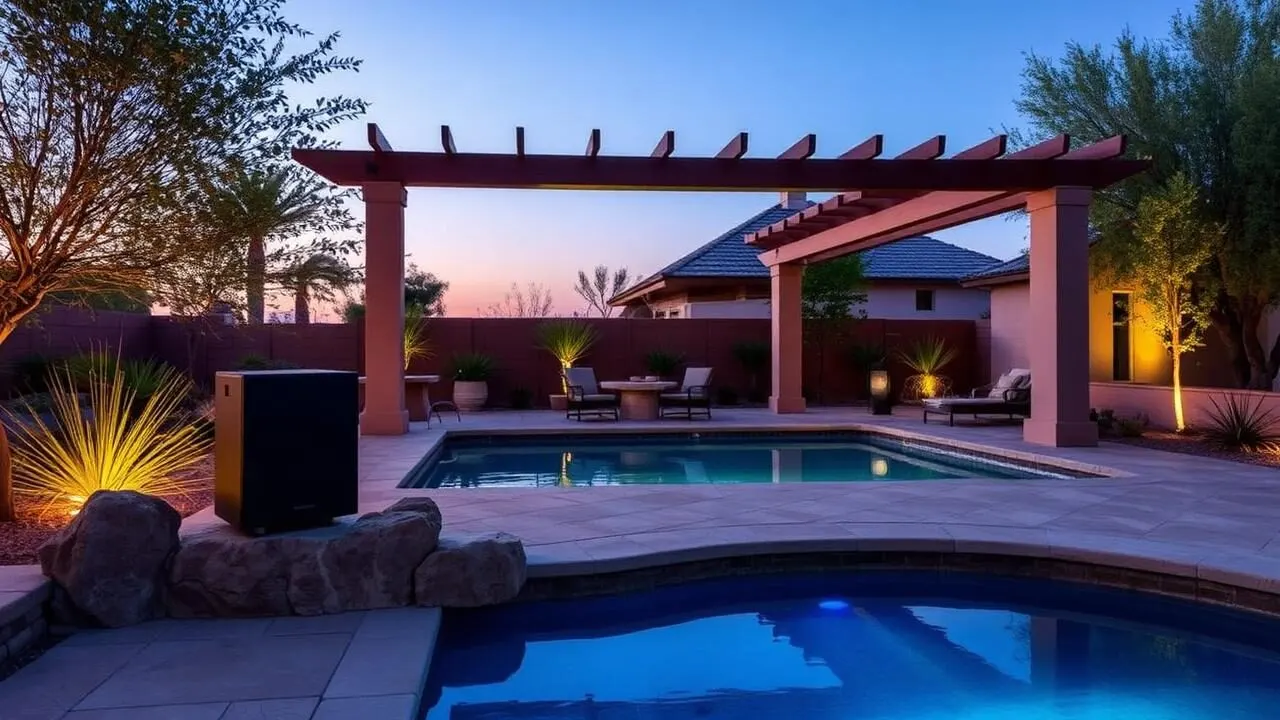
Almost every disappointing outdoor TV in the Valley is a mismatch between the panel and the wall it ended up on. Before you compare brands, spend one afternoon looking at the spot: how many hours of direct sun it gets, which direction it faces, whether anything reflects into the screen, and how deep the cover overhead actually is. A screen that faces west under a shallow patio cover is a fundamentally different purchase than one tucked under a fully enclosed ramada.
Once the exposure is honest, the shortlist gets short fast. Manufacturers publish their panels by exposure category for exactly this reason, and matching that category is the single decision that most affects whether you like the picture in July.
What "outdoor-rated" actually means
An outdoor-rated television is engineered for a different environment than a living-room set: a sealed or gasketed enclosure, thermal management designed for high ambient temperatures, weather-protected connection bays, anti-reflective screen treatments, and a published operating temperature range. Manufacturers also publish an exposure class — full sun, partial sun, or full shade — along with a brightness figure and their own warranty terms.
Those published figures are the ones that matter, and they change by model and model year. Confirm current specifications, exposure class, operating range, and warranty coverage with the manufacturer and your installer before you buy.
Brightness, glare, and why picture quality is mostly placement
Brightness helps a screen stay readable in bright ambient light, but glare is a separate problem: it is light bouncing off the screen surface toward your eyes. A very bright panel aimed at a white block wall or an open sky reflection can still look washed out, while a moderately bright panel angled away from the reflection can look excellent.
That is why the three levers that most improve outdoor picture quality are cheap: pick the shadiest viable location, tilt the screen so it reflects the ground or a dark surface instead of the sky, and give the screen a matte, non-reflective backdrop. Then buy brightness for whatever exposure is left.
The three shade categories, in plain language
- Full shade — a fully covered patio or enclosed ramada where direct sun never lands on the screen. The most forgiving placement, and the one where a shade-class outdoor TV performs well.
- Partial sun — under a pergola, deep overhang, or ramada that still admits bright indirect light or brief direct sun. Partial-sun-class panels are built for this.
- Full sun — direct sunlight lands on the screen for part of the day. Requires a full-sun-class panel, and you should still expect the picture to be at its best when the sun is off the screen.
- If you are between two categories, buy the brighter one. Nobody in Arizona has regretted having more headroom in August.
Heat, dust, monsoon, and the honest version of durability
The Arizona-specific stresses on any patio electronics are heat soak, ultraviolet exposure, blown dust, insects, monsoon humidity and driven rain, and condensation cycles. Outdoor-rated sets are designed and warranted with those conditions in mind; indoor sets are not.
What nobody can honestly give you is a failure date. An indoor TV in a deeply covered, well-ventilated, shaded location may run for a long time. The same TV on a west-facing wall may not last a season. The risk is real and it is unpredictable, and manufacturer warranty coverage for outdoor use depends on the specific model and its written terms — read them before you assume you are covered.
The cheapest route, described fairly
Mounting a normal indoor TV under a deep cover is the lowest-upfront-cost option, and plenty of Valley homeowners do it. If you choose it, go in with your eyes open: it is not an outdoor-rated product, the manufacturer's warranty may not cover outdoor installation, and you are accepting an unpredictable replacement cycle in exchange for a lower price today.
Two things make that gamble noticeably better: put it in the deepest shade you have, and use a cover when the TV is not in use. Two things make it noticeably worse: direct afternoon sun and a mount so tight to the wall that heat has nowhere to go.
How to decide in five minutes
- Direct sun on the screen at any point in the day → shop full-sun-class outdoor panels only.
- Bright indirect light under a pergola or overhang → partial-sun class is the intended fit.
- Fully covered, never direct sun → a shade-class outdoor panel is usually the value sweet spot.
- Picture quality is your top priority and budget is flexible → look at the premium outdoor lineups first.
- You want a purpose-built outdoor set at the lowest price you can → compare the value outdoor brands, and read the warranty, not just the spec sheet.
- You are willing to accept unpredictable replacement to spend the least today → the indoor-TV route, in deep shade, with a cover.
Questions to ask before you buy
- What exposure class is this exact model, and does it match my measured exposure?
- What operating temperature range and brightness does the manufacturer publish for this model year?
- What does the warranty cover for outdoor installation, and for how long?
- Who provides service if it fails in year two — the retailer, the manufacturer, or the installer?
- Does the mount, the cabling method, and the power source match how the manufacturer expects the set to be installed?
Comparing the real options
There is no universal winner here — there is a best fit for your exposure, your budget, and how much replacement risk you are willing to carry. Every weather rating and brightness figure below is model-specific, so confirm the exact model's published specification, exposure class, and warranty terms with the manufacturer and your installer before you buy.
- Best fit
- Homeowners who want the best picture on a designed patio and will match the variant to the wall.
- Exposure category
- Offered in partial-sun and full-sun variants — check which variant a listing is before ordering.
- Weather rating (model-specific)
- Samsung publishes IP-rated weather resistance (IP55 or IP56 depending on the exact model). Model-specific — confirm the rating on the model you are buying.
- Daylight / picture strengths
- QLED panel with an anti-reflection screen, tuned for daylight viewing.
- Relative cost tier
- Premium
- Main tradeoff
- Highest-cost route of the purpose-built options, and picking on picture alone without matching the exposure variant is the common mistake.
- Best fit
- Buyers who have measured their exposure and want a panel class that matches it.
- Exposure category
- The lineup is organized by exposure: Veranda for full shade, Solis and Pro for full sun, per SunBrite's current compare page.
- Weather rating (model-specific)
- Weather and impact protection are published per series and per model — read the spec sheet for the exact model.
- Daylight / picture strengths
- Full-sun series are the brightest, anti-glare panels in the lineup; the shade series is not intended for direct sun.
- Relative cost tier
- Mid-to-premium
- Main tradeoff
- You have to know your exposure first. A shade-class panel on a sunny wall disappoints regardless of brand.
- Best fit
- A purpose-built outdoor set with a clear exposure ladder at a lower entry point than the premium lineups.
- Exposure category
- Furrion lists full-shade, partial-sun, and partial-sun Premier tiers; on the current product pages that maps roughly to 400-nit, 750-nit, and 1,500-nit models. Figures vary by exact model.
- Weather rating (model-specific)
- Furrion's Aurora overview page states IP54 weatherproof housing on the current lineup. Model-specific — verify on the product page for your model.
- Daylight / picture strengths
- Brightness steps up with the tier; Furrion notes Aurora models should not sit in extended direct sunlight.
- Relative cost tier
- Value to mid
- Main tradeoff
- More utilitarian feature set and finish than the premium picks. Confirm the exposure class of the specific model before you order.
- Best fit
- Homeowners who want an outdoor-rated product at the value end of the market.
- Exposure category
- Sylvox groups its models into partial-sun and full-sun series on its official comparison page; read the series and model you are actually buying.
- Weather rating (model-specific)
- Weather protection and brightness are published per model on Sylvox's own comparison page — we do not restate a single figure, because it differs by model and model year.
- Daylight / picture strengths
- Daylight performance depends entirely on which series and model you choose; verify on the linked comparison.
- Relative cost tier
- Lowest of the purpose-built options
- Main tradeoff
- Read the model spec, warranty, and service terms closely rather than buying on price alone.
- Best fit
- The lowest acquisition cost, in a fully shaded, well-ventilated spot, when the risk is accepted knowingly.
- Exposure category
- No outdoor exposure class. It is an indoor product placed outside.
- Weather rating (model-specific)
- No outdoor IP or weather rating at all.
- Daylight / picture strengths
- Not tuned for ambient daylight; glare and washout are common even under cover.
- Relative cost tier
- Lowest
- Main tradeoff
- Highest environmental and replacement risk. Heat, dust, insects, humidity, and condensation all raise the chance of failure, lifespan is unpredictable, and coverage for outdoor use depends on the specific model's written warranty terms.
Last reviewed August 2026. Brand names are referenced for comparison only; AE is not claiming a single best system, and specifications, availability, and warranty terms are set by each manufacturer.
Official sources and what to verify
Weather ratings, brightness, exposure class, and warranty terms are set by each manufacturer and change by model and model year. Open the manufacturer page for the exact model you are considering and confirm the specification in writing before you buy.
- Samsung — The Terrace outdoor TV overview (official product page) (opens in a new tab)
- Samsung Support — using and placing The Terrace outdoors, including its weather rating (opens in a new tab)
- SunBrite — official compare page: Veranda (full shade) vs Solis and Pro (full sun) (opens in a new tab)
- Furrion — Aurora outdoor TV overview, including exposure tiers and IP54 housing (opens in a new tab)
- Furrion — Aurora Partial-Sun product page (750-nit model specifications) (opens in a new tab)
- Furrion — Aurora Partial-Sun Premier product page (1,500-nit model specifications) (opens in a new tab)
- Sylvox — official product comparison, partial-sun and full-sun outdoor series (opens in a new tab)
Independent educational comparison. AE has no affiliate, referral, or paid-placement relationship with the brands named here, and earns nothing if you buy any of them.