Outdoor Fireplace vs. Fire Pit — What's Right for Your Backyard?
Cost, code, ambiance, and resale value — how to choose between an outdoor fireplace and a fire pit for an Arizona backyard.
The fundamental difference
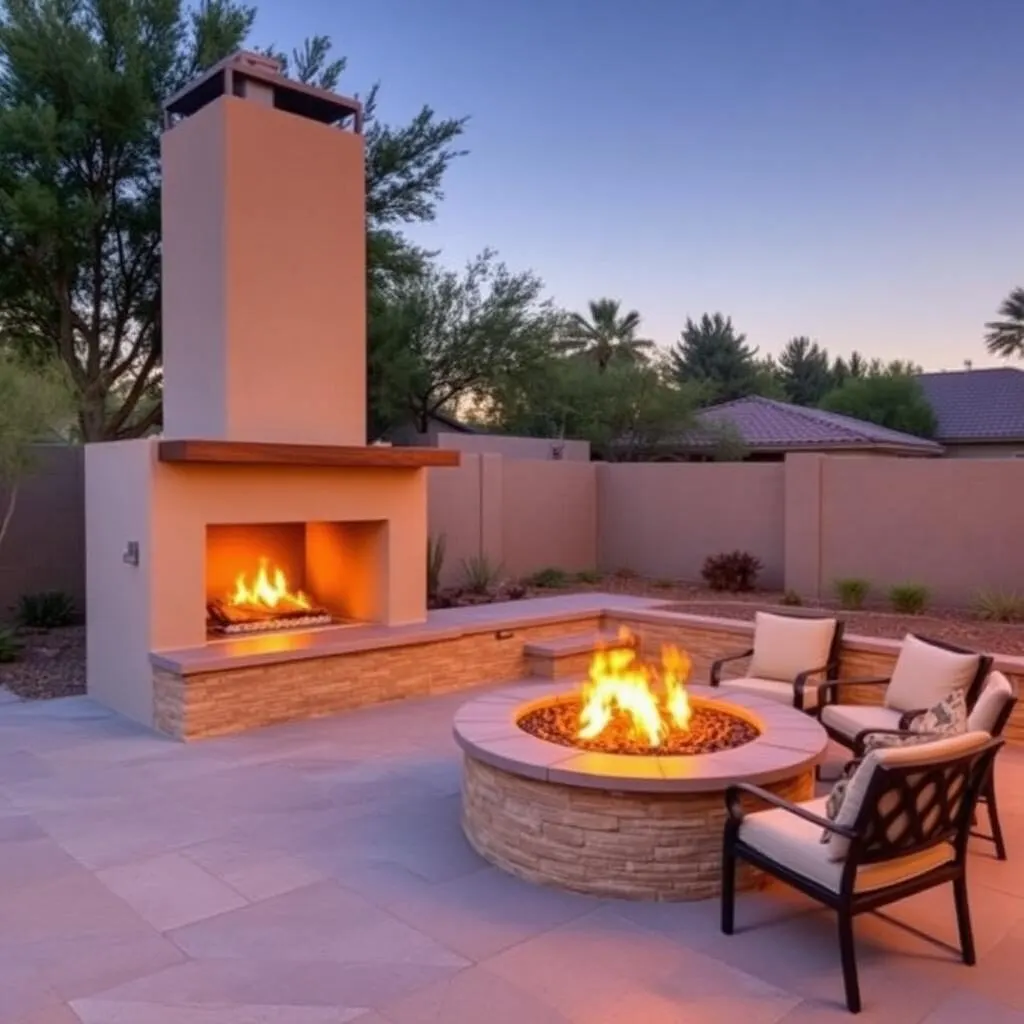
A fire pit is an open, usually low feature that throws light and warmth outward in every direction, so people arrange themselves around it. An outdoor fireplace is a vertical, enclosed feature with a firebox and a flue that pushes light, heat, and attention in one direction, so people arrange themselves in front of it.
Everything else — how it looks, where it fits, what it takes to build — follows from that one structural difference.
Who a fire pit usually suits
A fire pit fits households that entertain in loose groups, want conversation rather than a focal wall, and prefer a feature low enough to keep the view of the pool or the yard intact. It is also the more flexible option on a smaller patio, because it does not consume a wall or block sight lines.
Who an outdoor fireplace usually suits
A fireplace fits households that want an architectural anchor — a defined outdoor room, a backdrop for a seating group, masonry that makes a plain patio feel finished. It suits smaller, more intimate settings, and it gives you vertical surface to design with when the patio is bordered by a blank property-line wall.
Seating orientation, group size, and heat direction
Group size is the most reliable predictor of satisfaction. Circular, 360-degree seating around a pit puts everyone the same distance from the fire and lets side conversations happen. Directed seating in front of a fireplace concentrates warmth and attention forward — excellent for a few people, awkward for a crowd, because the seats at the edges get less of both.
Radiant heat follows the same pattern: an open pit shares heat evenly but loses much of it upward, while a firebox reflects heat forward from the back wall. Neither is better; they are different comfort patterns.
Presence, sight lines, and backyard circulation
A fireplace is a building element with real mass. It casts shade and changes what you see from the kitchen window — the point when you want it, a problem when it lands in a view you like.
Circulation matters just as much. People need a comfortable path from the door, around the seating, and to the pool or lawn without walking between the fire and the people watching it. Mark the footprint and the seating on the ground and walk the route before anything is built.
Fuel, smoke, and cleanup at a high level
Either feature can be built for wood, natural gas, or propane, and the fuel changes daily use more than it changes design. Wood means sourcing, storing, tending, ash cleanout, and smoke that drifts wherever the wind sends it. Natural gas means a supply line and an appliance installed to its listing. Propane means a tank that has to live somewhere accessible and be refilled.
Enclosed fireboxes tend to manage smoke better than open pits because the flue gives it somewhere to go. Gas features skip ash but still collect debris in the burner media, and burners, igniters, and valves are serviceable parts. Our gas versus wood fire features comparison goes deeper than this page needs to.
Wind, dust, and monsoon-season operating realities
Arizona evenings are frequently breezy, and monsoon season brings sudden wind, blowing dust, and rain. Open pits are more exposed: wind pushes flame and smoke sideways and scatters embers from wood fires. A fireplace opening gives some shelter, but a poorly placed one can catch prevailing wind.
If the feature sits under trees, near a pool deck, or in a wind corridor between houses, say so during design — it affects placement more than the style choice does.
New construction versus retrofit
In new construction, a fire feature is easy to integrate: the gas run, electrical, footing, drainage, and paver layout are all still on paper.
Retrofits are where constraints show up. Existing hardscape may need to be cut and reset, a gas line has to be routed and sized by the appropriate trade, and a fireplace generally needs a structural footing designed for its mass and the soil beneath it. That is not a reason to avoid a retrofit — it is a reason to scope it honestly first.
Integrating with patios, pools, seating walls, shade, and kitchens
A fire feature rarely lives alone. Plan it with the paver field it sits on, the seating wall that gives people a place to land, the pool deck and its traffic, the ramada or pergola overhead, and the outdoor kitchen pulling people the other way.
Anything overhead — a shade structure, a soffit, a tree canopy — has to be evaluated against the appliance's listed clearances and the manufacturer's instructions, not eyeballed. And competing focal points cancel each other out: if the kitchen, TV wall, and fire feature all demand the same view, one should move.
When two separately zoned fire features make sense
On larger lots the answer is sometimes both — because the yard already has two distinct rooms. A fireplace anchors the covered patio while a fire pit sits in a separate lounge zone near the pool. That works when each zone has its own seating and its own reason to exist, and the budget covers both properly. If one would only be used when the other is full, build one and build it well.
Surfaces, heat-sensitive materials, and the safety questions to ask
Heat, embers, and radiant exposure can damage or discolor nearby materials, and artificial turf is particularly vulnerable — heat and embers can melt or damage the fibers. Placement, a suitable noncombustible base, the appliance's instructions, and any required clearances all have to be verified for your specific product and location rather than assumed. There is no single universal setback that applies to every appliance, surface, and property.
Bring these questions to your designer and installer before the layout is locked:
- What are the listed clearances for this specific appliance, to combustibles, structures, and overhead cover?
- What do the manufacturer's instructions require for the base, surround materials, and ventilation?
- What surfaces sit under and around the feature, and how do they respond to heat and embers?
- Where will people actually walk, and does any path cross in front of the opening or too close to the pit?
- For gas: where must an accessible, code-compliant shutoff be installed for this appliance and location?
- Who pulls any permit that applies, and what inspections come with it?
HOA, municipality, fire authority, and utility coordination
Requirements are local and specific. Your HOA may have rules about fire features, height, chimney appearance, or fuel type — or none at all. Your municipality and the fire authority with jurisdiction determine what is permitted, what setbacks apply, and what inspections are required. Your gas utility or propane supplier governs the supply side, and seasonal or temporary burn restrictions can affect wood-burning use. Confirm all of it for your property and appliance before construction.
What actually moves the investment
We price scoped projects rather than publish ranges that mean nothing, because the same two words can describe completely different builds. What drives your investment is the size and mass of the feature, materials and finish, footing and structural work, how far utilities travel, whether existing hardscape must be cut and restored, the appliance selected, and surrounding work such as seating walls, decking, and lighting.
An enclosed masonry fireplace generally involves more structure and labor than a comparable fire pit, but a large custom pit with extensive seating walls can exceed a modest fireplace. Get an itemized number for your yard.
Honest pros, cons, and when neither option fits
Fire pit strengths: shared, even warmth, better for groups, lower visual impact, flexible placement. Trade-offs: more exposed to wind, less shelter for smoke, no architectural presence, and it occupies floor area on all sides.
Fireplace strengths: strong focal point, defined outdoor room, directional warmth, better smoke management. Trade-offs: larger structural commitment, seats fewer people comfortably, casts shade, blocks sight lines, hard to relocate.
Sometimes neither is right — very small yards where the feature would consume the usable space, sites or restrictions that rule out a compliant installation, or budgets that would force a compromised build. Shade, lighting, seating, or a portable listed appliance used per its instructions may serve better.
Your decision checklist and the bottom line
Build a fire pit if you entertain in groups, value shared warmth and conversation, want to preserve views, and prefer placement flexibility. Build an outdoor fireplace if you want an architectural anchor and intimate directional warmth for a few people. Consider both only when the yard has two real rooms and the budget supports each properly.
Work through these before you commit:
- How many people typically gather, and do they sit in a circle or face one direction?
- Do you want a focal point that changes the architecture, or a feature that stays low?
- Which fuel matches how you will actually use it, and is supply available where you want the feature?
- How much floor area can the feature and its seating take without breaking circulation?
- What is overhead, underfoot, and adjacent — and has each been checked against the appliance's requirements?
- What do the HOA, municipality, fire authority, and utility require for your property today?
- Is this a new build where it can be designed in, or a retrofit that needs scoping first?
Is a fireplace or a fire pit better for a small backyard?
It depends on how the space is shaped and used. A fire pit needs clear space on every side for seating and circulation, which can be difficult in a narrow yard. A fireplace consumes a wall and casts shade but leaves the floor in front open. In tight yards we usually study both footprints on the actual patio before recommending one.
Do I need a permit for an outdoor fireplace or fire pit?
That depends entirely on your municipality, the fire authority with jurisdiction, the appliance, and the fuel involved. We cannot promise that any given project is exempt or approved. The right step is to confirm requirements for your specific address and appliance before construction and to build to whatever applies.
Can a fire feature go on or near artificial turf?
Treat this carefully. Heat and embers can damage or melt turf fibers, so placement, a suitable noncombustible base, the appliance's instructions, and any required clearances all have to be verified for your product and site. It is not a universally safe or universally prohibited combination — it depends on the specifics.
How does a gas shutoff work for a fire feature?
Where required, an accessible, code-compliant shutoff must be installed in accordance with the listed appliance, the manufacturer's installation instructions, and applicable local code. Where it goes and what form it takes is determined by those requirements, not by a general rule, so it should be confirmed for your installation during design.
Can I convert a wood-burning fire feature to gas later?
Sometimes, but never assume it. Conversion depends on the existing structure, the appliance or burner being considered, the available gas supply, and what the manufacturer and local requirements allow. If gas is a possibility down the road, it is far easier and cheaper to plan the supply route during the original build than to add it afterward.
Should I build both a fireplace and a fire pit?
Only when the yard has two distinct rooms that each deserve a destination, and the budget covers both without compromising either. A common version is a fireplace anchoring the covered patio and a pit in a separate lounge zone near the pool. If one zone would sit unused most of the time, build one feature properly instead.