
Fire · Authority guide
Designing Fire Features That Actually Get Used in Phoenix
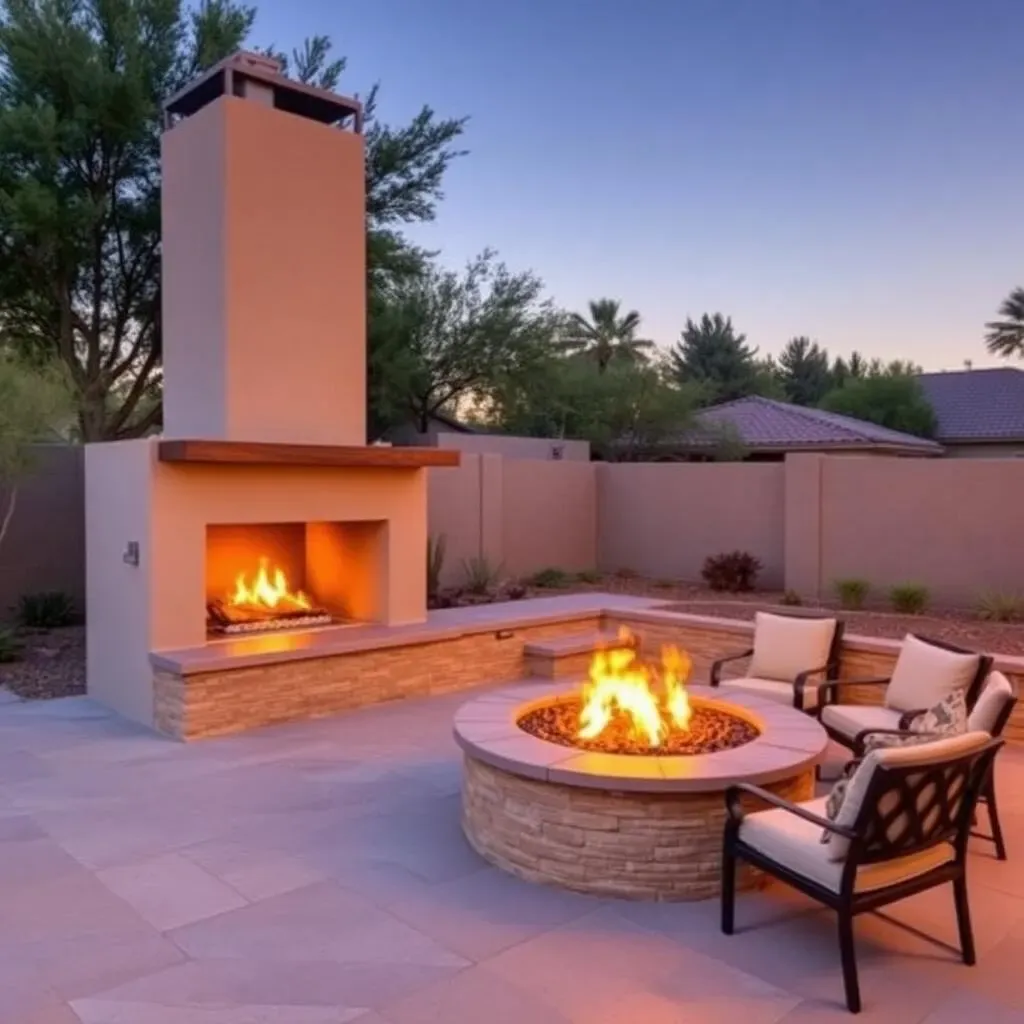
Phoenix winters are short, beautiful, and made for fire. Late October through March, a backyard with a real fire feature gets 10x the use of one without — and adds night-time depth on every other yard photo.
The fire feature itself is the easy part. What separates a feature you actually use from one that sits dark is BTU sizing, gas-line capacity, ignition reliability, and where the smoke and heat go.
In this guide+
Fire feature types and when to use each
- Gas firepit — round or rectangular, seating-height (18–20") for conversation, lower (12–14") for accent. Best ROI in Phoenix.
- Fire bowls — concrete or steel, scupper-mounted on raised pool walls or in pairs flanking an entry. Visual accent more than heat.
- Outdoor fireplace — 4–8 ft tall, masonry chimney, often the visual anchor of the yard. Real heat for cool nights.
- Fire & water bowls — fire on top, water spilling into the pool. Premium pool feature; needs careful gas + plumbing routing.
- Wood-burning firepit — only outside HOA-restricted areas; check the Maricopa County no-burn day rules.
BTUs, gas lines, and ignition
- BTU sizing — 65k for small bowls, 90k–125k for full conversation firepits, 150k+ for outdoor fireplaces. Bigger isn't better; oversize burners run dirty and stain media.
- Gas line — 3/4" minimum for a single firepit on a short run; 1" or larger for higher BTUs, long runs, or shared gas with kitchens and pool heaters. AE sizes the line by pressure drop, not by guess.
- Ignition — electronic spark ignition with flame sensor (Warming Trends Crossfire, Hearth Products Penta, or HPC Match Light Plus). Avoid match-lit only — they fail, look unsafe, and aren't allowed in some HOAs.
- Wind kill switch — required by some cities for unattended firepits; AE installs them by default on every electronic ignition build.
- Lava rock + decorative media — rated for the BTU level. Glass on too-high BTU pops; lava rock under-rated melts.
Safety, permits, and HOA
- Permit — required by every Greater Phoenix city for a new gas drop and any masonry over 18" tall. AE pulls.
- Setbacks — 10 ft minimum from any structure, overhang, or combustible material is the practical rule (some cities require more).
- HOA — most West Valley and Scottsdale HOAs require architectural review for fireplaces over a certain height. We submit on your behalf.
- Pool barrier interaction — a firepit between the pool and the back yard counts as a barrier penetration in some city interpretations; we design around it.
- Gas shutoff — accessible ball valve within 6 ft of the feature, code-required.
Real Phoenix fire-feature ranges
Scope
Investment
Typically includes
Built-in gas firepit (round/rectangular)
$4k–$9k
CMU enclosure, stone or stucco skin, 90k–125k BTU burner, electronic ignition, gas line.
Custom firepit + seating wall
$8k–$15k
Firepit + 12–20 ft of seating wall, integrated lighting, stone veneer, gas, permit.
Outdoor fireplace (4–6 ft)
$14k–$26k
Masonry fireplace with chimney, mantel, hearth, stone veneer, gas line, permit.
Fire & water feature (pool integration)
$18k–$45k+
Dual or quad scupper bowls on raised pool wall, gas, plumbing, automation.
What ruins a Phoenix fire feature
- Undersized gas line — burner pops, won't reach height, eventually trips the safety.
- Match-lit only — looks unsafe, fails to ignite in wind, banned by some HOAs.
- Wrong media for BTU — glass pops, lava rock melts.
- Built too close to a pergola — heat scorches the underside in one season.
- No shutoff or no permit — uninsured if anything goes wrong.
Frequently asked
- How much does a backyard firepit cost in Phoenix?
- Built-in gas firepits run $4k–$9k installed with permit, gas, and electronic ignition. Add a seating wall and you're at $8k–$15k. Outdoor fireplaces run $14k–$26k, and integrated fire-and-water features on a pool wall run $18k–$45k+.
- Do I need a permit for a firepit in Phoenix?
- Yes — every Greater Phoenix city requires a permit for the new gas drop, and for any masonry feature over 18" tall. AE handles permitting, HOA review, and inspection on every build.
- Gas or wood-burning firepit?
- Gas. Wood-burning is restricted in much of the Valley by HOA and by Maricopa County no-burn days, and the maintenance is real. Electronic-ignition gas with proper BTU and the right media is the right answer for almost every Phoenix backyard.
- Can I add a firepit to an existing patio?
- Yes. Most additions need a gas line run from the meter or an existing stub, a permit, and either a built-in masonry enclosure or a pre-cast bowl on the existing surface. AE prefers built-in for permanence and resale value.
- How big should the gas line be?
- 3/4" minimum for a single 65k–125k BTU firepit on a short run. 1" or larger for higher BTUs, long runs, or when the same line serves an outdoor kitchen or pool heater. We size by pressure drop on every job.
About the author

David "Dave" Bell
Dave is the owner of AE Outdoor Living in Peoria, Arizona and the current president of the Southwest Hardscape Association — 13 years on the board, 15 years involved. He has designed and built outdoor environments across Greater Phoenix since 2005.