

Red Bird of Paradise
Caesalpinia pulcherrima
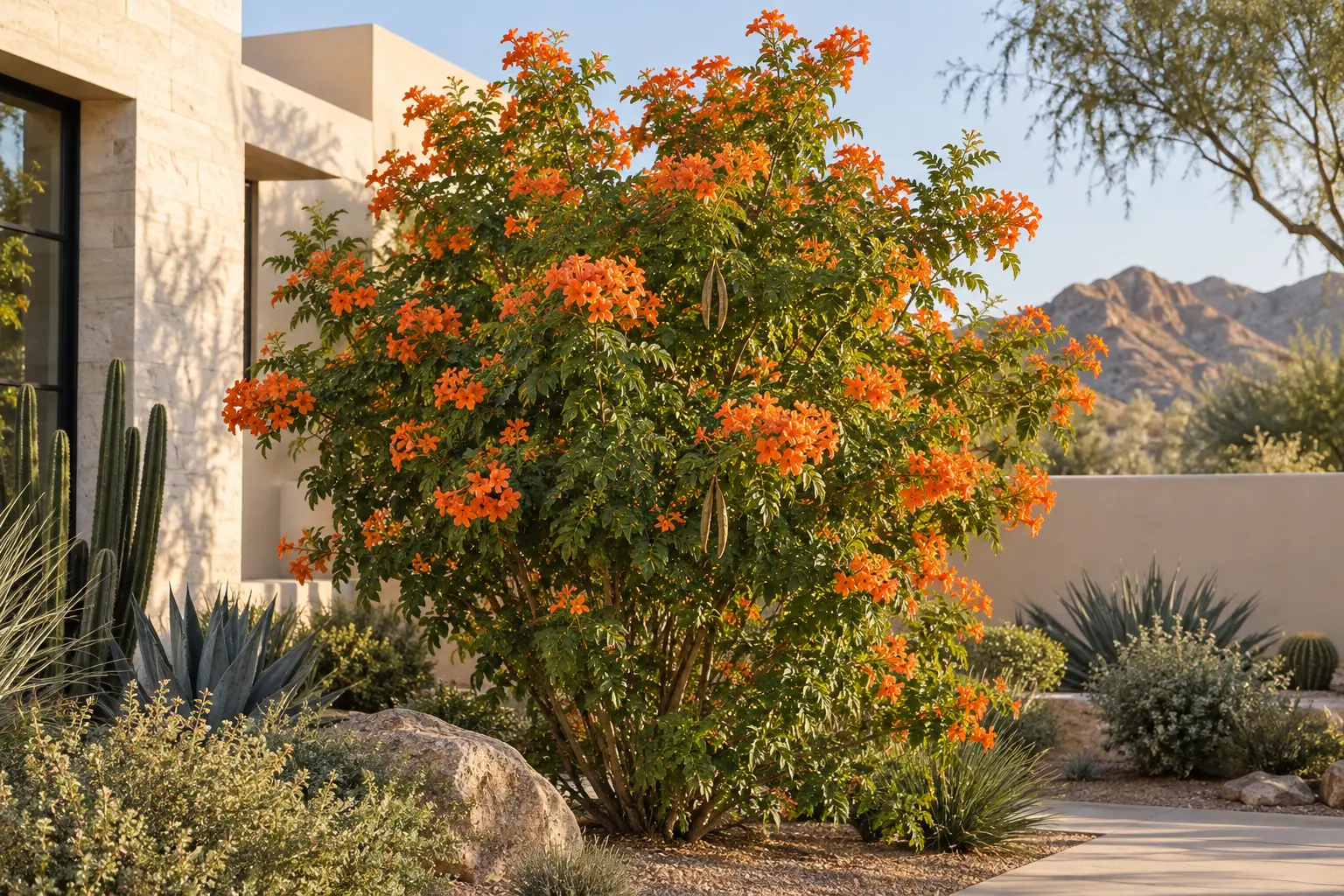
The Valley's hardest-working summer color: fast, fine-leafed and covered in orange-and-yellow flowers from late spring straight through fall, with honest winter dieback to plan around.
Forest & Kim Starr / Wikimedia Commons / CC BY 3.0 — license
Not sure if this plant belongs near your pool, wall, pavers, or foundation?
AE reviews microclimate, root intrusion risk, and soil compatibility.
Schedule: Weekly to twice-weekly in summer, less in cooler months.
Emitters: 1–2 emitters per shrub adjusted seasonally.
Most desert-adapted shrubs prefer drying out between waterings.
Arizona yards have very different microclimates. West-facing walls, glass, artificial turf, pavers, travertine, porcelain, and pool decking all increase reflected heat. AE considers these before confirming placement.
- Low root impact
AE verifies pool deck, paver, foundation, wall, and utility clearances before final planting.
Quick Facts
- Plant type
- Shrub
- Mature size
- 6 ft tall, 6 ft wide
- Growth rate
- Fast
- Sun
- Full sun
- Water use
- Moderate
- Bloom season
- Late spring through fall
- Flower color
- Orange and yellow
- Foliage
- Dark green
- Evergreen / Deciduous
- Deciduous
- Thorns / spines
- Mild
- Litter level
- Low
- Pool area
- Good with placement
- Maintenance
- Seasonal pruning
- Privacy value
- Medium
- Shade value
- Low
- Native
- Desert-adapted
About Red Bird of Paradise
Red Bird of Paradise is what a Phoenix landscape reaches for when everything else has gone quiet in the heat. AMWUA lists it as native to the West Indies and Mexico, fast growing to roughly 6 feet tall and 6 feet wide, with dark-green fine foliage and orange-and-yellow flowers from late spring through fall. Butterflies and hummingbirds work it constantly. Water use is moderate — more than a true desert native, less than anything tropical — and it is deciduous, dropping its leaves in winter. Cold is the honest part of the story: AMWUA rates it to about 30°F, which means most Valley winters will burn it back to some degree and a hard freeze can take it to the ground. That is normal for this plant here, not a failure. The right response is to wait until freeze risk has passed in late winter or early spring and then prune out what the cold actually killed, cutting back to live wood; how far you cut depends on the winter you had and the size you want, not on a fixed rule. The stems carry small prickles, litter is low, and rabbits generally leave it alone. Give it sun, moderate water and room for a 6-foot spread and it will carry your color budget for half the year.
Best uses: Long-season orange-and-yellow color in a 6-by-6-foot shrub slot — back of beds, block-wall softening, pollinator planting and hot-color accents near patios
AE Designer Opinion
Design Uses
- Hot-color accent along block walls and rear property lines
- Back-of-bed color behind lower evergreen shrubs and perennials
- Pollinator and hummingbird planting near patios and windows
- Summer-season color in resort-style backyards
- Informal screening within a moderate-water zone
- Softening utility walls, equipment screens and blank stucco
Care & Maintenance
- Plant in full sun and run it on a moderate-water zone, deep-soaked rather than sprinkled
- Wait until freeze risk has passed in late winter or early spring, then prune frost-killed wood back to live growth
- Shape after the spring flush rather than shearing during bloom
- Reduce irrigation frequency in winter while the plant is dormant
- Keep mulch off the crown and check drainage in heavy clay soils
- Remove spent pods if seedlings in the bed are unwanted
Common Homeowner Mistakes
- Cutting frost-damaged wood back in the middle of winter, before freeze risk has passed
- Applying a fixed hard cutback every year regardless of how much wood actually died
- Planting it on a very-low-water native valve and wondering why bloom is thin
- Placing it in part shade and expecting the full late-spring-through-fall flower show
- Crowding it into a 3-foot bed that it outgrows in a single season
- Setting it right at the pool edge where the prickly stems meet bare feet and swimsuits
Placement Warnings
⚠ Frost sensitive to about 30°F — expect winter dieback in the Valley and prune damaged wood back to live growth only after freeze risk has passed. Stems carry small prickles. Water use is moderate, not very low.
- Frost damage is normal here; do not place it where a bare winter shrub ruins the view
- Prickly stems — keep it back from walkways, gate swings, pool coping and play areas
- Plan for a 6-foot mature spread; it fills its space fast
- Moderate water means it needs its own valve or a shared moderate-water zone, not a very-low-water desert zone
- Deciduous — pair it with evergreen structure if the bed needs year-round presence
- Full sun is required; shaded placements bloom poorly and grow leggy
AE reviews final placement based on sun, irrigation, drainage, mature size, and overall design.
Pairs Well With
- Red Yucca
- Damianita
- Lantana
- Texas Sage
More Arizona Plants Like This



Ready to Build Your AE Plant Wishlist?
Add Red Bird of Paradise and your other favorites to your wishlist, then send it to the AE design team for the final plant palette.