
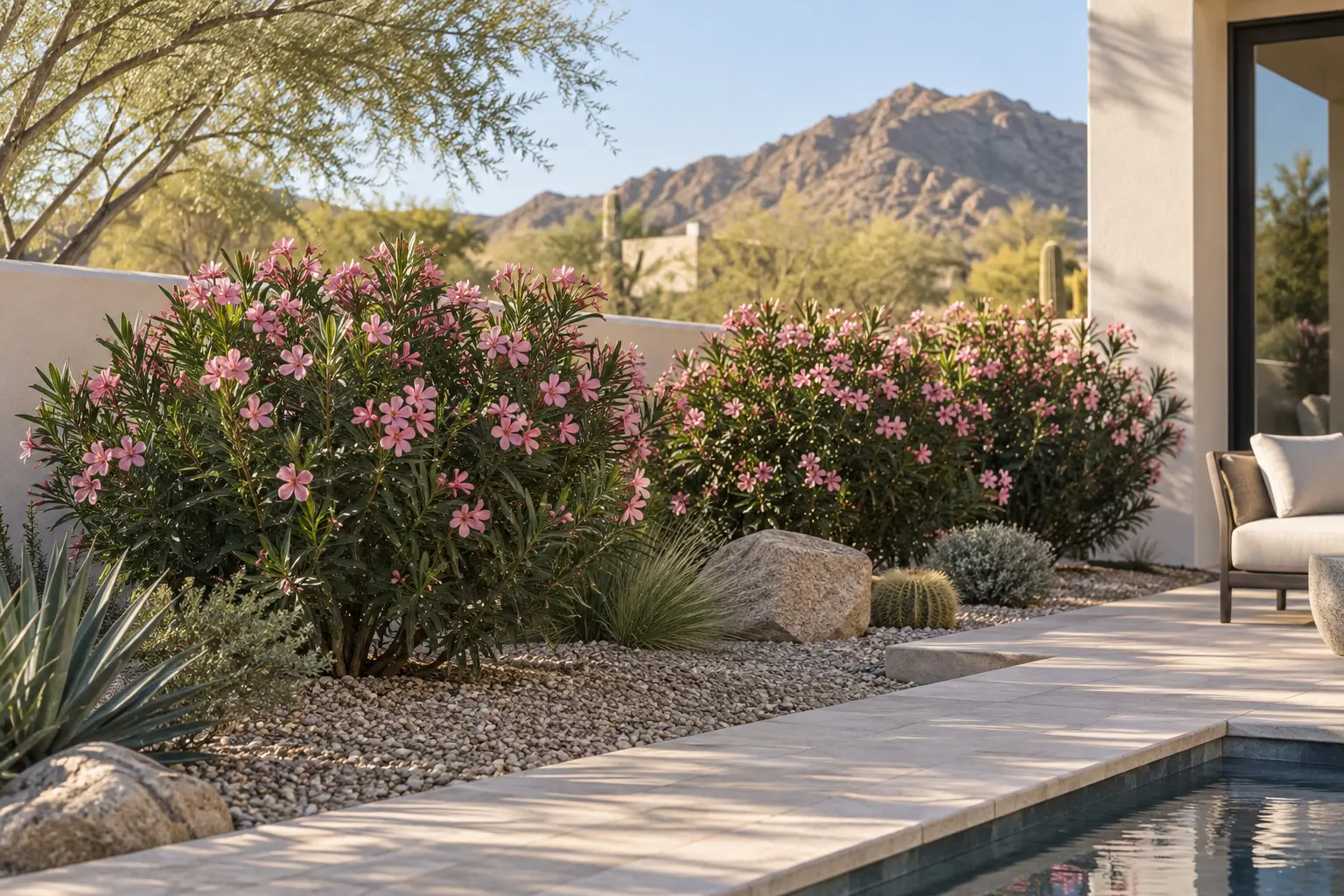
Dwarf Oleander
Nerium oleander (dwarf cultivars)
Dwarf oleander offers evergreen flowering mass in heat, but a smaller cultivar does not reduce its toxicity. AE generally avoids oleander on most residential projects; identifying the cultivar and evaluating exposure comes before color selection.
Not sure if this plant belongs near your pool, wall, pavers, or foundation?
AE reviews microclimate, root intrusion risk, and soil compatibility.
Schedule: Weekly to twice-weekly in summer, less in cooler months.
Emitters: 1–2 emitters per shrub adjusted seasonally.
Most desert-adapted shrubs prefer drying out between waterings.
Arizona yards have very different microclimates. West-facing walls, glass, artificial turf, pavers, travertine, porcelain, and pool decking all increase reflected heat. AE considers these before confirming placement.
- Low root impact
AE verifies pool deck, paver, foundation, wall, and utility clearances before final planting.
Quick Facts
- Plant type
- Shrub
- Mature size
- Around 5 ft; cultivar dependent tall; Around 4 ft; cultivar dependent wide
- Growth rate
- Moderate to fast with water and warmth
- Sun
- Full sun
- Water use
- Low
- Bloom season
- Broadly spring through fall, depending on cultivar and conditions
- Flower color
- Pink, red or white by named cultivar
- Foliage
- Green
- Evergreen / Deciduous
- Evergreen
- Thorns / spines
- None
- Litter level
- Medium
- Pool area
- Avoid nearby
- Pet/kid placement
- Toxicity caution
- Maintenance
- Moderate
- Privacy value
- Medium
- Shade value
- Low
- Native
- Mediterranean-adapted
About Dwarf Oleander
Dwarf oleander is a cultivar class of Nerium oleander, not a single botanical taxon. This Mediterranean-origin evergreen flowering shrub is nonnative to Arizona. A practical dwarf planning size is around 5 ft tall by 4 ft wide, but exact dimensions and pink, red or white flower color require a named cultivar/tag and reliable clonal provenance. Standard oleander can exceed 20 ft. Full sun and reflected heat suit established plants with low water use and good drainage. Flowers can run broadly spring through fall in the low desert, depending on cultivar and conditions. Moderate flower and leaf litter needs a disposal plan. Near 20°F, frost damage is possible; hardiness is not a guarantee for every exposure.
Best uses: Cultivar evaluation for a deliberately separated planting zone; Evergreen flower mass only where exposure is controlled; Reflected-heat beds evaluated independently of residential play spaces
AE Designer Opinion
Design Uses
- Cultivar evaluation for a deliberately separated planting zone
- Evergreen flower mass only where exposure is controlled
- Reflected-heat beds evaluated independently of residential play spaces
- Screening plans based on a documented dwarf selection
- Comparative selection studies where a less consequential alternative may be preferable
Care & Maintenance
- Water deeply during establishment, then irrigate infrequently with dry-down.
- Avoid high-frequency irrigation and soggy soil.
- Remove confirmed winter damage after the cold period, once new growth declares itself.
- Otherwise prune lightly after flowering; avoid repeated geometric shearing.
- Wear gloves, bag fresh and dried debris, and follow local disposal guidance; never burn it.
Common Homeowner Mistakes
- Assuming dwarf is a single taxon or a toxicity reduction
- Buying without a cultivar tag and reliable clonal provenance
- Using standard oleander dimensions for a dwarf cultivar or vice versa
- Burning trimmings or leaving dried debris accessible
- Shearing geometric forms repeatedly or irrigating soggy soil
Placement Warnings
⚠ All fresh and dried parts are highly toxic. ASPCA lists oleander as toxic to dogs, cats and horses because of cardiac glycosides; sap can irritate skin. Never burn trimmings or inhale their smoke. Use gloves, bag debris and follow local disposal guidance. Children, pets, livestock, play areas, food gardens, pools and any place debris could be mouthed or enter water make this a high-consequence selection; dwarf stature does not soften the warning.
- AE generally avoids oleander on most residential projects.
- Keep high-consequence exposure to children, pets and livestock central to selection.
- Avoid play areas and food gardens.
- Do not allow toxic debris to enter pools or other water.
- Allow the named cultivar’s spread and access for controlled debris removal.
AE reviews final placement based on sun, irrigation, drainage, mature size, and overall design.
Pairs Well With
- Desert Museum Palo Verde
- Red Yucca
More Arizona Plants Like This



Ready to Build Your AE Plant Wishlist?
Add Dwarf Oleander and your other favorites to your wishlist, then send it to the AE design team for the final plant palette.