
Watch
Heat-cool pumps — in David's words

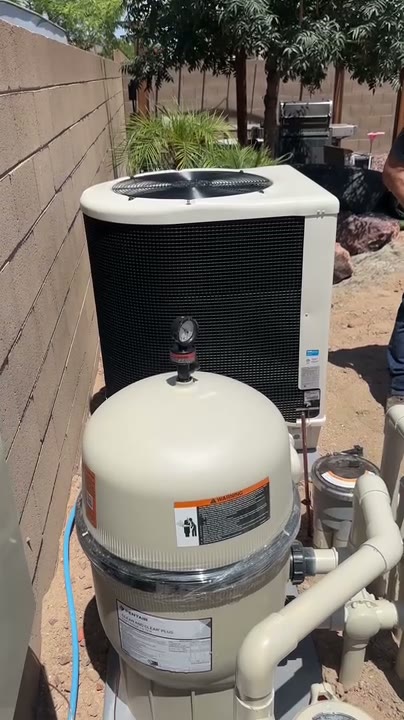
Pool heat pumps and chillers in Arizona — how year-round temperature control turns a six-month pool into a twelve-month one.
An untreated Phoenix pool is usable about four months a year — too cold from November through March, then bathwater warm and chlorine-harsh from June through September. Gas heaters solve the cold half; chillers and reversible heat pumps solve the hot half. Putting both in play is what gets a Valley pool to 80–86°F year-round and changes what the backyard is actually for. This guide is the honest spec — what each unit does, what it costs, what it pulls from your panel, and which configuration fits which household.
- AZ ROC 211530 · 347738 · 341002 · 340966
- Arizona-built since 2005
- President, Southwest Hardscapes Association
Why traditional gas heaters aren't enough in the Valley
A gas heater is a fast, brute-force way to add 20–30°F in an afternoon — useful in February, useless in July. Phoenix water doesn't have a heating problem from June through September; it has a cooling problem. Unshaded plaster pools hit 92–96°F by mid-July and stay there for ninety days. Warmer water raises chlorine demand, accelerates chloramine off-gassing (the eye-burn and harsh smell), and makes the pool unusable for the exact purpose most owners bought it for: cooling off in summer. Gas-only setups are a winter solution to a year-round problem.
Heat pumps vs chillers vs reversible units — the actual difference
- Heat pump — moves heat from outdoor air into the water. Heats only. 4–6x more efficient than gas above 50°F ambient.
- Chiller — moves heat from the water into outdoor air. Cools only. Most efficient overnight when ambient is coolest.
- Reversible heat pump (heat-pump chiller) — both functions in one cabinet on a four-way reversing valve. The cleanest year-round solution for new builds.
- Gas heater — fast surge heating, expensive to run, the right call for occasional fast-recovery scenarios like winter parties.
- Solar — can supplement heating cost-effectively, contributes nothing to summer cooling, takes significant roof real estate.
Want a number for your own property?
Tell us the space and we'll come back with a real range for your site — no pressure, no "call for pricing."
Configurations that actually work for an Arizona pool
- Reversible heat pump only — cleanest install, full heat + cool, slower winter recovery than gas
- Gas heater + dedicated chiller — fastest winter recovery, lowest summer cooling cost, two pieces of equipment on the pad
- Heat pump + small gas heater — best operating-cost balance for households that occasionally want fast surge heating
- Heat pump only (no chiller) — cuts heating cost vs gas but leaves summer water temperature problem unsolved
- Gas only — adequate for occasional cool-season use, not a year-round answer in Phoenix
Sizing — gallons, BTUs, and Arizona's ambient extremes
Heat pumps and chillers are sized in BTU/hr against pool volume and target temperature delta. A 14,000-gallon Valley pool typically wants a 125,000–140,000 BTU heat pump and an 80,000–110,000 BTU chiller to hold 82–86°F through August. Undersized equipment runs continuously, costs more in electricity, fails earlier, and never reaches setpoint on the worst days. We size against actual gallons, pool surface area (the cooling load on an exposed 600 sq ft surface is real), prevailing wind, and how much shade the deck and water carry. No guessing.
Electrical and pad reality in Phoenix
- Most units need a dedicated 240V 50A or 60A circuit at the equipment pad
- Older homes with 100A or 125A main panels often need a load calc, panel upgrade, or 200A service upgrade — flagged at design
- Pad placement needs 24 in of clearance on intake and discharge for airflow
- Never enclose in a tight equipment closet without engineered ventilation — 115°F pad temps kill compressors
- Discharge oriented away from outdoor living areas and neighbor bedroom walls
Brands we install and why
- Pentair UltraTemp / UltraTemp ETi reversible heat pumps — best IntelliCenter automation integration, what most AE pools run
- AquaCal Heat & Cool — strong non-Pentair option, integrates with Jandy iAquaLink and Hayward OmniLogic
- Glacier Pool Coolers — chiller-only retrofits when the customer already has a working gas heater
- Hayward HeatPro — heat-only units for budget-sensitive new builds with future chiller capacity
- We do not install bargain-tier units — they don't survive Arizona pad temps and warranty service is nonexistent
Investment ranges — real Arizona numbers, fully installed
- Heat-pump only (heating): $5,500–$8,500 installed
- Dedicated chiller (cooling only): $6,500–$9,500 installed
- Reversible heat pump (heat + cool, one unit): $8,500–$13,500 installed
- Gas heater + standalone chiller pair: $9,000–$14,000 installed
- Panel upgrade if required: $2,500–$6,500 additional
- All ranges include equipment, plumbing tie-ins, dedicated 240V circuit, pad work, and automation integration
Operating cost — what the monthly utility bill actually looks like
Holding a 14,000-gallon Valley pool at 85°F costs roughly $80–$160/month on a heat pump vs $300–$600/month on a gas heater (APS / SRP rates, off-peak overnight runtime). Running a chiller to hold 82–86°F through July and August costs roughly $90–$170/month, again overnight when ambient is coolest and the unit is most efficient. The cooling spend is what most owners are surprised by — it is roughly the same as the heating spend, not double, because the chiller works with cooler nighttime air instead of against 115°F afternoon air.
How year-round temperature control changes how the pool gets used
Untreated Phoenix pools are usable about four months a year. Heating-only stretches that to seven or eight months but loses the worst of summer. Heating plus cooling is the difference between a six-figure feature that sits unused half the year and an outdoor living centerpiece that gets daily use in February and July alike. From a backyard-design standpoint this is the same thinking that drives proper shade structure placement, deck surface temperature, and pool fencing for safety in family environments — comfort and safety designed in from the start, not bolted on after the fact. A year-round pool is what an Arizona pool should be.
Retrofit vs new build
- New build — design the pad, plumbing, and electrical for reversible heat pump or heat-pump + chiller from day one
- Retrofit with gas heater present — add a dedicated chiller, keep the gas heater for fast winter recovery
- Retrofit with no heater — reversible heat pump is usually the cleanest single-unit answer
- Retrofit with maxed-out electrical — sequence the panel upgrade first, equipment second
- Always tie into existing automation (IntelliCenter, iAquaLink, OmniLogic) — never run as an island system
What AE won't do
- Install without a load calc on the main panel
- Bury equipment in an enclosed closet without engineered ventilation
- Quote bargain-tier units with no in-state warranty support
- Pitch a chiller as a substitute for proper pool shade design or correct surface color
- Sell a year-round pool experience on a one-sided (heat-only or cool-only) system
Common questions.
Planning a year-round Arizona pool?
Send a few photos of the equipment pad and the pool, plus your monthly target temperature. You'll get a sized heat-pump and chiller spec, an honest installed investment range, and the panel reality for your home — no 'call for pricing.'
Get a Year-Round Pool PlanWhy this is an investment, not a cost.
An AE backyard is engineered to add daily livability and long-term home value. We publish honest ranges and build to code with a licensed and bonded Arizona crew. AE provides project-specific workmanship and manufacturer-warranty information in the signed agreement. Website summaries are for planning only.
- Licensed, bonded & insured in Arizona. ROC 340966 (R-62) · ROC 341002 (R-3) · ROC 347738 (KA-5) · ROC 211530 (CR-21). Most Arizona contracting work valued at $1,000 or more — or requiring a permit — must be performed by a properly licensed contractor, subject to statutory exemptions. Verify the legal entity, license status, and classification with the Arizona Registrar of Contractors.
- Real ranges, itemized scope. You see materials, finishes, equipment models, and a line-item budget before you sign — not a one-line "pool — $90,000."
Plan your investment with a designer.
Five minutes, a real range, and no sales pressure. Or vet any Arizona contractor (us included) before you spend a dollar.