
Real fire. Real food. Arizona-tested tips, temps, and recipes from a builder who actually cooks.
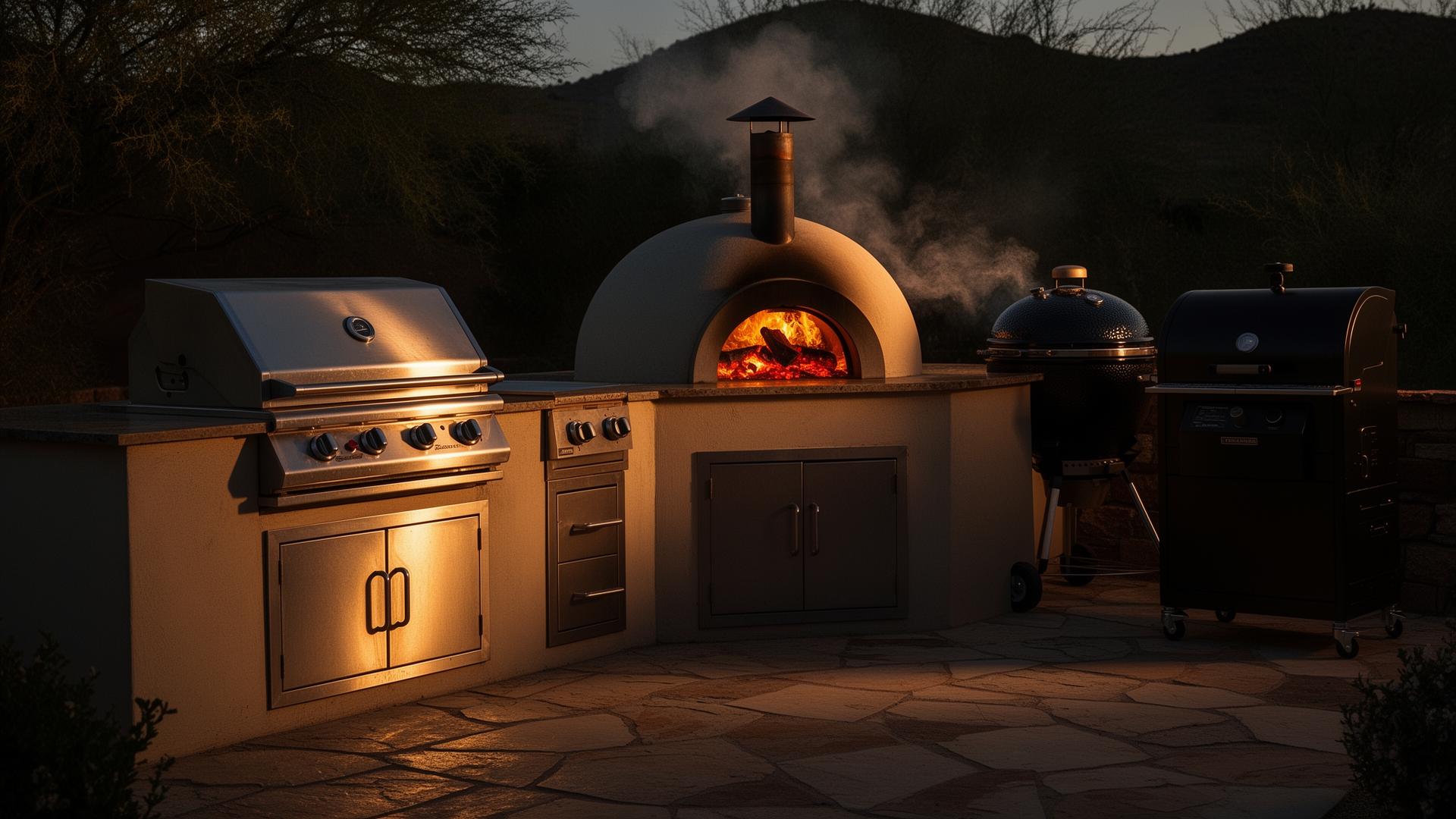
Gas, charcoal, pellet, offset, and wood-fired pizza — every method, every temp, every wood, every common mistake. Written by David Bell, President of the Southwest Hardscapes Association, owner of a Lynx, a Yoder, a Weber kettle, and a Forno Bravo Toscana, and the guy your friends call when their brisket stalls at 165°F.
- AZ ROC 211530 · 347738 · 341002 · 340966
- Arizona-built since 2005
- President, Southwest Hardscapes Association
Why we built this section
I've been cooking outside in Arizona for two decades and building outdoor kitchens for fifteen. The amount of bad grilling advice on the internet — pellet grill bros selling you the wrong wood, gas snobs telling you charcoal is dirty, charcoal snobs telling you gas is for cowards — got old years ago. This is the section I wish existed when I started: real fire, real temps, real wood, real recipes, real safety. Written by me (David Bell), not a freelance copywriter who's never lit a chimney. If you cook outside and you live in Arizona, you're in the right place.
Gas grill mastery (weeknight hero)
- Preheat 10–15 minutes on full high, lid closed. The grates need to be 500°F+ before food touches them or you get gray steaks and stuck burgers.
- Two-zone fire always: one side full high, one side off or low. Sear on the hot side, finish on the cool side. This is the single biggest weeknight upgrade you'll ever make.
- Reverse-sear thick steaks: cool side at 225–275°F until internal hits 115°F, then 60–90 sec per side ripping hot. Better crust, edge-to-edge pink.
- Infrared sear burner: use it for the last 60 seconds only. Step away for 90 and dinner is shoe leather.
- Never close the lid on a flare-up. Move the food to the cool side, let the fat burn off, brush the grates, return the food. Closing the lid traps grease vapor and you'll get carbon flavor on everything.
- Replace the regulator and hose every 5 years — they're $25 and they fail before the grill does. UV cracks the rubber.
- Clean the burner ports monthly with a stiff wire brush — clogged ports cause uneven flame and the 'one side cooks hotter' complaint.
Want a number for your own property?
Tell us the space and we'll come back with a real range for your site — no pressure, no "call for pricing."
Charcoal & kamado (live fire flavor)
- Lump charcoal over briquettes for high heat. Briquettes for long, steady, low-and-slow cooks (snake or minion method in a kettle).
- Chimney starter — never lighter fluid. 20 min from match to coals-ready. Lighter fluid leaves a chemical signature on the first 3 cooks no matter how long you 'burn it off.'
- Two-zone in a kettle: bank coals to one half. Reverse-sear works identically to a gas grill but the flavor jump is real.
- Snake method for ribs in a 22" kettle: 2 briquettes wide, 2 stacked, in a C-shape around the perimeter, with wood chunks every 6". Light one end with 8 lit coals. Holds 250°F for 6 hours hands-off.
- Kamado (Big Green Egg, Kamado Joe, Primo): close the dome and choke the bottom vent slowly — these things are oxygen-starved engines and overshooting 350°F means you're cooking at 500°F+ in 4 minutes.
- Never close all vents to 'save coals' — you starve the fire of oxygen and create creosote that coats the next cook. Let it burn out cleanly.
- Ash cleanup matters: a clogged bottom vent on a kettle or kamado kills airflow and you'll fight the fire all night.
Pellet smokers (Sunday hero)
- Hardwood pellets only — Lumber Jack, Knotty Wood, Bear Mountain. Skip 'competition blends' that are mostly alder filler. The bag should list one or two woods, not five.
- First 4 hours at the lowest temp the unit will hold (super-smoke, 165–180°F) — this is when the smoke ring forms. Then bump to 225°F.
- Add a 12" smoke tube on the grates for the first 3 hours when you want a real smoke punch — about $20 from Amazon, doubles the smoke output.
- Don't open the lid. Every peek = 15 minutes of recovery time. Use the meat probe ports.
- Bark develops uncovered. Wrap (pink butcher paper, never foil) only after the bark is set and dark mahogany — push it with a finger; if it smears, wait.
- Pellet storage in Arizona: airtight bin, indoor or shaded garage. Monsoon humidity turns pellets to mush in 14 days and your auger will jam.
- Burn pot cleanup every 3–4 cooks. Ash buildup is the #1 cause of 'won't ignite' and runaway hot fires.
- Best Sunday cook for beginners: 3-2-1 St. Louis ribs. Best second cook: pork shoulder for tacos (pull off at 203°F, rest 1 hour, shred). Brisket comes after you've nailed both.
Offset stick burners (the hobby tier)
- Real offsets are 1/4" thick steel minimum: Workhorse 1975, Mill Scale 94, Yoder Loaded Wichita, Lone Star Grillz 20". The $300 'offset' at Home Depot is a leaky toy that will cost you a brisket.
- Pre-heat with a real fire — newspaper + kindling + 2 splits. Bring the cook chamber to 300°F before you ever put meat on.
- Manage with the firebox door and the stack damper. The intake on the firebox is your throttle. Stack stays wide open 95% of cooks — you want clean draft.
- Splits the size of a beer can. Add one every 30–45 minutes once you're up to temp. Pre-warm splits on top of the firebox so they ignite cleanly instead of smoldering.
- Clean blue smoke or thin gray. White or yellow smoke = bad fire = bitter food. Open the firebox door and the intake until the smoke clears.
- You will lose sleep. Set a 90-minute timer all night. Coffee thermos required.
- Wood storage outdoors in Arizona: split wood seasons in 4–6 months in our dry climate (vs 12 in the Midwest), but cover the top of the stack — direct UV cracks the splits and they burn too fast.
Wood-fired pizza oven (Friday night ritual)
- Cure slow: six small fires over six days. Skip it, get cracks. No refractory dome forgives a fast first burn.
- Floor temp matters more than air temp. $35 IR thermometer. Neapolitan: 850–900°F floor. NY-style: 600–650°F. Roasting (whole chicken, vegetables, focaccia): 450–550°F after the fire has died down.
- Fire on one side, pizza on the other. Rotate the pie every 20 seconds with a turning peel — the dome side cooks faster than the floor side.
- Dough — my house recipe: 1000g flour (Caputo 00 for Neapolitan, King Arthur bread flour for NY), 650g cold water, 25g salt, 2g instant yeast. Mix, fold every 30 min × 4, ball, 24–48 hr cold proof. The fridge is the secret.
- Stretch by hand, never a rolling pin (kills the bubbles). Light sauce, light cheese, light toppings — heavy toppings = soggy bottom in a hot oven.
- Sauce: 1 can San Marzano DOP, crush by hand, pinch of salt. That's it. Cooked sauce burns at 900°F.
- Cover when not in use. Arizona UV destroys door gaskets and chimney caps in 2 seasons uncovered.
- Wood: kiln-dried oak or almond, sub-20% moisture. Avoid local mesquite for pizza — burns too hot and too acrid for short cooks.
David's signature recipes (the ones I'm asked for)
- Reverse-sear ribeye (1.5" choice or prime, dry-brine 24 hr with kosher salt uncovered in the fridge, smoke at 225°F to 115°F internal, sear 60 sec/side at 700°F+, rest 5 min, cracked pepper at the end — not before).
- Spatchcock chicken with mesquite (whole 4–5 lb bird, spine out, flatten, dry-brine 12 hr, mesquite chunk in the kettle, 375°F indirect skin-up, pull at 160°F breast / 175°F thigh, rest 10 min).
- Sunday St. Louis ribs (trim, light yellow mustard binder, 50/50 kosher salt + 16 mesh black pepper rub, 225°F unwrapped 3 hr, wrap pink butcher paper + 1 tbsp butter + splash apple juice 2 hr, unwrap and glaze 30–45 min with thinned sauce until tacky).
- 12-hour pork shoulder for tacos (8–10 lb bone-in butt, rubbed heavy with brown sugar + salt + pepper + chili powder + cumin + garlic, 225°F overnight to 203°F probe-tender, rest 1 hr, shred, crisp in a cast-iron with rendered fat, lime + cilantro + raw white onion + corn tortillas).
- Smash burgers (80/20 chuck, 3 oz balls, ripping-hot griddle or cast-iron grate, smash with a stiff spatula and parchment, 90 sec one side, flip, American cheese, soft potato bun, mustard not ketchup — fight me).
- Friday pizza Margherita (cold-proofed dough above, San Marzano crushed by hand, fresh mozzarella di bufala torn not sliced, 4 basil leaves, finishing olive oil after the bake, flaky salt).
- Brisket (12–14 lb whole packer, trim fat cap to 1/4", salt-pepper-garlic rub, 225°F to 170°F internal, wrap pink butcher paper, continue to 203°F + probe-tender, rest in cambro or 150°F oven minimum 2 hours — 4 is better. Slice point against the grain, slice flat with the grain.) Don't try this one third.
Outdoor kitchen build tips (from the install side)
- Insulated jacket on every built-in grill, no exceptions. Every spec sheet requires it for combustible enclosures. Half of Valley installs skip it. It's a fire hazard and it voids the warranty.
- Run the gas line one size larger than you think you need. A 42" grill + side burner + pizza oven + fire pit on one 3/4" line is undersized — by the time the fire pit kicks on, the grill flame drops 30%.
- GFCI outlet within 6 feet of the grill island. Pellet smokers, rotisseries, lights, blender. You will use it.
- Vent hood ONLY if the kitchen is under a solid roof. Open pergola = no hood needed. Solid ramada with grill against the back wall = mandatory or smoke discoloration on the ceiling within 18 months.
- Counter depth: 30" minimum behind a built-in grill for prep. 36" if you're going to use it. The 24" 'space-saver' Pinterest builds are a usability nightmare.
- Pizza oven on its own pad — refractory ovens weigh 800–1200 lbs and the thermal expansion will crack tile or thin pavers if it's not isolated.
- Lighting: warm 2700K under the hood and under the bar. Cool blue 4000K above a grill makes raw meat look gray and you'll overcook everything.
What I'd never recommend
- Charcoal in a covered ramada with no airflow — carbon monoxide is real and silent. Open patio only.
- Pellet smokers under a low pergola — sparks from the burn pot during ignition are rare but real. 8 ft vertical clearance minimum.
- DIY gas line tied into the main. Licensed plumber + permit + leak test. Always.
- Lighter fluid in a kamado — ruins the ceramic seasoning for the life of the unit.
- Wood you found on a hike. Pesticides, sap, unknown species. Buy your wood from a wood supplier.
- $300 'offset smokers' from a big-box store. Thin steel, leaky doors, you'll fight the fire all day and get bitter food. Save up.
Common questions.
Want this in your backyard?
Outdoor kitchens, gas line runs, pizza-oven pads, ramadas, lighting — we build the whole envelope. Send us a photo of your space and we'll give you an honest plan.
Plan My Outdoor KitchenWhy this is an investment, not a cost.
An AE backyard is engineered to add daily livability and long-term home value. We publish honest ranges and build to code with a licensed and bonded Arizona crew. AE provides project-specific workmanship and manufacturer-warranty information in the signed agreement. Website summaries are for planning only.
- Licensed, bonded & insured in Arizona. ROC 340966 (R-62) · ROC 341002 (R-3) · ROC 347738 (KA-5) · ROC 211530 (CR-21). Most Arizona contracting work valued at $1,000 or more — or requiring a permit — must be performed by a properly licensed contractor, subject to statutory exemptions. Verify the legal entity, license status, and classification with the Arizona Registrar of Contractors.
- Real ranges, itemized scope. You see materials, finishes, equipment models, and a line-item budget before you sign — not a one-line "pool — $90,000."
Plan your investment with a designer.
Five minutes, a real range, and no sales pressure. Or vet any Arizona contractor (us included) before you spend a dollar.